Jesse Gerritsen
AT full time, the arithmetic felt wrong. A team from a country of just 5,5 million people, appearing at a World Cup for the first time in 28 years, had defeated five-time champions Brazil to reach the quarter-finals for the first time in their history.
During Norway’s victory over Brazil last Sunday, there was little to separate the dazzling footwork of Vinícius Júnior from the raw power of Erling Haaland. Yet while the contest on the pitch was evenly matched, the journeys that shaped the players could hardly have been more different.
Neymar, Matheus Cunha and Vinícius emerged from a system that prioritises prodigies, identifying talent at an early age and accelerating development through academies focused on a single sport. Haaland, Martin Ødegaard and Antonio Nusa came through an entirely different environment.
That difference dates back to 2007, when the Norges idrettsforbund (NIF), Norway’s governing body for sport, revised the eight “rights” it had originally adopted in 1987 to safeguard every child’s participation, safety and enjoyment in sport. The regulations are mandatory for every coach and club affiliated to the NIF, and they read almost like sporting heresy in a world obsessed with early specialisation and relentless talent identification.
Under the framework, children under the age of nine play only local club matches. There are no results tables, league standings or trophies. Regional competition begins at the age of 11, but scores and rankings remain largely secondary. Only at 13 can a Norwegian youngster participate in anything resembling a national championship.
Of the eight rights, two stand out in direct opposition to the culture of the sporting tiger parent: mastery and freedom to choose.
The principle is simple but profound. Children have the right to explore multiple sports instead of being funnelled into a single discipline before they are mature enough to make that choice for themselves. For talented youngsters, the reward is the opportunity to carry skills from several sports into the one they eventually embrace.
Haaland is the most famous product of that philosophy. He was six when the revised rules came into force and, according to his father, Alf-Inge, spent the next eight years combining football with handball, athletics and cross-country skiing. Norway’s handball establishment reportedly viewed him as a future star before he eventually committed to football at the age of 14.
Watch Haaland closely and traces of that upbringing appear everywhere. His towering leap for headers seems to carry echoes of years spent rising above defenders in handball. His finishing often possesses the coiled efficiency and controlled power of an athlete who learned to generate force without wasting movement — a hallmark of cross-country skiing. None of this diminishes the years of football-specific training that followed, but it is entirely possible that the sports he was never forced to abandon are still reflected in the way he plays today.
Alexander Sørloth, Haaland’s strike partner, followed a similar path. Growing up in Trondheim, he divided his time between football, handball and speed skating. Like Haaland, he comes from an athletic family — his father represented Norway at the 1994 World Cup, while his mother competed in handball. Two of Norway’s most imposing forwards arrived at professional football only after spending years developing a broader athletic foundation.
Norway goalkeeper Ørjan Håskjold Nyland belongs to an older generation, having been 17 when the rules were revised. Yet his story demonstrates that the philosophy did not invent Norway’s sporting instincts so much as formalise them. Nyland balanced football with handball and alpine skiing long before settling between the posts.
Against Brazil, that diverse athletic background may have revealed itself when it mattered most. First came a crucial penalty save from Lionel Messi, achieved with the explosive lateral movement of a skier. Then, with Norway narrowly ahead and Brazil pressing for an equaliser, Nyland somehow clawed away a goal-bound deflection from Kristoffer Ajer using the kind of acrobatic body control more commonly associated with elite handball players.
This is not simply a story about football. It is an argument for what can happen when a nation builds patience into childhood rather than urgency.
Norway has a history of success built on this philosophy. At the Winter Olympics, the country has repeatedly demonstrated how effective a broad-based approach to youth sport can be. With a population dwarfed by many of its rivals, Norway continues to outperform nations several times its size on the global stage.
Most countries follow a version of Brazil’s model: identify talent early and shape a child’s future around a presumed position or pathway. That system has undoubtedly produced some of the most gifted footballers the world has ever seen. Yet Norway’s
World Cup success offers a compelling reminder that there may be another route — one that protects a child’s right to explore, to experiment and ultimately to choose.
Legislating patience is unusual. Winning because of it is rarer still.
What makes Norway’s story particularly remarkable is that those eight rights were never designed to produce World Cup quarter-finalists. They were created to ensure that a child could make mistakes without embarrassment. To ensure that a gifted nine-year-old could still simply be a nine-year-old.
The football world will remember this Norwegian team for defeating Brazil. But joy, oddly enough, is what the policy was designed to protect.
“To enjoy football and make it the thing you like to do most in life,” the former Norway and Tottenham goalkeeper Erik
Thorstvedt has said. “The most important thing is, don’t put too much pressure on the kids.”
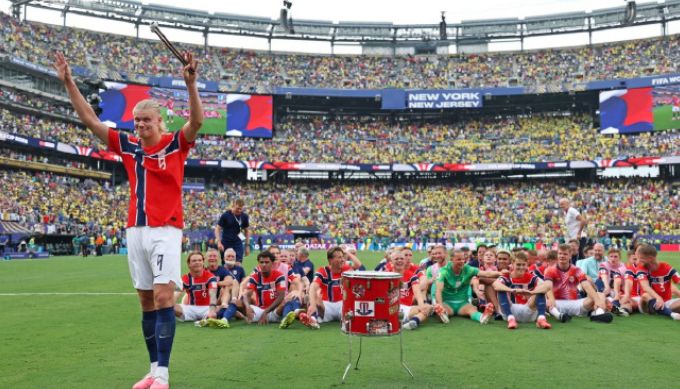
After the final whistle against Brazil, Norway’s supporters broke into their famous Viking clap, beginning with a slow, deliberate rhythm before building into something deafening.
It is easy to hear it as little more than a tribal display of celebration. Yet it sounds different once you understand the values that shaped this team. It becomes less a roar of conquest and more the collective voice of thousands of parents standing on touchlines through the years — the kind who allowed their children to choose their own sport, in their own time, and then showed up every weekend to support them regardless.
On Saturday, against England and their famous academy system, Norway will attempt to make history again by reaching the semi-finals.
There is one version of this story that is purely about football — about a team that defied the odds and stunned one of the giants of the game.
But there is a better, quieter version.
It is the story of a small nation that chose to let children be children; to play, to explore, to move between sports and, above all, to enjoy themselves. It was never intended to create a team capable of beating Brazil. The fact that it did is almost incidental.
What truly matters is that an entire nation stood on the touchline and watched its children fly. — Guardian Football