Online Reporter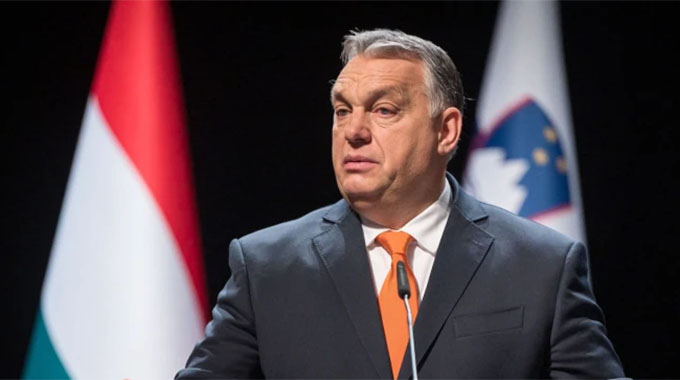
BUDAPEST. – Hungarian Prime Minister Viktor Orban has resisted pressure to support a multi-billion-euro emergency EU loan for Ukraine at a summit in Brussels.
It follows the seizure of Ukrainian cash transit vans by Budapest earlier this month and threats against Orban by Vladimir Zelensky and other Ukrainian figures. Tensions between the two neighbours are now at a fever pitch.
The Hungarian PM said that he vetoed the transfer of €90 billion (US$103 billion) to Ukraine at the meeting on Thursday over its reluctance to resume the flow of oil via the Druzhba pipeline, which has not been operational for over two months. Kiev claims that the conduits were damaged by Russian strikes, while Budapest insists that they are in working order and accuses Zelensky of endangering its energy security for political reasons.
Politico claimed that Zelensky, who joined the gathering in the Belgian capital via video-link, made “things worse rather than better” with his address.
German Chancellor Friedrich Merz and some other EU nations’ leaders were counting on the Ukrainian leader to reassure Orban that he would fix the Druzhba pipeline, but he went on the offensive instead, the report read.
“Zelensky played it harder than [our] expectations,” an unnamed official told the outlet. It also cited a diplomat as saying that Orban looked at the Ukrainian leader’s image on screen “with contempt.”
Orban defended his U-turn on an earlier promise to support the loan if Hungary, Slovakia, and the Czech Republic would not have to contribute to it, telling journalists on Friday that he was merely acting in line with his country’s national interests. “If there is no oil [for Hungary], then there is no money [for Ukraine],” he stated.
According to Orban, the EU leadership opted to postpone the decision on the loan until the bloc’s next summit because it hopes that the leadership in Hungary will change after the election on April 12. Brussels wants to “get a government that is pro-Ukraine, pro-Brussels and implements what they are asking for,” which is giving up on Russian oil, he said.
“Zelensky is also waiting for this,” the Hungarian prime minister stated. The Ukrainian leader deliberately shut down the pipeline in an attempt to cause “panic and chaos” in the country before the vote, he claimed.
Budapest has “a lot of cards in our hands” when it comes to persuading Kiev to unblock the oil flow, Orban warned. “Forty percent of Ukraine’s electricity supply goes through Hungary, we haven’t touched that yet,” he said, adding that Hungary could also block EU attempts to impose new sanctions on Russia. Slovakia, which is also affected by the shutdown of the Druzhba pipeline, halted electricity supply to Kiev late last month.
On March 5, Hungary’s Counter-Terrorism Centre intercepted two armoured vehicles near Budapest, sparking one of the most explosive diplomatic confrontations between the two countries in recent months. Officers dressed in black surrounded the vehicles at a fuel station and forced their occupants to the ground.
The trucks and their crews belonged to Ukraine’s state-owned Oschadbank and were carrying US$40 million and €35 million in cash, along with 9kg of gold from Austria’s Raiffeisen Bank International.
Hungarian authorities briefly detained seven Ukrainian nationals, who were later deported back to their homeland. The cash, gold, and the vehicles, however, remain impounded as evidence in the criminal investigation.
Neither Ukraine nor Hungary has officially disclosed the names of those involved in the transfer. However, Hungarian government spokesman Zoltan Kovacs said the operation was overseen by a former general from the Ukrainian Security Service , with a former Air Force major acting as his deputy.
Several others also reportedly had military backgrounds.
Ukrainian investigative journalist Vitaly Glagola, citing sources, identified the general as Gennady Kuznetsov, the former head of the SBU’s Center for Special Operations to Combat Terrorism, adding that he had links to the Alpha special forces unit.
Hungary’s Foreign Minister Peter Szijjarto demanded “immediate answers” from Kiev regarding large cash shipments passing through the country, adding that they “raise serious questions about a possible link to the Ukrainian war mafia.”
According to Szijjarto, in 2026 alone, more than US$900 million, €420 million, and 146kg of gold bars were transported across Hungarian territory into Ukraine. – rt.com