


 tawandamusarurwa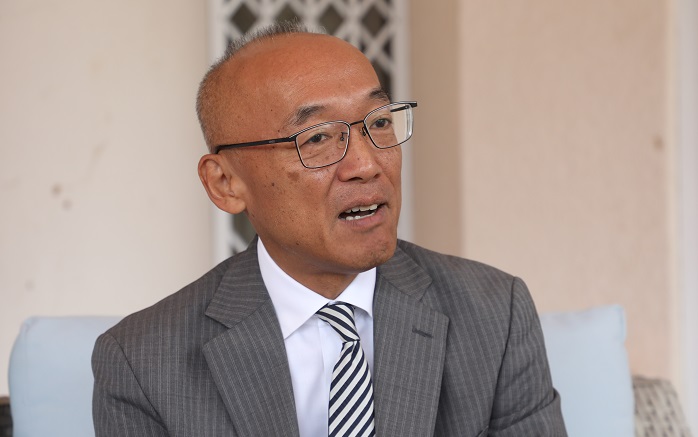
Dr Tatsushi Tsuboi, a rice expert from Japan International Cooperation Agency (JICA), was recently in the country at the invitation of First Lady Dr Auxillia Mnangagwa to advise on how Zimbabwe can boost rice production. The country spends about US$80 million annually on rice imports. However, the visit was seen as a sign of strong diplomatic relations between Harare and Tokyo. The Sunday Mail’s TANYARADZWA RUSIKE (TR) spoke to Japanese Ambassador to Zimbabwe Mr Satoshi Tanaka (ST) on relations between the two countries and how the East Asian economic giant is facilitating enhanced production of rice in the country.
*****************
TR: Can you begin by outlining the state of diplomatic relations between Zimbabwe and Japan?
ST: Zimbabwe and Japan have enjoyed warm and friendly relations for a long time, both at government-to-government and people-to-people levels.
Our two countries established official diplomatic relations after Zimbabwe’s independence in 1980, and we have been continuing to support the country’s sustainable development ever since, in areas such as food security, health, education, agriculture and infrastructure.
In terms of high-level exchanges between our two countries last year, the Minister of Higher and Tertiary Education, Innovation, Science and Technology Development, Professor Amon Murwira, visited Japan in May to receive Zimbabwe’s first satellite.
In September, former Vice President Kembo Mohadi visited Japan to attend the state funeral of our former Prime Minister, Mr Shinzo Abe.
In addition, in November, the First Lady Auxillia Mnangagwa visited Japan for the first Asia-Pacific and Africa Women’s Economic Summit.
Exchanges at the people-to-people level have been equally important for our two countries to get to know each other better and enhance our friendship.
Through our Japan International Cooperation Agency (JICA) training programmes, Zimbabwean Government staff have been able to go to Japan and learn the latest expertise in their respective fields.
And through our scholarship programmes, a total of 55 Zimbabwean students are currently studying in Japan, including six who left Harare at the beginning of this month.
We have also sent young Japanese volunteers to Zimbabwe to teach at various institutions.
Currently, 11 youths are teaching information and communication technology (ICT), physical education, baseball, football, judo and tourism in the country.
It was unfortunate that our cooperative relationship was stagnant for the past couple of years due to Covid-19, but the situation has been getting back to normal.
I am sure the bilateral relations between our two countries will be strengthened not just in the diplomatic area, but also in any other areas such as economic and cultural ones.
TR: Can you outline the value of trade between the two countries and how you plan to increase the levels of economic and trade cooperation?
ST: In terms of trade relations, before 2008, when hyperinflation occurred, Zimbabwe’s annual exports to Japan exceeded US$150 million.
However, this has now fallen to less than a fifth of that amount.
In 2021, exports to Japan amounted to about US$30 million, which was mainly leaf tobacco, non-ferrous slag, ferro-alloys and raw minerals.
Imports from Japan have also decreased to around US$20 million, and they are now mainly vehicles.
After independence, in the 1980s, there were more than 20 major Japanese companies operating in Zimbabwe, but after the economic upheaval in the last two decades, many firms moved out of the country and today, only a few remain, one of which is Toyota.
Last year, the embassy and ZimTrade held an awareness event for the upcoming World Expo 2025 to be held in Osaka, Kansai, Japan.
We are very glad that Zimbabwe will have a pavilion there, and it will be a great opportunity for the country to highlight its attractions and bring in foreign investment and tourists.
The number of officials from Japanese companies visiting Zimbabwe to see investment opportunities for themselves has increased lately. In addition, some of them have expressed interest in doing business in this country, especially in the areas of ICT and green technology.
It is very useful for Zimbabwe to improve its business environment and tackle certain fundamental obstacles so that Japanese companies can easily enter the Zimbabwean market. I believe Zimbabwe should be a very attractive country for Japanese businesses because of its huge potential in various sectors.
I also hope that, with a more friendly business environment created, many Japanese companies would again begin operating here, as they did in the past.
TR: How have Japanese investors responded to Zimbabwe’s opening up for business?
ST: Japanese companies are cautiously looking at opportunities in Zimbabwe, especially in the field of abundant natural resources and fertile agricultural land.
In order to promote trade and investment between the two countries, Japan expects Zimbabwe to make progress in improving the business environment.
On the other hand, Japan, through the embassy and JETRO (Japan External Trade Organisation), will strive to provide accurate information on the economic situation and investment environment in Zimbabwe.
At the Eighth Tokyo International Conference on African Development (TICAD 8) held last year in Tunisia, the Japanese Prime Minister, Fumio Kishida, announced a US$30 billion package for investment in Africa over a period of three years.
The Green Growth Initiative, for example, will promote investment to enable Africa’s progress towards sustainable green growth to address climate change.
Zimbabwe could come up with viable projects to secure investment through these initiatives.
TR: Can you outline Japan’s position on Zimbabwe’s engagement and re-engagement drive?
ST: I understand that this initiative of engagement and re-engagement is very important.
Zimbabwe depends greatly on other countries, and vice versa.
The current unstable global issues, such as climate change, the Ukraine conflict and the consequential slowdown in global economic growth make the international partnerships much more important.
So, I believe it is essential for Zimbabwe to strengthen relations not only with Southern African countries, but also with others in Africa, Asia and beyond.
By the same token, I believe the engagement and re-engagement policy can contribute to further development of our relationship.
TR: Can you outline Japan’s position on sanctions imposed on Zimbabwe by some Western countries?
ST: As you may know, Japan has not imposed sanctions on Zimbabwe, and we will not change this stance.
We understand that the Zimbabwean Government has been working on political and economic reforms, and I hope they will bear fruit for all Zimbabwean people.
Dialogue between the Government and the international community has been started, and I really hope that it helps strengthen mutual understanding and build trust, which would contribute to addressing the difficulties.
TR: Can you outline work being done to improve collaboration between Japan and Zimbabwe in the technology sector?
ST: In the technology sector, the collaboration on ZimSat-1 last year was probably the most memorable.
The satellite was developed by a few young Zimbabwean scientists studying at the Kyushu Institute of Technology in Japan, which really portends Zimbabwe’s bright future.
Japan is also supporting Zimbabwe’s technology sector through its training programmes. Eleven Zimbabweans are now studying in Japan for their master’s and doctorate degrees.
We hope these people-to-people exchanges between our two countries will continue to expand in the future, leading to further development of Zimbabwe’s technology sector.
It is important to note that, while technology is very important for development, we also need to look at the impacts it has on the environment. In other words, we need to ensure that development is sustainable.
We also need to make sure that adequate measures are taken to protect the environment.
Most developed countries went through painful environmental problems, and I believe countries that are undergoing their development paths should not tread in the same tracks.
TR: Dr Tatsushi Tsuboi, a rice expert under the Japan International Cooperation Agency, was recently in the country. Can you outline Japan’s plans to help Zimbabwe scale up rice production?
ST: Dr Tsuboi’s visit to Zimbabwe came about as a result of a request from the First Lady. She was in Japan to attend the Asia-Pacific African Women’s Economic Summit last November.
I also understand that she attended a lecture by Dr Tsuboi — who is a senior technical adviser on rice crops at JICA, and a leading expert on new rice for Africa, or NERICA. In the hope that growing NERICA rice would help rural women in Zimbabwe to improve their livelihoods, she decided to invite Dr Tsuboi to Zimbabwe.
He spent about three weeks here and, during his stay, held discussions with the First Lady, conducted three field surveys of experimental NERICA rice farms in each agricultural experiment station, held two seminars on NERICA rice promotion for relevant stakeholders and exchanged views on future activities with the Permanent Secretary of Lands, Agriculture, Fisheries, Water and Rural Development (Dr John Basera).
I accompanied him during several events, and I was surprised to hear that Zimbabweans are consuming more and more rice, and it is becoming an important part of their diet.
Actually, I have been in Zimbabwe for over two years now, and I thought that Zimbabweans nearly always ate sadza.
Now I realise that I was totally wrong.
However, I understand that while the demand for rice is increasing rapidly, Zimbabwe only grows very little, so the country is dependent on imports.
I feel if more rice is grown here, it will save foreign currency on importing rice.
It will also improve food security and the livelihoods of rural people, if they can grow it and sell it for a good price.
Dr Tsuboi’s visit was just to check the current situation, and I understand that he needs to carry out at least one more survey and intensive training of farmers before rice is grown on a larger scale.
I, however, do hope that Zimbabwe will start to grow rice.
TR: How do you assess Zimbabwe’s ability to ramp up rice production?
ST: I myself am not an expert on agriculture or rice, but, based on discussions with Dr Tsuboi, the rainy season, which is usually from November to March, may be suitable for the cultivation of NERICA rice.
Additionally, when combined with irrigation, the yield will be sufficient.
Japan has also been cooperating with Zimbabwe to develop its irrigation schemes, such as the Nyakomba Irrigation Scheme.
Dr Tsuboi also visited Zimbabwe in 2006 and 2007. At that time, he also provided guidance on the cultivation of rice at the Agricultural Experiment Station.
However, due to the economic turmoil such as hyperinflation that occurred immediately afterwards in 2008-2009, Japan was not able to continue its support on the dissemination of NERICA rice.
It is, however, commendable that even without any support, over the years, the Agricultural Experiment Station has maintained its enthusiasm to propagate NERICA rice and has continued its research.
So, I believe Zimbabwe does have the ability to increase rice production.
TR: What sort of support will Japan offer Zimbabwe to boost rice production?
ST: We have a lot of types of support, such as dispatching rice experts to Zimbabwe, sending ministry officials for training in Japan or other countries where NERICA rice is grown, supporting construction of irrigation schemes and providing support in terms of mechanisation.
The best form of support will be determined based on the results of further surveys conducted on rice production.
Agriculture is one of the priority areas in terms of our cooperation with Zimbabwe, because the country has a lot of potential in this area.
We would also like to see the country become the breadbasket of the region, like it used to be.
Also, at TICAD 8, held in Tunisia last year, African countries and Japan committed to making agriculture more resilient and sustainable, as well as ensuring food security, in spite of increasing prices of agricultural inputs.
Food and nutrition security is one of the key pillars of NDS 1 (National Development Strategy 1).
We funded development of the Nyakomba Irrigation Scheme, which was completed in 2020, and we have just committed to providing support of fertiliser of US$4,7 million for small-scale farmers, which will be distributed through the Government-subsidised Climate-Proofed Input Programme, or Pfumvudza/Intwasa.
Japan is also supporting the Zimbabwe Smallholder Horticulture Empowerment and Promotion, or ZIM-SHEP, project.
This is a six-year project being implemented by JICA, which started in 2019.
Small-scale horticulture farmers around the country are being trained on market-oriented agriculture and changing their mindsets from “grow and sell” to “grow to sell”.
According to the mid-term assessment, farmers have significantly increased their incomes, in spite of Covid-19 and the Ukraine crisis.
Additionally, they are now starting to invest their savings in maintenance of their facilities.
Also, more farmers are now growing crops according to the market demands, which is expected to contribute to enhanced resilience and sustainability.
I sincerely hope that with the current support, as well as future support from Japan, rice production in Zimbabwe will increase.
The incomes and livelihoods of vulnerable rural populations, especially women, will also improve.
TR: Can you outline in broad terms issues that are set to be discussed during the next Tokyo International Conference on African Development?
ST: The Tokyo International Conference on African Development, or TICAD, was launched in 1993 by the government of Japan.
It was the first international conference focusing on development in African countries. The basic objective of TICAD has been to promote African development.
At TICAD 8, the three pillars adopted were achieving sustainable economic growth and development, realising a resilient and sustainable society and ensuring peace and stability. Japan committed to invest US$30 billion over the next three years to ensure sustainable growth in Africa.
Increasing investment of Japanese companies in Africa and investment in start-up companies were also top of the agenda.
To achieve resilient and sustainable societies, African countries and Japan resolved to achieve universal health care, or UHC.
Japan committed US$1,08 billion to fight infectious diseases, through the Global Fund, and to ensure food security.
Japan will provide US$300 million to support this and strengthen the capacity of 200 000 people in the agriculture sector.
These were just some of the commitments made at TICAD 8 to ensure sustainable growth and greater human security on the continent.
We will follow up on these commitments as we aim to towards TICAD 9 to be held in Japan in 2025.
Twitter: tdrusike



 Bongani Ndlovu
 Online Reporter