admin
admin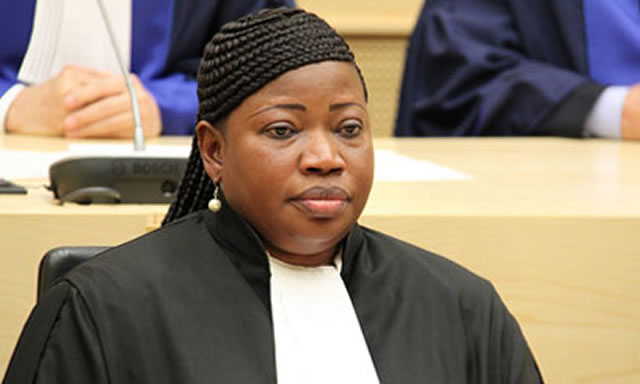

The Hague — The International Criminal Court said it had opened an initial probe into war crimes in the Central African Republic, where another lynching on Friday underscored spiralling sectarian violence.The latest victim fell off a lorry in a convoy of thousands of terrified Muslims fleeing Christian vigilantes in Bangui.
Residents hacked him to death and dumped his body on the road side, an AFP photographer saw, a killing observers say is only the tip of an iceberg.
On Wednesday, government soldiers stabbed, trampled and pelted a suspected ex-rebel in a gruesome lynching that took place moments after a military ceremony attended by the Central African Republic’s new interim president.
France’s 1,600 troops and the African Union’s contingent of more than 5,000 have so far been unable to stem the sectarian violence which has displaced around a quarter of the population.
The ICC chief prosecutor’s move to investigate the unrest that has plagued the nation of 4.6 million for more than a year brings yet another African case to the Hague-based tribunal.
“My office has reviewed many reports detailing acts of extreme brutality . . . and allegations of serious crimes being committed,” Fatou Bensouda said.
“I have therefore decided to open a preliminary investigation into this . . . situation,” she said.
The UN refugee agency said 9,000 people, mostly Muslims, have fled to neighbouring Cameroon over the past 10 days alone.
Violence broke out in the poor landlocked country in late 2012 when a coalition of mainly Muslim rebels launched an offensive against Francois Bozize, who had been in power for a decade.
The Seleka fighters toppled him in March but some went rogue, killing, raping and looting in a bloody campaign their former leader Michel Djotodia — by then the country’s first Muslim president — was unable to stop. The violence drew comparisons with the warlords of Somalia and sparked revenge attacks by villagers who formed vigilantes known as “anti-balaka”.
Former colonial power France deployed a force of 1,600 troops in December and thousands of African peacekeepers also began patrolling the capital but sectarian hatred boiled over.
The violence has in recent weeks “reached intolerable and unprecedented levels,” the Doctors Without Borders group said. “Civilians remain in constant fear for their lives, and have been largely left to fend for themselves,” the charity’s emergency co-ordinator Martine Flokstra said.
Wednesday’s lynching, moments after the new interim president Catherine Samba Panza spoke of her pride in seeing the armed forces contribute to national security again, sent shockwaves across the international community.
In front of dozens of journalists who had covered the ceremony, uniformed troops ganged up on a suspected ex-Seleka rebel and beat him up.
One soldier dropped a huge block of concrete on the lifeless body as it was being dragged through the streets. The mob then burned the corpse and some posed for pictures in front of it.
“Honourable ministers, hunt them down and bring them to justice,” the CAR’s interim prime minister, Andre Nzapayeke, said at a press conference Friday.
“They are all over the Internet, they were parading in front of the cameras in a macabre spectacle. That means they can be identified,” he said.
Thousands have been killed in the vast country —larger than France — although no accurate figures exist for a conflict that has remained largely under radar outside of Bangui.
Meanwhile, mob violence in Bangui has escalated to the point where crowds slay Muslims and mutilate their bodies almost daily despite the presence of thousands of French and African peacekeepers. Bangui, is engulfed in an orgy of bloodshed and looting.
“We are in a moment where immediate action is needed to stop the killings,” Peter Bouckaert of Human Rights Watch said calling for a full-fledged United Nations peacekeeping mission. “Otherwise the future of the Muslim community of this country will be gone.”
“There are some who don’t want Muslims in this country,” Prime Minister Nzapayeke said on local radio om Saturday.
“But when the Muslims have left the country, what happens next? The Protestants will throw out the Catholics, and then the Baptists against the Evangelists, and finally the animists? It is time we regain control and stop ourselves from plunging into an abyss.”
Muslim women who could not get on the trucks tried to hand their children to strangers aboard the vehicles. Whole neighbourhoods are abandoned and Muslims who cannot leave are hiding inside mosques that have not already been set ablaze or destroyed by angry crowds.
Entire Muslim communities also have left towns in the rural northwest, sometimes only to come under attack from Christian militiamen and die while trying to get out of the anarchic country.
Across a wide stretch of northwest Central African Republic, Christian militiamen known as the anti-Balaka (or anti-machete) have driven tens of thousands of Muslims out of the area. Many are seeking refuge in Chad or Cameroon, as there are few corners of Central African Republic where Muslims are an outright majority.
The violence against the Muslims is in reaction to abuses perpetrated by the Muslim Seleka rebels during their 10-month rule that began last March. — AP


 Online Reporter