admin
admin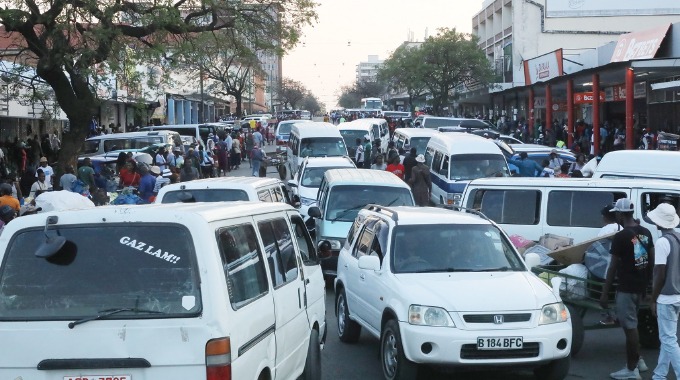
KOMBI crews, illegal tax operators and inter-city buses continue to cause chaos in Bulawayo city centre where picking and dropping off passengers at undesignated points remains commonplace despite repeated raids by law enforcement agents.
Total disregard for traffic regulations and city by-laws reign supreme during peak hours in the morning, afternoon and after working hours, sometimes in the presence of city parking crews.
The chaos creates unnecessary congestion as kombi crews and illegal taxi operators sometimes block the entire road as they jostle for clients, making driving a nightmare for other motorists and at the same time risking accidents.
Police in Bulawayo have vowed to clamp down on criminal activities through continuous raids on offenders including illegal taxi-rank kingpins who are behind the recent mushrooming of several unsanctioned pick-up and drop-off points on street corners.
So far over 30 illegal taxi drivers have been arrested, and their vehicles impounded since the first day of the raids that started on Monday last week. Police say the blitz will continue until authorities are satisfied that law and order has been restored in the transport sector.
The police action to impound unregistered public transport vehicles came as a response to calls by registered taxi operators such as Tshova Mubaiwa and the Bulawayo United Passenger Transporters Association (BUPTA), who feel short-changed by the activities of the illegal taxi operators.
Council regulations stipulate that all public passenger operators must be registered and are bound by city by-laws to pick up and drop off passengers only, at designated points. The transport policy also stipulates that all routes in the City of Bulawayo shall emanate from designated termini and that operators shall follow routes established by the council in consultation with relevant associations, among others.
The city has four registered public passenger operators namely Tshova Mubaiwa, BUPTA, Bulawayo City Transit, and Vuka Uzimele Taxi Association (VUTA).
However, stubborn illegal taxi operators, commonly known as mushikashika, are known to break rules set in the city’s transport policy and police in Bulawayo are taking a strong stand against such lawlessness.
“Police are concerned about the mushrooming of illegal taxi ranks by mushikashikas in all corners of the city centre where they park, pick up and drop off passengers illegally,” Bulawayo provincial police spokesperson, Inspector Abednico Ncube, said.
“Bulawayo Central Police traffic, commonly known as Drill Hall, is conducting routine raids in those illegal taxi ranks and as of today (yesterday) we have impounded over 30 mushikashika vehicles.
“The impounded vehicles include Honda Fit and Toyota Vitz cars, among other smaller vehicles that are used in illegal activities.”
Insp Ncube appealed to members of the public to co-operate with law enforcement authorities when such raids are being conducted.
“We would like to warn members of the public to desist from boarding these illegal vehicles anywhere in the city centre as doing so endangers their lives.
“When drivers of mushikashikas see a police vehicle approaching, they speed off with total disregard for the safety and lives of the passengers on board as well as pedestrians walking in the streets,” said Insp Ncube.
“The daily raids by our traffic division are not an operation but routine duties of law enforcement authorities to maintain sanity in the city.
“We urge members of the public to co-operate and assist the law enforcement by adhering to the law. All mushikashika vehicles have third-party insurance hence in case of a mishap their clients are left to foot the bills.”
Chronicle yesterday took a survey to ascertain the number of illegal taxi ranks that have mushroomed in the city and witnessed first-hand the lawlessness that manifests there.
Corner Fife Street and 8th Avenue, opposite a popular bank, has been turned into an illegal taxi rank for passengers plying the city-Selbourne Park suburb route and several vehicles could be seen ferrying passengers during rush hours between 4pm to 8pm.
A Honda Fit driver said the “taxi rank” has been operating for close to four months. To circumvent parking rules enforced by Trendy Three Investments (TTI), which stipulate that a vehicle must pay US$1 for an hour, the self-appointed taxi rank marshals pay for four bays during peak hour and each vehicle spends less than two minutes picking up or dropping passengers.
When a parking bay is empty and enough passengers are ready to be ferried to a particular destination, another vehicle pulls into the parking bay and picks up the passengers. It’s a quick operation that is done efficiently.
“Our passengers now know where to get transport back home in the late afternoons and evenings, so we don’t waste time,” said the rank marshal on condition of anonymity.
“As long as five passengers are gathered here, it takes less than 45 seconds to load them into the vehicle and it leaves.”
Other illegal taxi ranks include the one corner of Fort Street and 8th Avenue opposite the Bulawayo Public Library, which ferries passengers travelling to western suburbs such as Nketa, Nkulumane and Emganwini.
Another one is along George Silundika Street between 8th and 9th Avenue where illegal transport operators ferrying passengers from the city to Paddonhurst suburb have set a base.
One of the biggest illegal taxi ranks is situated along Joshua Mqabuko Street and Third Avenue where people travelling to Trenance, Northend and Saucerstown look for transport.
Tshova Mubaiwa’s route overseer, Mr Elisha Taurai, said the illegal taxi ranks were set up to entice passengers not to walk to the nearest official termini such as Egodini and TM/Pick and Pay.
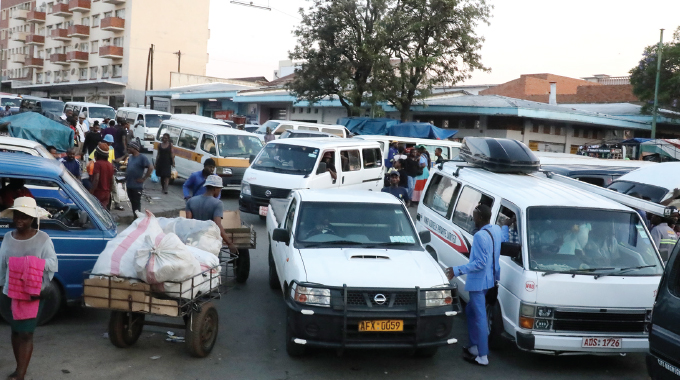
Kombi chaos at the corner of 6th Avenue and Lobengula Street in Bulawayo
“Passengers are picked up on their way to the established taxi ranks and it’s difficult to put an end to the operations of these mushikashikas. So, we appeal to the police to enforce the law and keep them away from the roads.
“Our businesses are under threat as a result of illegal operators who don’t pay taxes, are not registered and care very little for the welfare of passengers,” said Mr Taurai.
Meanwhile, a group of taxi owners operating under the banner of the United Bulawayo Taxi Association has formally petitioned the Bulawayo City Council (BCC) and transport associations, expressing their concerns over the contrary effects of the route-sharing policy.
The 81 members of the association signed the petition on Thursday, voicing their grievances.
They argue that the route-sharing arrangement has detrimental effects on both the transport sector and the public.
Association chairperson, Mr Richard Zvidzayi, said the council must address the matter urgently to avoid chaos.
“We urge the City of Bulawayo and transport companies to reconsider the route-sharing policy and explore alternative solutions that promote competition, improve service quality and protect the interests of both operators and commuters,” Mr Zvidzayi said.
“We demand the immediate reversal of the route-sharing policy, the implementation of measures to promote fair competition among transport operators and the protection of the rights and interests of individual transport operators.”
The taxi operators said the current transport policy lacks clarity on who holds the authority regarding route-sharing, asserting that neither the City of Bulawayo nor public transport providers should monopolise this practice.
They also highlighted that route-sharing has led to unjust fare impositions, saying route-sharing leads to arbitrary fare increases that do not reflect the actual economic conditions.
“This practice puts an undue burden on commuters and fails to address the underlying issues in the transportation industry,” said Mr Zvidzayi.
Among other complaints is that the route-sharing policy diminishes competition, resulting in a decline in service quality and stifling modernism while promoting monopolistic practices, restricting the freedom of individual operators and hindering the development of a diverse transport sector.
The petitioners asserted that the route-sharing policy infringes upon ownership rights, dictating how transport operators should manage their vehicles and businesses. They emphasised that the policy fails to effectively address industry challenges such as inadequate infrastructure, traffic congestion and regulatory inefficiencies.(chronicle)



 Online Reporter