admin
admin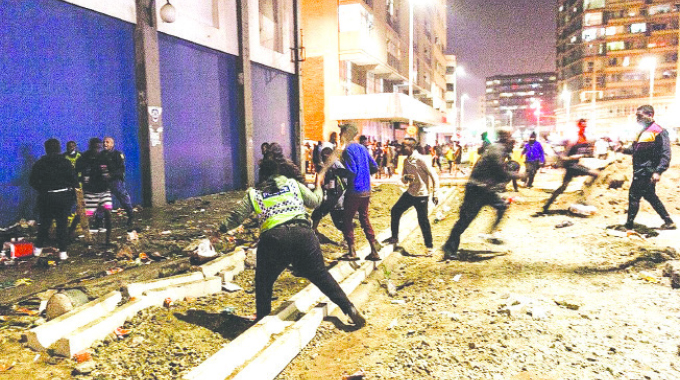
CAPE TOWN. – The National Treasury told Parliament’s Select Committee on Finance on Tuesday afternoon that the economic damage from the recent unrest could shave between 0,7 and 0,9 of a percentage point from GDP growth in 2021.
This does not account for potential value chain disruptions and resultant second-round price or output effects, it said.
Small businesses account for 89 percent of those impacted by the unrest, it added.
Protests over the arrest of former president Jacob Zuma for contempt of a Constitutional Court ruling sparked the unrest.
It quickly morphed into waves of violence that led to looting and the destruction of businesses, mostly in KwaZulu-Natal and Gauteng, causing the loss of hundreds of lives and causing economic losses estimated at around R20 billion in KwaZulu-Natal alone.
The impact on national GDP has been estimated at around R50 billion.
National Treasury’s submission estimated that only 6 percent of impacted businesses were open as usual, while 51percent of impacted business in the two riot-affected provinces had closed -7percent had closed permanently and 44percent had closed temporarily.
National Treasury said the rand had been appreciating since June 2021, largely due to rising commodity prices. But between 9 and 19 July 2021, the local currency depreciated by 2,4 percent, from R14,22 to R14,57 against the US dollar.
The submission further said longer-term borrowing costs increased in July due to the social unrest, but had since recovered.
The local 10-year bond yield was trading at 9,06 percent on 9 July compared to 9,16 percent and 9,2 percent on 19 July and 22 August respectively, the submission said.
National Treasury director-general Dondo Mogajane told the committee that as the government planned the path to recovery from the unrest, it was critical to address the impact of unemployment and the threat to future stability.
“The message has to be understood by all. We must drive it home, in terms of what has happened and its impact on the economy. I agree with the notion of issues of opportunity, access and employment that we cannot shy away from,” said Mogajane.
Mogajane said state-owned insurer Sasria was coping with the claims process since the unrest and that stable management would continue to hold the entity in good stead.
“Their claims, as we speak, are between the R20 billion and R50 billion mark. They are not funded by us but their own operations. They have acknowledged that their cover is very cheap. They are not solely dependent on us as government and are running a good operation,” Mogajane added.
He said government allocated R2,3 billion for small business support in response to the unrest. He also said the economy could recover if Operation Vulindlela was implemented as planned and government stuck to the fiscal fundamentals.
National Treasury head of economic policy Duncan Pieterse told the committee that the rand showed volatility during the period after the unrest, largely because of its exposure to global currencies, commodity prices and macro fundamentals.
“Our currency does look volatile relative to an average, but even if you compare us to our emerging market peers, our currency is relatively volatile. One way to think of it is that our economy is still tied to what happens in global commodity prices, the commodity cycle and price of commodities we produce,” said Pieterse.
National Treasury director for general sectors, intergovernmental relations and economic policy Boipuso Modise said there was significant upward pressure on commodities which were having an effect on prices, but that once the commodities cycle plays itself out, the impact of the unrest of commodities will be clearer.
“The extent to which the unrest has second round impact still remains to be seen. Literature suggests that there tends to be a lasting impact and to the extent that significant economic infrastructure is damaged, that will also have an impact on the economy’s ability to recover,” said Modise.
DA MP Stephanus Du Toit said social grants were not the best solution and that South Africa had to consider opening up the economy to allow a recovery from the unrest as well as the Covid-19 pandemic and the subsequent national lockdown.
Du Toit said South Africa needed to come to terms with the reality that the unrest had its beginnings in ANC factional battles, rather than putting the blame squarely on rigid economic inequalities.
Committee chairperson Yunus Carrim took exception to Du Toit’s characterisation of the unrest and its causes, and added that if South Africa did not address inequality, it would continue to see similar waves of unrest in the future. -Fin24


 Online Reporter