


 Chronicle Editor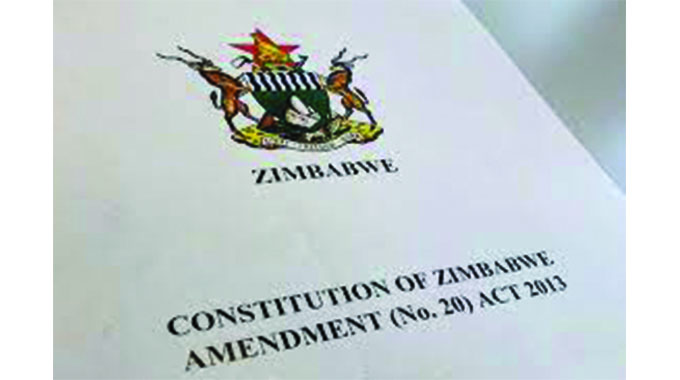
Samantha Sithole and Ikechukwu Raphael Ndu
Traditional institutions can be broadly defined as establishments whose legitimacy is based in part on their affiliation with traditional modes of community governance.
These institutions are political in the sense that they make decisions that regulate and provide for the collective, and they are traditional in the sense that they are widely perceived to be associated with custom.
We emphasize that in the popular imagination, these institutions are associated with custom, not that they are accurate reflections of historic governance practices.
Traditional political institutions include a wide range of entities, from village-level to national-level. Zimbabwe adopted a new Constitution in 2013 (Constitution of Zimbabwe), which recognises the role of traditional leadership institutions alongside modern state structures. While strengthening the institution’s role and status, the new Constitution strictly regulates the behavior of traditional leaders.
Despite this uplift and strict regulation, the role and relevance of traditional leadership is being heavily scrutinised. Traditional leadership has always been central to community governance in Zimbabwe, as it is in many other parts of sub-Saharan Africa. In many African countries, including Zimbabwe, traditional authorities take various forms and shapes. In Zimbabwe, for example, the structures and systems of leadership in Ndebele, Shona, Kalanga, Tonga, and Venda ethnic communities show some striking differences while also displaying some similarities. Currently and generally, the institution of traditional leadership is made up of chiefs, headmen, and village heads, in that order.
Village heads are physically closest to the people and thus have the most interactions with rural residents. Prior to Zimbabwe’s colonisation, the institution of traditional leadership served as the sole governance structure with governing legitimacy derived from tradition and culture. Traditional leaders had combined “governmental” powers and authority, such as judicial, administrative, and political powers. Soon after colonialism began in 1890, the colonial government dismantled, and in some cases replaced, traditional governance structures with “modern” State institutions in order to advance its interests and exert firm control over the black population.
It implemented a slew of measures that tainted the institution of traditional leadership. Traditional leaders’ powers, such as the ability to allocate land, were stripped or limited. Chiefs began to be appointed outside of the relevant ruling clan or tribe as salaried government officials accountable to the colonial government. Following that, the institution’s role was redefined.
In some areas, the colonial administration distorted succession principles, undermining the legitimacy of the relevant traditional leaders. Legislative enactments in the independent era attempted to resurrect these succession principles.
The 2013 Constitution expanded on these enactments by requiring traditional leaders to be appointed in accordance with relevant traditional norms and practices. The Constitution requires Parliament to pass legislation governing the appointment and removal of traditional leaders. Such legislation must provide for the President to appoint chiefs on the recommendation of the relevant provincial assembly of chiefs, as well as the National Council of Chiefs and the Minister responsible for traditional affairs.
A similar procedure applies to the removal, suspension, and resolution of disputes concerning chiefs’ appointment, removal, and suspension. The Traditional Leaders Act provides for the Minister to appoint headmen from a list of people nominated by the chief of the relevant area. The Secretary responsible for traditional affairs appoints village heads from a list of people nominated by the relevant headmen and approved by the chief.
Traditional leaders hold their positions for life unless they are removed for misconduct. While it was once considered taboo to appoint women as traditional leaders, more women are now being appointed as traditional leaders than ever before, demonstrating the institution’s adaptability to the changing times.
Incorporating traditional African political values into modern governance values is a critical step in the reconstitution of the African State. Decentralising decision making, resolving conflicts by narrowing differences, making key decisions consensually, and establishing power sharing governance arrangements all contribute to bringing the State under broader popular control, based on African political and cultural values. Thus, the reconstitution of the state and the integration of traditional institutions are complementary processes that must occur in tandem.
Traditional authorities can mobilise local communities for political participation, allowing them to influence policy regarding the distribution of public services.
Traditional authorities can also help governments with service delivery by participating in the administration of justice and mobilising human and financial resources to expand educational and health services. Thus, African traditional values not only converge with modern democratic values, but also have the potential to supplement modern democratic mechanisms by filling gaps in their applicability.
They can also bring marginalised groups of society, such as the peasantry, into the political process and improve their access to public services.
Another area where traditional institutions could make a difference is in the prevention of resource-based conflicts. The widespread communal land tenure system in much of Africa serves as a foundation for traditional political structures and democratic values. The communal tenure system ensures that all members of the community have access to land. While it does not necessarily alleviate poverty or ensure social equality, it does create relative access equality in rural areas. Until economic development creates access to alternative opportunities, the communal tenure system remains a vital mechanism for reducing rural unemployment, poverty and inequality. It also makes the preservation of traditional democratic values and rural self-governance possible.
Traditional conflict resolution and consensus decision-making mechanisms can thus improve state building by making it possible to accommodate the interests of various sub-state entities and protect minority interests. Decentralisation of decision-making and adherence to term limits for leaders are two other traditional mechanisms that can help with state-building.
It is important for everyone to recognise inclusiveness and importance of traditional structures in modern systems.



 Bongani Ndlovu
 Online Reporter