

 admin
admin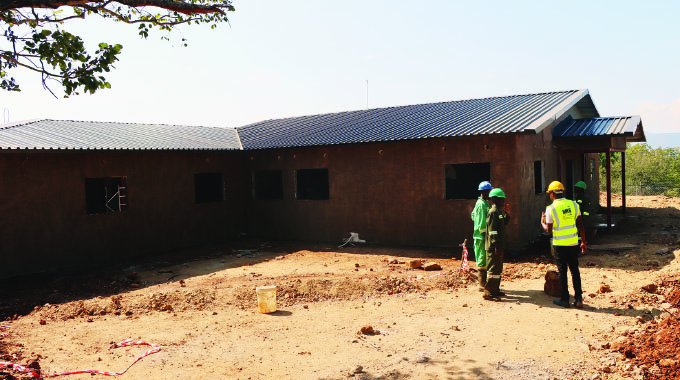
Rumbidzayi Zinyuke
Senior Reporter
Healthcare delivery is anchored as one of the pillars that drive economic development according to the National Development Strategy 1 (NDS1) and the Second Republic’s Vision 2030.
Increasing access to health services for all citizens is central to universal health coverage, particularly for the most vulnerable and marginalised people in communities.
However, with most rural communities having less access to health facilities owing to long distances being travelled by villagers to the nearest health centre.
To ensure equitable access to healthcare, President Mnangagwa’s Government has undertaken to construct health centres closer to the people as a way of ensuring universal health coverage.
A total of 30-22 bed health centres and five 60-bed district hospitals are being constructed across the country. The construction of the health centres is wholly funded by the Government through a US$210 million facility.
As such, the Ministry of Health and Child Care and the Ministry of Finance and Economic Development contracted NMS Infrastructure Limited for the design, construction and equipping of the health centres and hospitals.
The majority of the modern facilities are expected to be located in far to reach areas, improving access to health services for most communities.
To date, four health centres are at various stages of completion with the first one at Stoneridge in Harare already complete and operational.
Stoneridge health centre was commissioned by President Mnangagwa in May last year and is currently servicing the people in surrounding areas.
The second facility at Cowdray Park in Bulawayo is now 100 percent complete with all the equipment in place and now awaits commissioning.
At Mataga growth point in Mberengwa, the third facility is 97 percent complete on civil works. Installation of equipment is expected to commence by end of May after painting and flooring has been done.
Construction of the Runyararo health centre in Chimanimani where cyclone Idai survivors are being relocated started in December last year is now at 70 percent. By August, work on all centres should be complete.
According to NMS installation, commissioning, maintenance and training (ICMT) manager Mr Tendayi Gatsi, Cowdray Park is ready to be handed over to the Ministry of Health and Child Care.
“Cowdray Park is site number two and it is 100 percent complete like Stoneridge, which was the first site. We are proceeding to Mataga health centre in Mberengwa and Runyararo in Chimanimani,” he said.
He said work at Mataga started on November 1 last year and construction now is at 97 percent with only the final touches left.
“The construction of Runyararo health centre started in December last year with the steel works then they proceeded with the light weight steel frameworks. The plastering of the main facility and accommodation started in May now they are proceeding with the finishings that include the packing of the walls, flooring and painting,” he said.
NMS construction manager Mr Donald Fraser said besides the healthcare services that will come with the completion of the facility, the communities had benefited from employment opportunities created by the construction.
“We ensured that the contractor only brings in a skeleton staff and then employs locals. This has ensured employment opportunities as well as skills transfer for the communities,” he said.
All the facilities are self-sustaining with a full on solar system, accommodation units for the staff who will be stationed there and they have brick incinerators and water reservoirs.
The facilities are equipped with delivery, prenatal, post-natal and procedure rooms and each has a paediatric ward, three consultation rooms and an imaging store which houses a mobile x-ray machine.
Some of equipment installed there include anaesthesia machines, X-ray machines, ultrasounds and vital signs machines.
The construction of the facilities is a game changer in healthcare service delivery.
It has ensured that people can access services closer to where they stay as envisioned by the Second Republic.
For the community in Cowdray Park, people have been using a satellite clinic run by Bulawayo city council, which is too small to cater for the health needs of the population of over 76 000.
As a result, some residents had to travel further to Luveve and Emakhandeni clinics for health care.
Bulawayo Metropolitan Provincial Medical Director Dr Mafios Siyamchembu said they were now ready to receive the facility so that it could start operating.
“We have looked at the structure and we are ready to open. We are waiting for the green light from head office and his Excellency (President Mnangagwa) to commission it.”
He said Cowdray park is home to approximately 10 percent of the population in Bulawayo, and the construction of a health centre would improve access to healthcare for all.
“This facility will be busy serving this large population which is the second largest settlement in Zimbabwe and it will be helpful as people will not have to travel long distances to clinics and hospitals,” he added.
Dr Siyamchembu said the staff who would run the facility had already been employed and they included a resident doctor, clinical officer, matron, a number of registered nurses, midwives, radiographers, lab technicians as well as general hands.
In Midlands, Provincial medical director Dr Mary Muchekeza said the construction of Mataga health centre was a huge relief for the communities of Mberengwa and Midlands as a whole.
She commended the pace at which construction had taken place owing to the new building technology employed by NMS in assembling ready-made state of the art wall panels.
“The new facility is set to benefit a population of not less than 61 614 people in the catchment area which were currently being forced to travel to Mnene, Musume or Zvishavane in search of either secondary health services or admission facilities,” she said.
She said the top five causes of OPD (outpatient department) attendances in the catchment area were hypertension, malaria, neonatal services, pneumonia and injuries and these were currently being serviced by several rural health facilities.
However, severe pneumonia, injuries, complicated malaria, fever of unknown origin and neonatal services were the top five referral causes from the clinics to the admitting hospitals.
“It is therefore foreseeable that the local people who live peasantry life in this part of the province will be able to get secondary level health services at their own commercial hub at Mataga growth point. The new hospital is set to offer many services including maternity services, Opportunistic Infections and ART services, TB lab diagnostic services, health education, ambulance services, OPD services and the provision of medicines.”
Mataga health centre will employ a clinical officer, two midwives, two nurses, lab technicians, pharmacy technicians, domestic staff, environmental health technicians, psychotherapists, radiographers, nurse anaesthetist, a bio medical technician and doctors.
Runyararo health centre in Chimanimani is expected to service the new settlement where survivors of cyclone Idai are being relocated.
Although the centre is flanked by Bumba and Chayamiti clinics, it will offer more services not available at the two cinics.
Manicaland Provincial Medical Director Dr Munyaradzi Mukuzunga said not only would the facility offer healthcare services to relocated families but also the surrounding communities.
“We have over 260 families who are going to be moved, some of them have already moved from areas that were affected by cyclone Idai. The bigger vision is to have that area developed into a bigger settlement with irrigation and other services so definitely there is need to provide health services for that big population,.
Dr Mukuzunga said the fact that Runyararo health centre was a hybrid clinic cum hospital that could offer a wider range of services which meant more clients would need to use the facility.
“In an ordinary clinic we do not have theatre facilities and admission which will be offered by this clinic. Runyararo will therefore offer more services to people in the process of moving and those in surrounding communities of Bumba and Chayamiti thus increase the population that will be served by the facility. We will also have a resident doctor and offer caesarean sections so the expectation is that even other feeder clinics will also be able to refer to that facility,” he said.
Communities that are benefiting from these health facilities have expressed gratitude to the Government for ensuring that they have better access to healthcare.
“Our clinic is really looking good now that it is complete but we are worried by the delay in opening. We are tired of walking long distances to access the clinic that we are currently using and we want this one to start offering us services. Once this clinic opens it will be good for everyone, especially pregnant women who sometimes have to walk if they do not have the bus fare to travel to the nearest clinic,” said Ms Dalice Sibanda form Cowdray Park.
Mrs Tendai Gwemende, a village health worker in Mataga said the new clinic would improve the health seeking behaviours of locals and help to reduce maternal deaths.
“As Village health workers we have seen women facing challenges in getting assistance when they go into labour especially if it is in the middle of the night and there is no transport. Sometimes if we manage to get her to the clinic, she might be referred Musume hospital which is further away and there may be complications and the mother or the child dies.”
She said the new clinic would lessen the burden of not only pregnant women but also the disease burden on most of the people in the communities.
Mrs Gwemende said people would not hesitate to visit a health facility close by to get screened for treatable and preventable diseases such as cervical cancer and other illnesses.
“We are happy that once this clinic starts working we will see less of these avoidable deaths as people will be getting help from nearby and quickly get treatment,” she said.
Mrs Annette Muresherwa from Chimanimani said although she and her family had lost a lot in the cyclone disaster, they were slowly rebuilding their lives.
“We were in Chimanimani where we were affected by cyclone Idai and we relocated to this area. We are looking forward to settling in this area and we are thankful for what Government has done for us. We are particularly grateful for the clinic that is being built for us as it will bring health services closer to us,” she said.
It can be said that the construction of health facilities will definitely make healthcare more accessible and improve the health outcomes for the millions of Zimbabweans in hard to reach areas.



 Online Reporter