admin
admin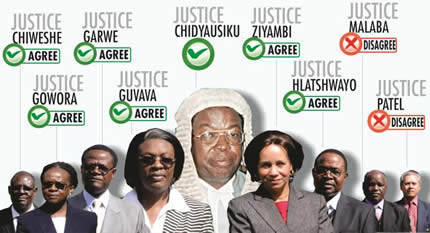
A national constitution consists of both rules and principles under which a country is governed. In any modern democracy, it is desirable that at any time all the three institutions are available as they provide checks and balances to each other.
The role of the Executive is to run the country using the rule of law, while the function of the Legislature is to make laws and provide oversight to the Executive. The Judiciary’s function is the interpretation of the law, in particular resolution of disputes between parties.
It is within this context that we should consider the decision of the Constitutional Court delivered on May 31 2013. In our constitutional democracy, the Courts are the only ones with the function of interpreting the law, and the final court in our land is the Constitutional Court. This is the final arbiter in any dispute in our country. Once it has spoken, its findings must be respected by all parties to the dispute.
The judgment binds us and we have to comply with it.
The question of the correctness of the judgment is a good academic exercise for scholars and intellectuals. It is certainly not something that litigants who were parties to the dispute should be encouraged to discuss. When you approach the courts as protagonists with a dispute, most likely one or more litigants will be unhappy with the judgment.
This is not the first time a litigant has been unhappy with a decision by the final court in Zimbabwe. There is nothing novel.
All litigants think they are correct when they present themselves before a court of law. Surely, a litigant has neither moral nor legal authority to discuss the correctness, or lack of it, of a judgment by the final court of the land.
This should be at the heart of our understanding of constitutionalism; the behaviour, the culture and the tradition of respecting our laws, in particular the Constitution. We must respect and comply with all court judgments, in particular those of the final court in the land. Constitutionalism means complying with all court decisions. In fact, compliance and respect are even more important with respect to judgments ruled against you, those decisions you consider wrong, and those findings you dislike. You must respect them all.
Constitutionalism means you must respect and obey all laws, including those you might consider unjust. The responsibility of the citizen is to change unjust laws.
How should the nation respond to the Constitutional Court decision of May 31 2013?
The most important national action should have been to immediately start collectively working on complying with the judgment, in particular the deadline of July 31 2013. How the case ended up in the Court system is no longer relevant. The final arbiter in our country has spoken.
The first guiding principle should be that every Zimbabwean who is eligible to vote must be given an opportunity to vote.
Secondly the election itself must be conducted in a conducive, free and fair environment. Peace, freeness and fairness must be guaranteed before the vote, during the voting, and after the voting, leading to a credible, legitimate and undisputed outcome. Is this possible within the time prescribed by the Court?
The answer is Yes and No.
Yes, if we gather and muster the requisite political will across the political divide. Yes, if we deploy the necessary resources, and more. Yes, if we work as Team Zimbabwe.
Of course, the answer is No, if we keep discussing, pontificating and trading insults over the judgment. By definition, if the decision by the final court in our country is “wrong”, it is uncorrectable. So why waste time on endless and meaningless discourse?
The answer is NO, if we pin our hopes on foreign players, unimaginative busy bodies, who have no power over our constitutional democracy and its processes. Let us work together, as Zimbabweans and deliver a credible and legitimate election by July 31 2013.
For those who feel strongly that the judgment was incorrect, they must think about long term remedies. First, you work on effecting a constitutional change to the law that you felt was wrongly interpreted, making it clearer to avoid or minimize future “wrong” decisions. Those offended by the judgment must work on developing better and clearer laws.
Furthermore, a position that says the judgment was wrong implies that the judges were incompetent or intellectually limited. Hence, another solution is that at the next opportunity, if one has the authority or can influence those that have it, you can then appoint judges that you think are more able. For those serving on the Constitutional Court, we also say, the power to be the final arbiter in any country carries with it immense honour and responsibility. This means any final court in any country should be extremely thorough, careful and responsible.
Let this episode of a disputed Constitutional Court decision be a learning opportunity for the entire Zimbabwean polity, including the Judiciary.
However, there is absolutely no scope or locus standi for foreigners to vary the decision of the final court of our nation. Whatever our political differences, whatever our divergent views on the specific issue at hand, we should not allow foreigners to violate and desecrate our sovereignty. South Africa, Sadc or the AU cannot vary or challenge Zimbabwean laws.
It is not acceptable for the South Africa facilitation team to use the language that says “With or without court ruling, an election roadmap has to be agreed,” thus, demeaning and disregarding the decision of our Constitutional Court, while implying that a roadmap outside the laws of Zimbabwe will determine the election date. This is an attack on our national sovereignty.
All Zimbabweans across the political divide; including those who are offended by the Constitutional Court judgment or feel that it was a wrong decision; must unite, oppose and reject this patronising and illegitimate posturing by our neighbours. The SA facilitation role, the involvement of Sadc and the AU was never meant to disregard Zimbabwe’s sovereignty and its territorial integrity Foreigners must respect our constitutional dispensation.
As Zimbabweans, we must preserve our national sovereignty. The language for the foreigners should be as follows, “A binding and final determination has been made by the Constitutional Court in Zimbabwe. We as the facilitation team fully respect that judgment, without reservation, as part of our acknowledgement of Zimbabwe’s sovereignty. It is within the confines of that court ruling that we will assist and facilitate the development of a clear roadmap to elections, with timelines agreed upon by the parties themselves.”
This should be the diction of individuals and institutions external to Zimbabwe. We cannot allow foreigners to violate our sovereignty in such a brazen manner. No.
When, chips are down, as Zimbabweans, we should be masters of our destiny. Let us work together within the provisions and processes of our constitutional democracy and deliver a free and fair election.
We owe it to posterity. Let us find each other, as we have always done. However, whatever we do, let us remain committed to constitutionalism and the preservation our national sovereignty.
l Professor Arthur G O Mutambara is Deputy Prime Minister, in the Republic of Zimbabwe



 Online Reporter