admin
admin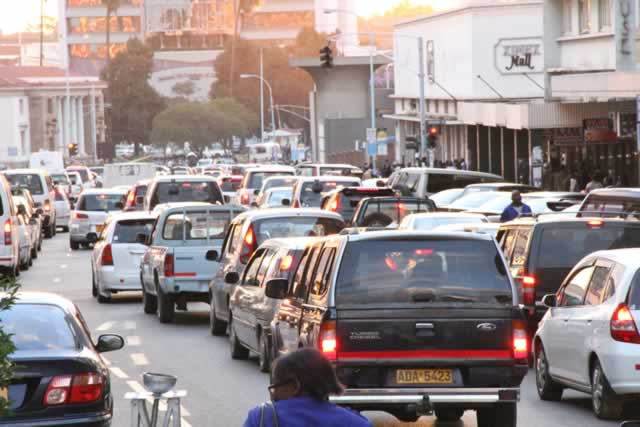
Kuthula Njokweni Matshazi
A FRIEND of mine posted a picture of traffic gridlock on Facebook of what seemed to be Don Valley Parkway, a highway in Toronto, Canada, that is known for its overwhelming vehicle capacity and frequent gridlocks. Lo and behold, the picture showed the area along Sam Nujoma Avenue (formerly Second Street), from Samora Machel Avenue to Jason Moyo Avenue, Harare.
Over the years, the vehicle population in Zimbabwe has grown exponentially without a corresponding increase in the road network. Alongside this growth is a dangerous assumption that Government can easily expand the road network to accommodate the ever increasing car population. That is not true. Government does not have adequate resources to build a road network to alleviate congestion. Even if it did, there is a limit to what Government can build otherwise every space will be turned into a road.
Responsible transportation management cannot compete with private car sales companies that want to stay in business and earn a profit. No one can tell a car dealer to stop selling cars because there are now many cars on the road. It is the people who should understand this challenge facing our nation. We can’t continue buying cars and not foresee that ultimately we are going to experience gridlocks.
Putting forward such an argument is not to suggest that I do not understand that a car is, in some instances, a necessity. Zimbabwe needs practical solutions that will mitigate the transportation system crisis. The idea of toll gates is great! It has a potential to cause further gridlock, at least, in the initial stages, but overtime it will eliminate them as people abandon cars to avoid gridlock inconveniences and regular payments of tolls. When that happens, the objective of the toll gates would have been achieved! Local authorities would have managed not only to raise funds for rehabilitating and improving the roads, but reducing congestion by encouraging people to use public transport, and where this is not possible, make drivers pay the full cost of driving.
When Government, in partnership with local authorities, achieves its policy objective of reducing the number of people driving, they need to offer alternative means of transportation. One such way, is to create parking facilities near the main public transport routes in the suburbs where drivers can park their cars and then get into Zupco buses or commuter omnibuses. Some people would say the reliability of Zupco buses is questionable. The Government should make sure that Zupco buses are reliable so that it can help families, the economy and its own traffic management program.
The commuter omnibuses are generally known to mistreat customers. Well, this new government transportation programme will give them an opportunity to increase customers. Government could consider limiting the licensing of commuter omnibus operators to the number of the travelling public so that it doesn’t create a situation where we have more commuter omnibuses than necessary. If that formula is not given serious thought it will serve to worsen the commuter omnibus cut-throat competition. This competition will only lower the customer service level than enhance it, as we have all seen. The mass licensing is creating a “race to the bottom” in terms of customer service. Car owners will not see a reason to use public transport.
In tandem with that, Government can create parking facilities on the outskirts of the central business districts. These facilities will be intended to discourage drivers from making unnecessary entry into the CBD. People will drive from their suburbs and park their cars there. In Harare, a car park facility, for example, could be established at the open grounds around Rainbow Towers for cars coming from the western side of the CBD, and similarly other parking facilities could be built for other areas.
The parking spaces will be limited to say, 30 percent of average total traffic volume driving towards the CBD per rush hour along the main road closest to the parking facility. This limitation of parking space will serve as a further deterrent to driving.
From these parking facilities, Zupco buses will pick up passengers and drop them in the CBD. Zupco might design three or so routes that cover the breadth of the CBD where people could be dropped off along these routes. That way, the volume of cars is drastically reduced and the commuter omnibus congestion in or near the CBD is eliminated.
In the CBD, the local authorities should consider reducing the number of vehicle lanes to a maximum two. Where the driving and parking lanes are six, including the parking lanes, as is along Sam Nujoma Street, between Samora Machel Avenue and Kenneth Kaunda, the Harare City Council would reduce the vehicle lanes to three. The two lanes will be for cars while the third lane will be dedicated to Zupco buses. Of the three remaining lanes, one will be dedicated to parking, one to bicycles, and the other to pedestrians. The funding of this new transportation system will come from different sources which will be a mixture of Government grants and loans, toll gates, public-private partnerships and private sector, especially in the technological part of the system.
I see this suggestion as a practical alternative than the myth that flyovers, highways and more roads are going to solve the traffic congestion problem without restricting the use of the car. London, Oslo and many other cities that have managed to deal with traffic congestion in the CBD have more money, much superior and larger road infrastructure with a series of highways, flyovers, etc. However, they still face serious congestion. The reason they are still functioning is because they have taken these steps that I have suggested: discourage the public from driving and provide public transportation and facilities.


 Online Reporter