

 admin
admin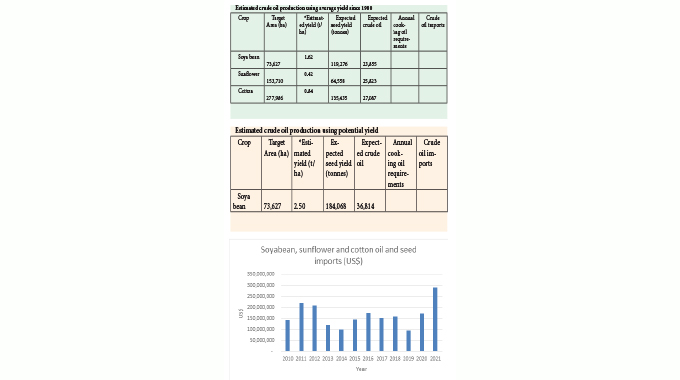
Edgar Vhera-Agriculture Specialist Writer
IT’S as clear as day that we will not require a solution from Mars or somewhere overseas to address cooking oil shortages that have afflicting the country in recent times. What the country only needs to do is actualise the Government’s call to adopt local solutions and increase productivity on targeted hectarages for oilseed crops such as soya beans, sunflower and cotton.
This simply means that the country has to move from the current low national to optimal yields to ensure that there is cooking oil self-sufficiency from this year going forward.
It is refreshing to note that the Government, contractors and self-financed farmers have since set themselves a combined target hectarage of 505 323 under oil crops. For soya bean, the hectarage was set at 73 627 while sunflower was at 153 710 with cotton taking up 277 986.
An analysis of data from Ministry of Lands, Agriculture, Fisheries, Water and Rural Development shows that the average yield of the soya bean crop since 1980 was 1, 62 tonnes per hectare while that of sunflower and cotton was 0, 42 and 0,84 tonnes per hectare respectively.
Twenty percent of crude oil is realised from the crushing of soya bean seed and ginned cotton seed while sunflower has a high oil content of 40 percent.
Assuming the country achieves the same average national yields for each of the three crops a combined seed tonnage of 319 269 will be achieved.
Expressing these products for oil will yield about 77 000 tonnes of cooking oil and given that the country has an annual cooking oil requirement of 140 000 tonnes, 63 000 tonnes of crude oil will need to be imported.
The combined influence of good agronomic practices, high yielding hybrids as well as decent rains can result in the yield of soya bean, sunflower and cotton rising to 2, 5 tonnes per hectare, one and two tonnes respectively.
Harvesting of soya bean and sunflower and processing of seed cotton will produce a cumulative total of 660 241 tonnes of seed.
Crude oil production from crushing of the seed realises 162 790 tonnes of crude oil. Refinement of the crude oil will ensure that the country has enough cooking oil for a year.
This will be a big boost to the country’s import substitution drive and save foreign currency.
Statistics from Zimstats show that the country imported soya bean, sunflower and cotton oil and seed for use in cooking oil and stockfeed manufacturing of over US$100 million annually from 2010 to 2021.
A sharp escalation was noticed from 2019 to 2021 with the import bill rising from US$95 to US$289 million, a whopping 205 percent increase.
In 2021 the country imported over 167 000 tonnes of cooking oil producing products worth over US$289 million. Crude soya bean oil imports accounted for the largest chunk with about 140 000 tonnes worth US$223 million, followed by palm oil and sunflower oil.
Cognisant of this unsustainable trend, the Government has operationalised the import substitution strategy through increased local production, as a smart way of avoiding exporting jobs and expenditure on foreign currency payments from cooking oil imports.
Various players within the soya bean, sunflower and cotton value chains have paid attention to the Government’s call for private sector to fund at least 40 percent of their raw material requirements through joint ventures and contracting with a lot of farmers nationwide having been contracted by oil expressing companies.
I recently had a chat with Oil Expressers Association of Zimbabwe chairman Mr Busisa Moyo who disclosed that the country normally gets its cooking oil from soyabeans, cotton seed, and soyabean crude oil. Last season, the country produced about 10 000 tonnes of cooking from 50 000 tonnes of soya bean, which was a far cry from the quantities the country requires yearly.
It is not surprising that with the vibe to achieve cooking oil self-sufficiency permeating the air, all stakeholders including contractors have this year increased hectarages to reduce imports of crude oil and save foreign currency.
According to Agricultural Advisory and Rural Development Service weekly report dated January 16 area under sunflower went up 383 percent from 4 271ha in 2022 as compared to this year’s 20 627ha.
The report shows that soya bean came second after achieving a 24 percent increase from 37 990ha to 47 203ha. Cotton on the one hand recorded a 22 percent jump in hectarage from 141 036 to 172 295 this season.
The joint combination of increased sunflower, soya bean and cotton production will enhance the country’s chances of achieving cooking oil self-sufficient as well as taking care of the stockfeed manufacturers’ needs.
Under the “Handei Kumunda Varimi, Asambeni Emasimini Balimi, Going4Growth buzz maxim,” the Government is encouraging farmers to do the 4Rs (right seed, right placement, right agronomic practice, right time) for increased production.
Cottco has since responded by giving farmers inputs on the basis of seed cotton deliverances to their depots this last season with those that sold less than three bales (below 600kg) getting inputs enough to plant on 0, 5ha while those who delivered three bales got inputs for a hectare.
Those who delivered more would get more on a pro-rata basis, which is one sure way of promoting high production.
For sunflower, experts have always argued that very high yields of up to 3, 5 tonnes per hectare can be achieved under irrigation with dryland farmers capable of reaching two tonnes while in marginal areas yields of up to one tonne are possible.
But the brutal truth on successful farming is that it is not hectarage that matters but productivity.
This means that the country does not benefit from pushing large volumes of inputs over vast hectarages to end up achieving the current low national average yields of between 300 to 350kg per hectare for cotton or 800kg for maize.
What is crucial is to target productive beneficiaries who will be supplied with enough input packages for optimal yields. It is such farmers who practise the right agronomic requirements who are credited with increased yields to fuel the country’s current agricultural revolution.
It does not pay to do a blanket disbursement of inputs to all households and record sub-optimal yields when allocation of inputs can be easily done based on a farmer’s known performance.



 Online Reporter