Chronicle Editor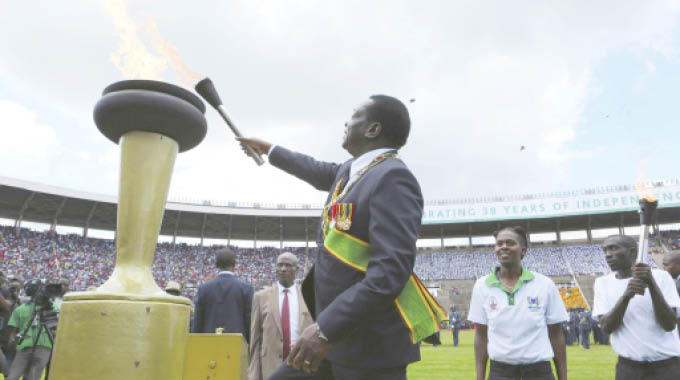
Richard Mahomva
The pivotal and unwritten resolution from the 18th Zanu-PF National People’s Conference in Goromonzi last year to rotate national commemorations beckons.
This pragmatic turn to disenfranchise centralisation of national celebrations was declared by the President Emmerson Mnangagwa. To a fairly reasonable extent, this policy pronouncement validates the role of the ruling-party’s annual indaba as a locomotive cogwheel for the ethos and the supremacy of the liberation spirit. The adoption of this never proposed resolution is articulate of President Mnangagwa’s propensity for egalitarian and inclusive national belonging. This is a mark of his sincere commitment to dismantle territorial incentivised supremacies which have threatened the possibilities of national unity. The corrosive effects of social imbalance emanating from regional superiority and inferiority complexes have only aided tribalism and political polarisation. Needless to emphasis the pitfalls of national consciousness after 1980, the state has got a role to play in justifying the logic for social cohesion. Immediately after independence there was a cosmetic application of peace and reconciliation in our polity. The birth of the Government of National Unity (GNU) attempted to rescue this crisis. Thanks to the new Constitution of Zimbabwe. It is not only a monumental blueprint guiding the reinforcement of national healing, but it sets the parameters of a social contract to assembling what our polarised polity cast asunder. The birth of the National Peace and Reconciliation Commission (NPRC) also affirms a commitment to redress the wrongs of yesterday. Therefore, when the national independence celebrations migrate to the City of Kings and Queens the reality of our oneness and is illuminated far and above the simplistic subterfuges of slogans.
The significance
The erstwhile rigid bias of commemorative activity towards Harare and the confinement of a certain administrative (public management) power to the capital city has served as an irony to the constitutionally prescribed tenet of devolution. This centralised style of governance was borrowed from the colonial public administration tradition. With one particular centre of resource distribution, colonial subjects were managed. Resource mobilisation was down-streamed from the centre’s artificial hold to the periphery. Resource distribution favoured the centre. This created an undefined but existent “us and them” chasm. One of the major objectives of the armed struggle was to break this yoke of centralisation and its excruciating effect to the need for socio-economic equality. After independence, the perpetuation of this flawed system of governance in the context of Zimbabwe has created a rift between Zanu-PF and every other part of the country which is not Harare.
Connotatively, Harare continued to carry the image if the old Salisbury status as the national citadel of power. Even after independence, a tendency to refer to Harare as KoBambazonke has been preserved. The colloquial christening of Harare as KoBambazonke by our people in the whole of Matabeleland and Bulawayo in particular signifies an emotive disillusionment about the perceived regionalist monopoly residing in the centrality of Harare as an expressive space and symbol of power. This umbrage towards Harare symbolises the countrywide disgruntlement caused by the limited distribution of opportunities since independence. Moreover, this has been exacerbated by the fact that most national events have been celebrated in Harare. Somehow, this has entrenched the view that national memory is also a monopoly of the centre.
The implications
Therefore, with the rotation of independence celebrations from one province to another, there is no doubt that the centre is moving away from itself. The move gestures devolution to reality. At the same time, regional balance is effectively pursued. The integration of national processes and their inclusive unifying effect must be realised now to create long lasting impressions of breaking down the barriers.
I am really not worried about the political capital and partisan posturing which this policy may be creating. After all, Zanu-PF must claim and consolidate its political share in every other part of Zimbabwe. Subsequently, Zanu-PF must create interaction platforms which reassert its role in the past and the present. At the same time, the ruling party must be entrenching the values of national belonging among our people to the fullest. Above all, what is important is the precedence and the foundation of inclusive national belonging which this strategy is building. In no uncertain terms, ten years down the line the perceived monopoly of Harare as an artificial centre will be broken to make way for practicable devolution. In the process, the cardinal value of national unity will be realised. By decentralising Harare we are confronting the imperialist vestiges of monopoly. In the process we are reclaiming the equality of each and every province in the country and making each one of us to feel the need to serve their country in loyalty and profound diligence.
This reignites interconnecting emotions of the continuity of our struggle beyond the peripheral points of dissent we have been submerged in since 1980. This opportunity should evoke the nostalgia of the centrality of Bulawayo in the history of the nationalist movement as it became the nerve of the cradle of our struggle against Rhodesia in the late 50s. The role of Bulawayo as a hub of anti-colonial national consciousness can be traced to the contribution to the working class at the time. Bulawayo as a mosaic of various ethnicities played a crucial role in building a collective national consciousness. At the time, the collective preoccupation of the oppressed was the need to dismantle the colonial system. In this post-colonial era, it only makes sense for us to return to Bulawayo — the source and the cradle of nationalist consciousness.
National unity gestured
The pre-independence urban mass had a profound consciousness to organise themselves to respond to the class marginalisation which was a creation of colonialism. Subconsciously, nativism was suspended for a while to redirect a unity of purpose towards class struggles. The common struggle of the dispossessed was defined.
Fast-forward, in 1987, the Unity Accord was a restoration of the principle of regional balance. It was a clarion declaration to peace-building, national healing and reconciliation. It was a unity of the nationalist movements who led the armed struggle. Indeed, the Unity Accord reaffirmed the political brotherhood of the gallant nationalists of our liberation, Cde Robert Mugabe and Father Zimbabwe, Cde Joshua Nkomo. Through the Unity-Accord, Zanu-PF was born and the nationalist vision was redefined.
Today, the value of this unity can be better realised if the centre is shifted. The emphasis on inclusive regional participation resides in this normative premise of national unity. This espoused tradition of unity is being personified by the deliberate effort to make every Zimbabwean part of the remembrance symbols and rituals of national belonging. Therefore, as we continue to engage, construct and deconstruct what it means to be Zimbabwean at this moment; the liberation legacy must be an exclusively embraced manual and not selective inclinations to its tenets. On that note, it’s imperative for Zimbabweans to vigilantly subscribe ideas which cultivate unity other than division and half-hearted patriotism. This position compliments President Mnangagwa’s remarks in the formative moment of the New-Dispensation: “I am a President for Ndebeles, Shonas, Zezurus, Ndaus, Karangas, Manyikas, Vendas, the Chewas, Sothos. I am also the President for the Tongas, Tswanas, Xhosas, Khoisans, Shangaans, Kalangas, Nambyans and other races, all who are celebrated in our national Constitution.”
– Richard Runyararo Mahomva is a Political-Scientist with an avid interest in political theory, liberation memory and architecture of governance in Africa. He is also a creative literature aficionado. Feedback: [email protected] / +263773877808.



 Online Reporter