

 admin
admin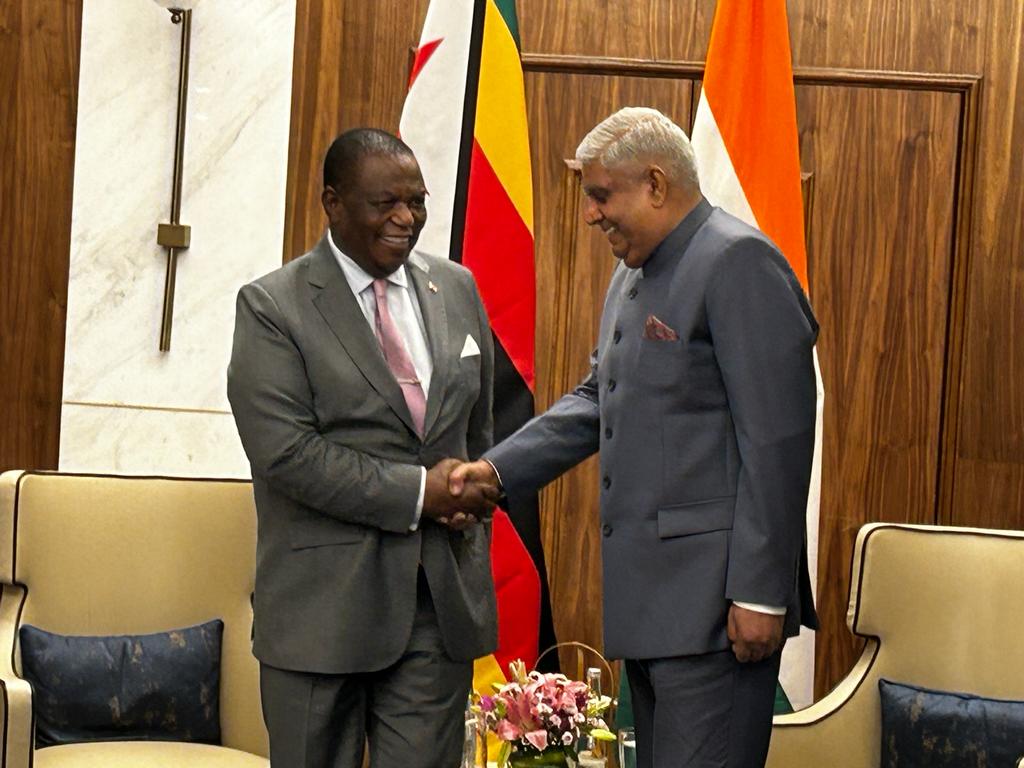
Africa Moyo in NEW DELHI, India
The 18th Confederation of Indian Industry-Exim Bank Conclave on India-Africa Growth Partnership ended here yesterday, with Vice President Dr Constantino Chiwenga saying it was a success and will bring tangible outcomes to Zimbabwe as they were in line with the National Development Strategy 1.
Under the NDS1, which runs from 2021 to 2025, Zimbabwe seeks to accelerate economic development through deliberately leveraging the country’s competitive advantages, particularly with regards to the configuration of natural resources, excellent ecological endowment and the great skills base; good corporate governance; domestic resource mobilisation, and pursuing the engagement and re-engagement drive.
All that is aimed at ensuring economic stability and the rolling out of massive infrastructure targeting key enablers such as roads, airports, dams for irrigation and energy generation, for a prosperous and empowered upper-middle income society. VP Chiwenga was speaking during the closing ceremony of the India-Africa conference.
He said the discussions that took place from Wednesday until yesterday, were thought-provoking and would spur Zimbabwe to greater heights.
All the sessions demonstrated a win-win methodology that Indians and Africans could adopt and deploy to promote socio-economic development for mutual benefit, said VP Chiwenga.
“The 18th conclave was successful and is testimony of the flourishing Indo-Africa ties anchored through partnerships in trade and entrepreneurial initiatives,” he said.
“As is widely known, development in Africa offers many opportunities in investment finance, infrastructure, manufacturing sector and information communication technology sectors.
“As such, the sessions on India-Africa health partnership, trilateral cooperation, among others, have been key in addressing the continent’s challenges.
“These sessions also provided a firm foundation for Africa’s achievement of the African Union Agenda 2063, and Southern Africa Development Community’s Vision 2050.”
VP Chiwenga said for Zimbabwe, the discussions were in line with the National Development Strategy 1 (2020-2025), which is the first five-year medium-term plan aimed at realising the country’s Vision 2030 of achieving a prosperous and empowered upper middle-income society by 2030.
Of particular interest, said VP Chiwenga, are the proposed new models of financing such as the Build-Own-Operate and Transfer and Build-Operate and Transfer, which will be instrumental in spurring sustainable and win-win economic development for India and Zimbabwe.
VP Chiwenga said harnessing digital technologies and innovation will transform Africa’s societies and economies.
“Apart from promoting Africa’s integration, the digital technologies generate inclusive economic growth, stimulate job creation, erase the widening digital divide and eradicate poverty,” he said. “In sum, these technologies help Africa in securing the benefits of the digital revolution for socio-economic development.
“They provide new solutions and, where there is appropriate infrastructure, skills, and services; these can be incredibly powerful in transforming education, healthcare, and the way we do business.”
The session on India-Africa health partnership was enlightening, he said, adding that India’s health care industry that has advanced infrastructure, technology, accessibility, and affordability, was an example of a modern health system.
VP Chiwenga implored African governments to greatly consider providing incentives which facilitate the Indian healthcare industry to work smoothly in Africa.
“Indeed, Africa-India health partnership is the way to go. Thus, the Indian public and private sector are encouraged to harness these opportunities to enhance digital transformation, agriculture, health and energy sectors,” he said.
Through working together, said VP Chiwenga, development was possible.
India has said that progress in the world is contingent on the development of the Global South, and VP Chiwenga said it was important to “capitalise on each other’s strengths to promote socio-economic growth in our countries”.
For the Zimbabwean delegation, the conference was particularly impressive after they engaged several business people who expressed a desire to take up investment opportunities in various sectors of the economy.
Importantly, the US$81,2 million deal to recapitalise the National Railways of Zimbabwe (NRZ), which had failed to materialise for some time due to challenges, was eventually signed and sealed during the India-Africa conclave.
NRZ will now get 315 wagons and nine locomotives from RITES, a company owned by the Indian government, and breathe life into the national bulk carrier.
The Gambia Vice President Muhammad Jallow expressed satisfaction with the engagements his delegation had with potential investors.
DRC Deputy Prime Minister Vital Nkingi said he held “important discussions” with investors, with a lot of them expressing interest in adding value to bananas, venturing into the production of liquid fertilisers while three Indian vehicle manufacturing companies, expressed interest to set up plants in his country.
India Minister of State for External Affairs Shri Muraleedharan said the conclave provides opportunities for partnerships, but said it was critical that the relations established be “taken to the next level”.
“We need to examine and implement these relations,” he said.
The India-Africa conference ran under the theme, “Creating Shared Future”.



 Online Reporter