admin
admin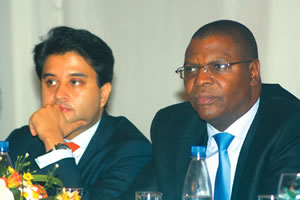
co-operation.
Minister of State for Commerce and Industry for the Republic of India Mr Jyotiraditya Scindia made the pledge yesterday at the Zimbabwe Business Conference in Harare.
Yesterday’s conference sought to explore trade and investment opportunities and challenges in Zimbabwe for Indian investors.
But the delegation from India said the early ratification of the bilateral investment protection and promotion agreement with Zimbabwe was critical for fast-tracking India’s investment in this country.
Mr Scindia said his country was ready to assist Zimbabwe rebuild its fragile economy through increased investment, technology transfer and capacity-building.
He said this could jolt the steadily growing trade between the two countries, which grew from about US$60 million in 2009 to about US$125 million in 2010.
Mr Scindia said India was interested in mining, agriculture, manufacturing, infrastructure, power and energy, ICT and the services sectors.
Opportunities also exist in healthcare, e-governance and education.
India exports transport equipment, motor vehicles, chemicals, pharmaceuticals and machinery to Zimbabwe while the latter exports nickel, diamonds (precious stones), dyes and non-ferrous metals, among others.
“The Indian Government desires to work with the Government of Zimbabwe in infrastructure and technology industries. For instance, in the area of development of rail infrastructure, we have tremendous expertise.
“We are happy to share our experience and success with the Government of Zimbabwe. Mineral sector growth is of interest to India and Zimbabwe,” he said.
India pledged to assist with technology transfer in the diamond-cutting and polishing industry.
India cuts and polishes 90 percent of global diamonds and accounts for 60 percent of global diamond trade by values.
Mr Scindia said Zimbabwe presented immense opportunities for investment and premium returns, being part of the world’s last frontier markets.
Against this background, he said, Zimbabwe would benefit from India’s US$5 billion investment for Africa, US$700 million institutional capacity building fund and India’s education programme for 22 000 Africans.
But Mr Scindia said the bilateral investment protection and promotion agreement signed with Zimbabwe in 1999 was not an end to ensuring Indian investment, but also crucial for enhanced investment co-operation.
Indian firms, such as Essar Global Limited, own a 54 percent shareholder in NewZim Steel, while Medex Global is a 50-50 joint venture partner in Surface Investments.
They bear testimony to the potential for improved economic co-operation.
With South-South cooperation showing significant growth, accounting for 20 percent of India’s global trade (by value), Zimbabwe believes growth opportunities lies in Asia, Latin America and Africa.
India is now a major foreign direct investor in the world, recording US$80 billion outbound FDI last year against inward FDI of US$198 billion.
The US$1,6 trillion economy is the fourth largest in the world by power parity ranking (according to World Bank, June 2011) after the United States, China and Japan.
Head of the Indian delegation to Zimbabwe Mr Sanjeev Agarwal agreed that economic ties between the two countries could only get better with time.
“It is encouraging to see that India’s engagement with Zimbabwe has been growing at a rapid pace. Our confidence stems from the fact that there is huge unexplored potential between the two countries. There is scope for significant diversification of the import and export basket,” said Mr Agarwal.
Industry and Commerce Minister Welshman Ncube said Government had created the right macroeconomic environment appropriate for foreign investment, adding that there was extensive latitude to boost trade with India


 Online Reporter