Chronicle Editor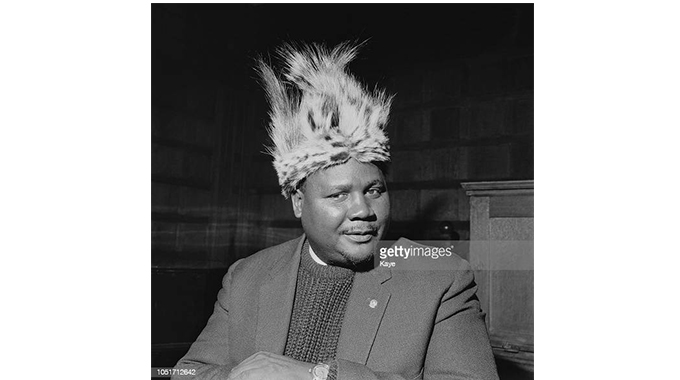
Pathisa Nyathi, Feature
OF late the media has been awash with animated stories pertaining to African staffs particularly those that belonged to political leaders. Induku/tsvimbo are buzz words. The first of July, being a day when we focus the spotlight on Joshua Nkomo, I thought it expedient to write about ideas that are resident in the staff, those of a ceremonial nature.
It does appear there is associated political and spiritual power and potency when it comes to induku/tsvimbo and its possession.
What is the story behind the attendant beliefs? In this article, which is an extension of the one on Joshua Nkomo as a cultural person and nationalist we have decided to focus the spotlight beyond the sensational narratives and bring forth African ideas on the subject.
It all starts with the ubiquitous free-standing stone pillars. It is the perceptions of these which ultimately explain and interpret the symbolism, meaning and interpretation of tsvimbo/induku. The stone pillars in question have been venerated as a result of associated symbolism and metaphor. There are two complementary parts that need to be observed.
First, it is the stone pillar, whose form is cylindrical and regarded as symbolic of a phallus, the male sex organ. The single stone pillar emanates from the ground, read earth, which is perceived as female. The stone-pillar-in-hole is a powerful metaphor in terms of sexuality, that biological process which is behind continuity, perpetuity, eternity and endlessness of the human race. “Individuals perish, humanity is forever,” I said once upon a time.
There is thus associated spiritual power and potency in standing or erect stone pillars. That power was associated with patriarchy, patrilenearity and masculinity. However, it should not be assumed that induku/tsvimbo was used only in Africa. Ancient minds shared a common worldview and ideology. European Kings too had these staffs fashioned out of various materials. When power shifted to the houses of parliament, the sceptre symbolized the same idea. It was carried ahead of parliamentarians and placed prominently within the parliamentary chamber.
The metaphor, whichever way we look at it, has to have the two components and indeed, as we shall see, that is true when one holds the staff in one’s hand. Before proceeding with the story, let us see the common ground in the objects that represent cylindricality and hence the male sex organ with its perceived power and potency, the basis of authority and rulership. The stone pillars are standing, or erect and that alone has a message. Have you not seen the San rock art where male figures have their manhood erect? Erection in the natural/biological process of procreation is a sine qua non.
A look at Great Zimbabwe reveals a whole phallus in stone passing for the conical tower. It is anatomically accurate as it is provided with two stone structures that complement the cylindrical part, the cultural metaphor for the male sex organ regarded culturally as the source of power. In order to render a complete biological picture as expressed culturally, the conical tower was built within a gigantic circular enclosure which is symbolic of the female sex organ.
The picture is complete and it symbolizes power emanating from sexuality which leads to the continuity of the human race.
At Stonehenge a similar chalk carving of the phallus was unearthed. The meaning is the same. To Africans, sexuality is a powerful force. For example, as narrated to me by Farai Chabata, nodules from an iron smelting site were spread in a crop field to render the field productive that is, endowed with fertility/fecundity. The iron smelting arrangement is symbolic of sexuality. There are male and female sides to it. It is a significant site that is infused with fertility.
Whereas there are male and female components in a world characterized by patriarchy, it is the male side that was given greater prominence and link with power. Tsvimbo/induku therefore is symbolic of the male sex organ. Indeed, it has some knob in its structure. Of course, its form is deficient that is, short of comparative anatomical accuracy.
There ought to be two representative knobs to accurately complete and therefore compare with known anatomy.
With one knob and not two, tsvimbo/induku all the same expresses and represents a male sex organ with attendant perceptions in terms of power, potency, energy and strength.
Now this should suffice as background knowledge and ideological underpinnings behind ascribed power in the male sex organs. The tree from which wood is cut is cylindrical and standing, erect. A “sleeping” tree trunk is unsuitable even if perfectly cylindrical as it lacks “erectile” power. The tree trunk, once cut, must be carved in such a way that it has some knob, induku. This is what is done in order to give it the necessary qualification as an artefact that is representative of and is endowed with potency as understood in the natural world of procreation.
The spiritual tsvimbo/induku undergo spiritual infusion after they have been fashioned out. The next stage complements the structural one which is perceived as having power by virtue of the symbol and metaphor that it represents. Augmentation is the next stage. Whoever is the spiritual person now infuses spiritual power into it. That intervention raises its stake as a powerful artefact, one that is beyond a mere structural or material object.
All this adds up to heightened and added power beyond the material. It is one thing to have a material or physical artefact in the form of induku/tsvimbo and quite another to have one which has undergone final transformative manipulation into an artefact that is endowed with spiritual power. It is such attendant beliefs that have led to animated interest in the induku/tsvimbo.
Let us add some icing to the tsvimbo/induku cake. We observe particularly in Southern Africa that women did/do not carry tsvimbo/induku, be they ceremonial/ritual or of the type used in hunting and fighting. Tsvimbo/induku has been associated with men in patriarchal societies. Spiritual women characters have been an exception. It is not them holding the staff by the way, but rather the male spirit of which they are the medium. Similarly, a male wosana will wear black female attire by virtue of being a medium for a female spirit.
Much as that is the case, let us look at what happens when a man carries the staff Nkomo style. The tsvimbo/induku, as explained above, is a representation of the phallus. When it is held in one’s hand, the fingers and the palm execute a clasping position/shape which, in representational and metaphorical terms, is female. We therefore end up with the very old metaphors exhibited through stone pillar-in-hole, wood-in-hole, conical tower-in-great enclosure (at Great Zimbabwe). The image in all the given instances is the same, one that encapsulates and expresses sexuality with its associated spiritual power that men seek to rule the people.
Even the parliamentary sceptre itself is no exception. It is not placed on a flat surface. Rather, it is held in cupped structures that symbolize the female component. The two, cylindrical sceptre and the cupped resting hands remain in symbolized in eternal erotic encounter. The ideas that are being expressed have come down the generations from the ancient societies. In a nutshell, this is the story of tsvimbo/induku. I love Africa and her messages that continue to baffle, elude and confound her children.
Last Thursday marked the 22nd anniversary of his death.


 Online Reporter