Online Reporter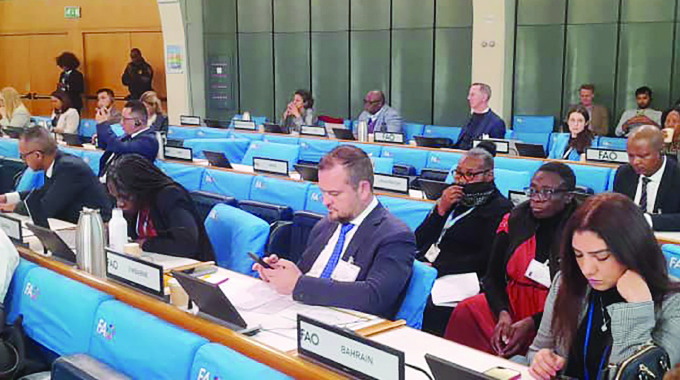
Theseus Shambare recently in Rome, Italy
INNOVATION, key partnerships and collaborations have been real anchors in driving Zimbabwe’s response to climatic shocks and remarkable progress towards food and water security.
Lands, Agriculture, Fisheries, Water and Rural Development Deputy Minister Vangelis Haritatos made these remarks during the 53rd Session of the Committee on World Food Security (CFS 53) in Rome, Italy, where Zimbabwe presented its integrated food and water strategy before hundreds of delegates drawn from governments, international organisations and development partners.
Running under the theme, “Building Resilient Food Systems for a Changing Climate,” the high-level session focused on practical solutions to global food security challenges through responsible investment, sustainable land use and climate adaptation.
Deputy Minister Haritatos said Zimbabwe’s story was one of resilience, innovation and determination underpinned by strong leadership from President Mnangagwa.
“Zimbabwe is a nation deeply connected to the soil,” he said.
“Our story is one of resilience, innovation, and an unyielding determination to transform our agricultural landscape in the face of climate change.”
He said the country had endured multiple climate-induced challenges that had threatened livelihoods, with droughts now occurring every three to four years instead of every seven years as experienced in the past.
“Our population of about 16 million requires roughly 2,2 million tonnes of cereals annually, and 70 percent of our people depend on rain-fed agriculture,” he said.
“This has left smallholder farmers vulnerable, but we have refused to be passive victims.”
To counter these threats, he said, the Government has implemented the Agriculture and Food Systems Rural Transformation Strategy (AFSRTS) — a master plan guiding sustainable production, food system development and resilience building.
Deputy Minister Haritatos said under the strategy, Government launched the Rural Development 8.0 Programme, a holistic model that integrates agricultural growth with rural industrialisation and water development.
“Its eight pillars — from climate-proofed inputs and borehole drilling to fisheries, livestock and cotton schemes — are creating diversified and resilient rural economies,” he said.
Deputy Minister Haritatos said over 3,5 million households were benefitting from the Presidential Input Support Scheme, which distributes climate-adapted inputs through the
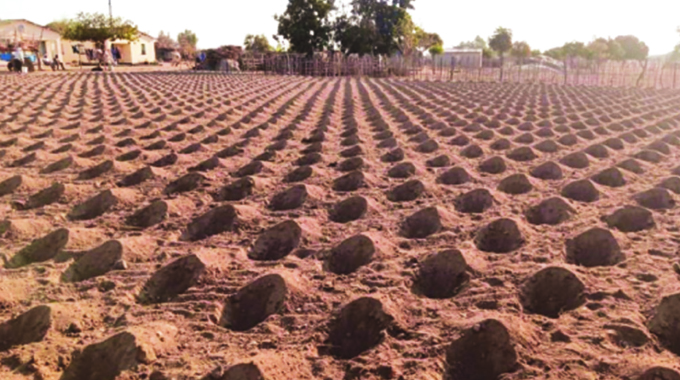
/Intwasa concept — a conservation agriculture model that improves soil moisture retention and productivity.
Zimbabwe has also adopted agro-ecological zoning, promoting traditional grains like sorghum and millet in drier regions while maintaining maize production in wetter areas to strengthen national food security.
At national level, Deputy Minister Haritatos said the country was implementing the Accelerated Irrigation Rehabilitation and Development Plan, targeting to expand irrigable land from 221 000 hectates to nearly 500 000ha.
“To finance this, we established the Irrigation Development Alliance — a consortium of public, private and development partners — to drive large-scale irrigation projects such as the Lowveld Green Zone,” he said.
Deputy Minister Haritatos also highlighted the National Enhanced Agriculture Productivity Scheme (NEAPS) as a model of effective public-private co-operation that has strengthened key value chains for maize, wheat, soybeans and livestock.
“Since the advent of the AFSRTS, our agriculture sector has grown from a baseline of US$5.2 billion to US$10.3 billion. We are now wheat self-sufficient — one of only two nations in Africa to achieve this feat,” he said.
Deputy Minister Haritatos said food insecurity had dropped from 56 percent in 2020 to 15 percent in 2025 — a 73 percent reduction — demonstrating the success of climate-smart interventions.
The success and methodologies presented by Zimbabwe directly aligned with the key global messages delivered by Mr Máximo Torero Cullen, Chief Economist of the Food and Agriculture Organisation of the United Nations (FAO), who presented the 2025 State of Food Security and Nutrition in the World (SOFI) report at the Plenary Session.
Underlining the necessity of such national efforts, Mr Torero stated: “Ending global hunger and building resilient agrifood systems requires innovation, investment and international partnership.”
He further reinforced the Deputy Minister’s focus on innovative solutions and collaboration, concluding: “Innovation and partnerships are central to transformation.”
Deputy Minister Haritatos concluded his address on a forward-looking note that echoed the FAO’s call for continued collective action:
“Our journey is far from over, but our direction is clear, our resolve firm and our partnerships strong,” he said.
“Together, we will continue to build resilient food systems and secure a hunger-free future.”