Online Reporter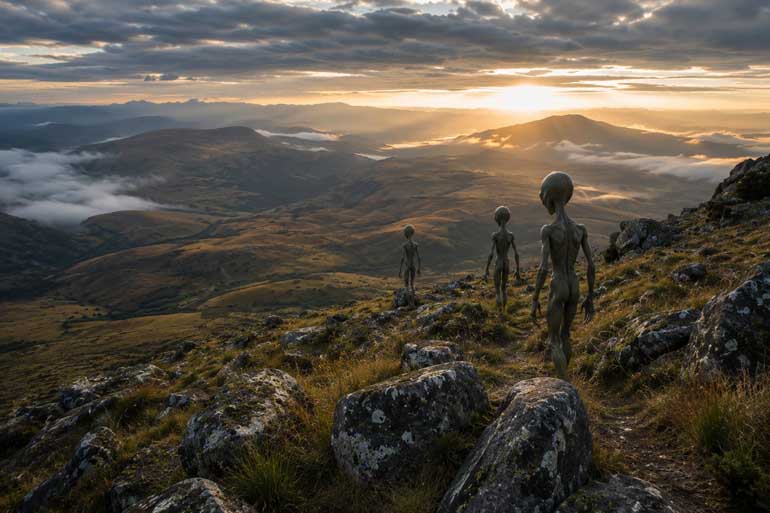
(Part One)
Lloyd Makonya
Correspondent
MIST curls around the jagged ridges of Nyanga Mountain as dawn breaks over Zimbabwe’s Eastern Highlands.
To hikers, it is a place of breathtaking beauty.
To local communities, it is a sacred landscape woven into ancestral memory.
Yet to a growing number of Unknown Foreign Objects (UFO) enthusiasts worldwide, Zimbabwe’s highest peak may conceal something far more extraordinary: an underground extraterrestrial base.
The latest claims come from former United States Army intelligence officer and remote viewer, Mr Lyn Buchanan, who recently reignited global fascination with the mountain during an appearance on the American Alchemy podcast.
Mr Buchanan, who took part in the controversial Cold War-era Stargate Project, alleged that remote viewers linked to the CIA-backed programme identified four subterranean extraterrestrial installations around the world.
One of them, he claimed, lies beneath Nyanga Mountain.
According to Mr Buchanan, the Nyanga site functions as a maintenance facility where unidentified flying objects undergo repairs before continuing their journeys.
He further alleged that remote viewers such as Mr Pat Price and Mr Joe McMoneagle had perceived humans and extraterrestrials working together at some of the locations.
Remote viewing is a highly disputed practice lacking verified scientific evidence.
The assertions have sparked widespread discussion locally and internationally. Yet for many Zimbabweans, the mysteries surrounding Nyanga Mountain did not begin with American psychic spies.
They have endured for generations.
Standing at 2 592 metres above sea level, Nyanga Mountain dominates Zimbabwe’s Eastern Highlands.
The mountain’s rolling grasslands, escarpments and sweeping vistas attract hikers, photographers and nature lovers year-round. But Nyanga has another reputation. Its slopes are synonymous with unexplained disappearances, spiritual encounters and enduring questions that resist easy answers.
Dense mist can descend without warning, swallowing footpaths and obscuring familiar landmarks.
Valleys disappear beneath blankets of cloud. Weather shifts rapidly.
For some, Nyanga inspires awe. For others, fear. Among the most widely remembered cases were the disappearances of the Masaya twins, daughters of former Cabinet Minister, Dr Tichaendepi Masaya.
In 1981, the girls vanished on the mountain. Despite extensive searches, they were never found. Their disappearance became etched into Zimbabwe’s national consciousness, reinforcing the belief that Nyanga Mountain is no ordinary place.
Another reported case involved Robert Ackhurst, a schoolboy from Banket Junior School who mysteriously vanished on November 22, 1984, during a field trip to Nyanga Mountain with 20 other learners and his teacher, Mr Peter Hastings.
Despite massive search efforts, no trace of him was ever found, cementing the mountain’s lore as a place where hikers disappear.
Then, on January 4, 2014, the mountain again captured global attention.
Mr Zayd Dada, a 31-year-old Zimbabwean businessman of Indian descent, disappeared while hiking Nyanga Mountain with friends.
Reports indicated he had gone ahead while others rested. What followed was one of the most extensive search operations in recent memory.
Police, soldiers, park rangers and volunteers combed the mountain. Helicopters surveyed the rugged terrain. Traditional leaders and spirit mediums were reportedly consulted as hope gradually gave way to uncertainty. No trace of Mr Dada was ever found.
Ironically, that same year another incident added to Nyanga Mountain’s mystique, though with a different outcome.
A DREAM expedition to Zimbabwe, funded through Oxford University’s Wallace Watson Award Lectures travel grant, nearly turned tragedy for 20-year-old British student, Mr Thomas Gaisford.
The second-year Human Sciences student had travelled to Zimbabwe to undertake a challenging expedition aimed at developing resilience, self-confidence and a deeper appreciation of different cultures.
After deciding to hike alone on Nyanga Mountain, Mr Gaisford found himself caught in the mountain’s notorious unpredictability.
Recounting his ordeal, he described a harrowing experience near the summit, narrowly avoiding becoming another name linked to Nyanga’s enduring mysteries.
He said heavy fog engulfed him from around 3pm. He subsequently lost his way down the mountain, and he pitched up a tent.
He slept in fear, confusion and anxiety under heavy rains. He met several snakes and nocturnal animals that he never dared disturb.
“I had heard lots of strange stories about the mountain, but I never believed them,” said Mr Gaisford.
“I climbed to the summit of the mountain. It was very difficult, but I endured up to the top. I was caught in a mist as soon as I reached there. I started getting uncomfortable and scared after heavy rains started falling. The fog engulfed the whole place I was, and surprisingly it was in the afternoon, around 3pm. I could not see anything. I was confused. I lost my way down and pitched a tent. I prayed and slept there for 10 hours. Several scary snakes approached me. I never disturbed them. They came in numbers, but I stood still. Various animals frequented the place, and I could see shining red eyes of several animals staring at me.
My character was tested. I remained steadfast. I woke up the following morning after the fog had cleared. I climbed down before I proceeded to Leopard Rock on foot,” he said.
For families left behind, such mysteries are not folklore. They are unfinished stories marked by grief and unanswered questions.
Long before extraterrestrial theories entered public discourse, communities living around Nyanga had their own interpretations of the mountain’s mysteries.
Many regard it as sacred.
Stories passed down through generations speak of ancestral guardians associated with particular areas of the landscape. Visitors are often cautioned to conduct themselves respectfully, avoid unnecessary noise and heed local advice.
Such beliefs are sometimes dismissed as superstition. Yet anthropologists increasingly recognise that indigenous knowledge systems often encode practical lessons about environmental risk and responsible behaviour.
To be continued next week . . .