admin
admin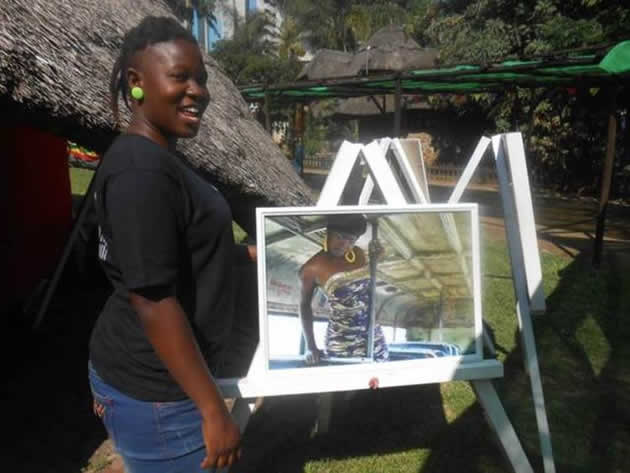
At the Gallery
Mbereko is the sling carrier used by women to carry a child on the back here in Zimbabwe and other parts of the world.
The most astounding element about Mbereko is the fact that it is commonly a stretch of cloth; full of colour, pattern and life, wrapped around a woman’s torso to create a nesting link between herself and her baby. In some cases, the Mbereko is just a drab towel bearing no beauty however, carrying and sustaining life all the same.
This January the National Gallery of Zimbabwe sets the stage for upcoming Photographer, Nancy Mteki to present her incise look at these “Carriers of Life” with exploratory ventures into the life of women and their infant children in most diverse locales.
The National Gallery of Zimbabwe (NGZ) sat down with Nancy Mteki (NM) to discuss her exhibition entitled Mbereko and her fascination with childhood development through playtime.
NGZ: This exhibition is a culmination of your Residency in Scotland. What was the run-up to that (residency) and who are the foremost players in this project?
NM: The project was initiated as a result of winning a grant at the 2012 Dakar Biennale. The grant sponsored my residency in Huntley, Scotland. The Grant was from an organisation called Deveron Arts who alongside the African Art Trust saw toward the build up of Mbereko.
NGZ: This is your first solo exhibition. What do you hope your audience will walk away with after viewing your show?
NM: I think they will learn that Art has no boundaries.
NGZ: I see in the text there is reference to toys. Why the fascination with toys?
NM: The conception of this exhibition did not include toys, even in the most remote way.
The toys revealed a conditioning process to me that they can either develop a destructive or a constructive state of mind in the child. There was this child I met there (Scotland) who had a playroom full of toys and books. The interaction she had with my own daughter was so sound and positive because, as I noticed, there were no guns or bombs. It was all doll-houses, dolls, fairy-tales and building blocks.
NGZ: One of the photographs details Scottish women making use of Mbereko sling carriers. What effect do you aim to achieve with this culture clash?
NM: I think it entailed the whole process of Cultural Exchange. It all started when we all decided to go shopping one day and took our children along. As I am naturally accustomed to Mbereko, when the time came to carry our groceries, I realised my daughter, Kayla was tired and needed a piggy-back ride. I then bought a body towel (they did not have large ones) and proceeded to wrap Kayla in the common way. My colleagues were surprised by this but with time started to follow suit and even started suggesting we take walks “takabereka”.
NGZ: How did your subject matter respond to the notion of applying a technique that was purely foreign to them and what effect did it have upon them and the babies?
NM: It connected them to their children. They used prams of course but I guess that has a dormitory effect. Mbereko is an interpersonal link so to speak, it represents shared warmth between mother and child and they felt comfortable sharing this experience. You could say it connected them to their children.
NGZ: The female experience is widely explored through your body of work. Do you feel motherhood is the single phenomenon that unifies women universally (or is it summed up to simply summed up to the way an individual experiences it)?
NM: Being an Artist and a Mother is one thing to me. I am always puzzled when female Artists (some of them colleagues) get married and suddenly warp out of their career on the premise of vouching for their families. I believe in the individual having to express themselves or pursue their dreams through the best means possible. I love being myself.
NGZ: On the 12th of February you have organised a Mother & Toddler Day. Who should come?
NM: Mothers. Sadly the event will be strictly by invitation. There will be a nurse in attendance and her purpose will be talking about children’s health issues.
I will also introduce the idea of a “Travel Rag” whereby a piece of material is embroidered with objects from a child’s time-line such as ultrasound scans, clothing, pictures and the like.
NGZ: What do you aim to achieve in the long run?
NM: I would like to re-explore these mothers (and my) progress after five years or so. It will be a map of alternate lives documented through the journey of this travel rag which may easily double as Mbereko
NGZ: Both your father and grandfather were renowned sculptors. What made you interested in Photography?
NM: In 2007 my father (sculptor Richard Mteki) taught me to sculpt and I gained confidence thereafter moving to Cape Town, with the intention of teaching sculpture there. I learnt that none of the stone common here was present there so I took to being a waitress to make ends meet. One day I was coming from work and saw some great photographs that happened to be by Buyaphi Mdledle.
We met after that and he introduced me to a group of passionate photographers. These people were not a school or any of that but just had a deep love for photography that was contagious. After that I entered some of my work in the Cape Town month of Photographers and then later on entered Gwanza. That is the path I chose to take and am enjoying up to now!
NGZ: Do you think Photography is getting the platform it deserves on the Contemporary Art scene?
NM: No. Opportunities are only available with international residencies such as the one that Mbereko is conclusive of. In relation to Art exhibitions, my work usually lands outside the criteria guide of these shows therefore I get work into less than ten shows a year, which really does clog my output.
NGZ: Do you believe ‘selfies’ have killed Photographic practice?
NM: Definitely, the world is flooded with images with lack of practicality and an over-infusion of vanity.
It is fine to take a self-portrait but it becomes a problem for this to become the standard mode of photography. I guess with technological advances and the like, people know the side of the lens they are most comfortable with.
NGZ: Do you have any hopes that the artistry in your family could run into the fourth generation?
NM: I would really love that. My daughter shows a lot of interest in my work and in art around her.



 Online Reporter