admin
admin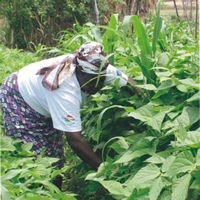
Gender Vaidah Mashangwa
According to the book, She Chimurenga, women constitute 70 percent of the people living in the rural areas. As such the issue of land is one that touches their survival and livelihood to the core. It is unfortunate that while the issue has been discussed at various fora, women’s access to land and other means of production remain critically low. Even when government subsidies and the mechanisation processes are in place very few women benefit from such processes.
It must be understood that women are the farmers, who grow crops and till the land while their male counterparts are in formal employment in towns and cities. It means therefore that the food security in Zimbabwe and other nations is largely dependent on production by women on the small-scale farms as well as the commercial farms. Farm labourers are usually the women too.
In 1993, submissions by women to the Land Tenure Commission (the Commission was established by His Excellency President Robert Mugabe to examine the appropriateness of each of Zimbabwe’s land tenure systems) were that land rights be offered regardless of women’s marital status and get to establish a quota system for women who needed land in all sectors. The women also called for gender representation at all levels of decision-making to ensure gender sensitivity. They also called for the redefinition of households to mean both spouses and leases to be registered in the name of both spouses where applicant is married.
The Constitution of Zimbabwe is clear in terms of gender parity in ownership of resources including land. However, representation of women in Land Committees and decision-making positions is still low. Women issues ought to be articulated by the women themselves.
Apart from that, there is also less investment in rural farming compared to commercial farming. Access to financial services contributes to economic growth and poverty reduction yet this is restricted in a rural setting. The other reason being that financial constraints in rural areas involve higher transaction costs due to greater spatial dispersion of production, quality of infrastructure and the seasonality of rural production activities. It is this low financial support that has fuelled poverty among some rural farmers who are mostly women.
The other limiting factor to increase women income and production levels is lack of well-functioning agricultural markets especially in the rural setting. Availability of markets for women farmers ensures food security. Quite often, women are seen standing along the highways selling water melons, sweet potatoes, fresh vegetables and so on. Improving infrastructure for markets in the rural areas might help ease such problems.
Efficient agricultural markets link farmers and trades to consumers and small holder farmers to domestic and international agricultural value chains. Most women farmers are also affected by price controls of some farming produce. At times they do not receive the price signals in time so that they can adjust their production to meet preferred market supply changes and demands. Knowledge of agricultural prices for various produce enables the farmers to grow the right crops that also meet consumer preferences.
Most of the women farmers also lack technological innovation and training in the newer methods of farming, soil fertility and other methods of increasing production levels. Production levels are further compounded by climate change and growing water scarcity and women farmers in the rural areas lack such knowledge. There is need for women to adapt in line with these changes.
Therefore agricultural extension services provide vital support for women farmers to increase their productivity. The outreach of these services is often inadequate and women are likely to miss out more often than men. In Ghana for example, 12 percent of male headed households compared to 2 percent of female headed households reported receiving extension services.
Women farmers at times fail to establish relationship with buyers who are in most cases males. At times they have problems with transport, restrictions on mobility and have lack of time to transport their goods due to unpaid work burdens. Most constraints in the agricultural sector heavily affect women farmers more than their male counterparts.
Laws that establish equal rights and rights to ownership of resources for men and women provide a solid foundation and indeed a precondition for achieving gender equality. However, in the rural areas there is a tendency of excluding women from land committees where women can also raise their concerns. Whenever government has subsidies, it is mostly the men who give out the information and who also do the distribution of inputs like seed and fertilisers.
There is need therefore to dismantle these structural barriers as well as discriminatory social norms and gender stereotypes so that women are part of all developmental processes. There is a great relationship between gender equality and economic growth. More equality is positively related to Gross Domestic Product (GDP).
Supporting women farmers results in greater economic performance and enhances individual productive capabilities. The World Bank also examined this relationship and concluded that improving gender equality is “smart economics,” that is, it contributes to growth and economic development.
Gender budgeting is also one important government initiative to ensure that decision-making processes on policies and budget are more democratic, participatory and responsive to the needs and demands of marginalised women and their communities, including women farmers. This is also important in particular sectors such as health, education, water and agriculture. It is unfortunate that poverty in most countries dwells among the widows, female-headed homes and in some of the families where a male figure is ‘absent.’
Vaidah Mashangwa is the Bulawayo Provincial Development Officer, Ministry of Women Affairs, Gender and Community Development. She can be contacted on cell: 0772 111 592, email: [email protected] <mailto:[email protected]>


 Online Reporter