

 admin
admin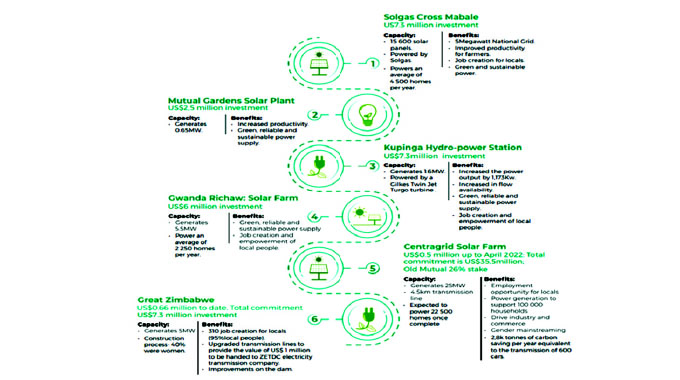
Business Reporter
In recent years, there has been a steady shift towards use of renewable energy sources. This change has been driven by a collective effort to reduce reliance on fossil fuels and reduce carbon emissions, which contribute to climate change.
As a result, there has been significant investments into renewable energy globally, which not only benefits the environment but also the economy and society as a whole.
Many corporations around the world have adopted more sustainable methods of operations in the global effort to reach net-zero carbon emissions by 2050. Locally, Old Mutual Zimbabwe Limited (OMZIL) is one of the companies that has been carrying out projects in renewable energy and has so far invested significantly in this space.
The company is setting up a US$100 million infrastructure fund to support several economic development projects, mainly those in renewable energy and will set aside a sub-fund of US$30 million for supporting renewable energy projects.
The primary goal for the fund is that it is going to be a platform for OMZIL to harness capital for funding renewable energy projects in various forms and various sectors.
OMZIL’s CEO Samuel Matsekete said their Responsible Business Approach is set at a group level and aligns with and supports the group strategy.
He noted that it is informed by an understanding of the expectations of their customers, the societies, and the communities they operate in, along with an awareness of the growing environmental and social crises our planet is facing.
“As part of our quest to keep doing great things always, we are excited to be involved in key national renewable energy projects, some of which are already contributing energy to the national grid. We commissioned a US$2,5 million solar plant at the Mutual Gardens Head Office in Mount Pleasant, Harare in November 2021.
“The solar plant generates 0,65MW of solar power for the Mutual Gardens Office Complex. We also commissioned the Solgas Solar plant in Hwange in November 2021 which we financed to the tune of US$7,3 million, in partnership with Solgas Private Limited,” he said.
The Solgas Solar Plant is already feeding 5MW of clean energy into the Zimbabwe Electricity Transmission and Distribution grid. Another renewable energy project the group invested in is the 1.6MW Kupinga Hydro Power Station in Chipinge which was financed to the tune of US$5,7 million.
OMZIL is also working on the central grid power plant in Nyabira, which is a 25MW photovoltaic solar power plant being financed at a total cost of US$35,5 million; and the Richaw Project, which is a 5MW solar ground-mounted PV located in Gwanda.
Looking at the benefits of renewable energy, it is quite understandable why OMZIL has invested significantly in it.
Firstly, renewable energy comes from sources that can be easily replenished like sunlight, wind, and water. Hence, investing in renewable energy is essential for the future because it helps to reduce dependence on fossil fuels and minimise the negative impact of greenhouse gas emissions on the environment.
Renewable energy sources like the ones mentioned above generate electricity without emitting harmful pollutants and greenhouse gases.
The shift towards renewable energy is also essential in the fight against climate change, which is one of the biggest threats facing the planet today. Investing in renewable energy technologies helps to mitigate the effects of climate change by reducing the amount of greenhouse gases released into the atmosphere.
Moreover, investments in renewable energy create jobs in various sectors of the economy, such as research, manufacturing, installation, and service. These jobs are not only essential in the economic growth of the country but also have a positive impact on society by providing livelihoods for people.
Renewable energy sources are most often found close to the areas where they are consumed, leading to more decentralised and localised energy systems. This can help to increase energy security and reduce dependence on foreign sources of fuels.
Investing in renewable energy is a key step towards a sustainable future, as it provides a more cost-effective solution in the long run. Once renewable energy plants are up and running, it is much cheaper to maintain the plants and generate energy compared to the costs of maintaining fossil fuel plants.
Mr Matsekete reiterated that as OMZIL, they are cognisant of the catalytic role played by energy in stirring industrial productivity for the betterment of the economy.
“Therefore, an unabated energy gap is detrimental to aspirations of the Vision 2030 which is premised on increased industrial and economic productivity,” he explained.
Taking a leaf from the first world
Renewable energy has been highly successful in many first-world countries. For example, in the United States, renewable energy has experienced tremendous growth over the past decade. In fact, renewable energy sources now generate more electricity than coal, and the country has set ambitious goals for further renewable energy expansion in the coming years.
Similarly, in countries like Germany and Denmark, renewable energy sources account for a significant percentage of the total energy mix. Germany, for example, has set a goal of producing 80 percent of its electricity from renewable sources by 2050, and Denmark has set a goal of becoming completely fossil fuel-free by 2050.
Overall, the success of renewable energy in first-world countries is largely due to a combination of supportive policies, public investment, and private-sector innovation. These factors have helped to drive down the cost of renewable energy technologies and make them more accessible to a wider range of consumers, businesses, and governments.
Hence, if done right, it is very possible for Zimbabwe to reach these same levels and do away with fossil fuels. Renewable energy is indeed the way of the future!
As part of its initiatives, OMZIL has also ventured into other responsible business investments, particularly in the agro-produce sector.
“SMEs and Entrepreneurs remain at the heart of Old Mutual Zimbabwe and we continue to include them in our initiatives to encourage their development.”
In 2022, OMZIL invested in existing Matanuska Banana Schemes, 75 percent of which are owned by women. A total of $300 000 was invested in the project and managed to reach 300 farmers. The company also ran two projects for sugarcane growers, selling their produce to Tongaat Hullets Zimbabwe and offering them the financial assistance they needed.


 leeroy
 Online Reporter