Online Reporter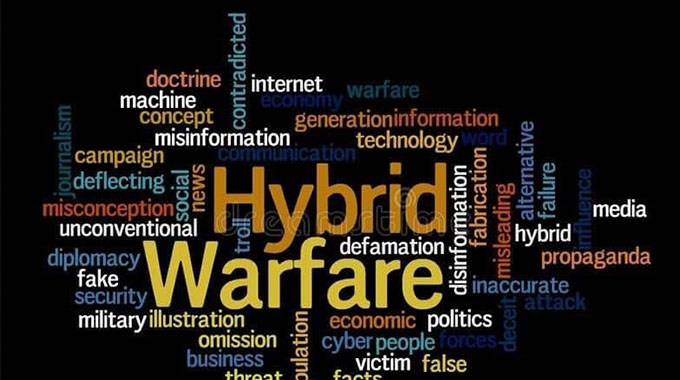
Nesbert Tafadzwa Madziwa
IN 2025-2026, Iran has witnessed widespread protests driven largely by economic hardships, inflation, and political stagnation. Many external analysts and Iranian officials alike have framed these upheavals as part of a broader “hybrid warfare” effort – where the United States and its allies allegedly attempt to weaken or topple the Iranian regime not through conventional military invasion, but via indirect economic, informational, and political pressures.
However, this hybrid campaign has not achieved its putative aims. To understand why, it is essential to unpack the strategy’s assumptions, Iran’s internal resilience and identity dynamics, and the regional geopolitical context.
What is “hybrid warfare”?
Hybrid warfare refers to the use of non-kinetic instruments – economic sanctions, information campaigns, support for dissenting groups, covert operations, and diplomatic isolation – to induce political change in a target state without full-scale military invasion.
In the Iranian context, this has included:
• Crippling economic sanctions aimed at depriving the state of resources and reducing public confidence in the regime.
• Narrative framing by US media and diplomatic channels portraying the Iranian leadership as illegitimate and disconnected from popular will.
• Alleged covert support for dissidents and groups outside official structures, intended to amplify internal grievances and escalate unrest.
Iran has long characterised Western pressure and unrest as a component of such a campaign. Iranian officials, including Foreign Minister Abbas Araghchi, have explicitly accused the US and Israel of instigating and backing riots and unrest, calling outside military intervention a “failed experience.”
Economic pressure not translated into political collapse
The US has indeed pursued economic strangulation as a lever of influence. Sanctions have weakened Iran’s economy for decades, contributing to inflation, unemployment, and currency instability. This form of coercive pressure aims to erode public support for the clerical state by making everyday life difficult.
Yet, protests in Iran primarily reflect domestic economic frustrations and political grievances, not a unified call for external intervention or regime overthrow. While sanctions exacerbate economic hardship, they do not automatically translate into a coordinated political movement with coherent leadership.
Unemployment and inflation are universal triggers for dissatisfaction, but in Iran the population remains deeply divided over what political transformation would look like and who should lead it.
Moreover, foreign interference as a frame has often bolstered nationalist sentiment. In recent protests, the government has successfully attributed unrest to foreign enemies, particularly the US and Israel, framing itself as defending Iranian sovereignty. This narrative resonates with Iranians who view external pressure as a longstanding threat to national dignity.
Religious and cultural factors as sources of resilience
The Islamic Republic is rooted in Twelver Shiʿa Islam led by the Supreme Leader, Ayatollah Ali Khamenei, and supported by a religious elite that situates governance within an Islamic framework.
This religious dimension is far from incidental; for many Iranians it is an intrinsic part of their worldview and social fabric, even if individual political views vary widely.
While many protesters reject specific policies or even the clerical leadership, an outright rejection of religion as a cultural pillar is far less widespread. The Iranian identity is layered – national pride, historical consciousness, religious rites, and opposition to foreign domination coexist in complex ways.
Thus, many Iranians perceive external attempts to destabilise the state as attacks not just on a political system, but on national and spiritual integrity. This helps explain why mass movements, even when widespread, have not resulted in regime change.
Myth of monolithic opposition or foreign-driven protest
Hybrid warfare assumes that social discontent can be harnessed into a cohesive movement to overthrow a regime.
In Iran, domestic protests are heterogeneous. They involve merchants angry at inflation, youths critical of political repression, intellectuals calling for reform, and ethnic minorities whose grievances are rooted in long-standing marginalisation.
There is no single united opposition capable of translating street protests into political power.
Additionally, recent “pro-government” rallies – large demonstrations organised by the state portraying support for the regime – have been widely reported and contested, with independent observers questioning turnout figures.
These organised rallies serve as narrative tools to show popular backing and dilute the impression of a society on the brink of collapse.
Strategic missteps and underestimations
A core flaw in the US hybrid approach has been underestimating Iranian resilience and misreading societal motivations. Sanctions and international pressure are blunt instruments; they compound suffering but do not inherently create conditions for political liberation.
Iran has also developed robust state mechanisms for countering external influence, which includes expansive security infrastructure – such as the Revolutionary Guards and Basij – tight control over communication networks, and an ability to disrupt information flows through internet blackouts, network throttling, and surveillance.
Beyond internal controls, Iran’s regional alliances with Russia and China provide economic and diplomatic ballast against isolation, further blunting the impact of Western pressure.
“Regional deterrent” factor
Iran’s geopolitical role complicates any external strategy aimed at its political transformation. Tehran positions itself as a counterbalance to US and Israeli influence in the Middle East – a point of pride for many Iranians across sectarian and ideological divides.
Its support for allied militias in Lebanon (Hezbollah), Iraq, Syria, and Yemen is part of this broader resistance posture.
Even for some critics of the Islamic Republic internally, Iran’s oppositional posture to Western hegemony is seen as a matter of sovereignty and dignity.
Hybrid warfare perceived as intertwined with foreign policy objectives thus risks pushing disparate internal critics into defensive nationalism rather than encouraging open embrace of foreign pressure.
Mosaic of miscalculations and resilience
The failure of a US hybrid warfare strategy against Iran is not reducible to a single factor, but a confluence of structural, cultural, and geopolitical forces:
• Sanctions have deep effects, but they have not produced a unified opposition capable of toppling the state.
• Religious identity and nationalist sentiment complicate narratives of external influence.
• Iran’s internal security apparatus and narrative control blunt protest capacity.
• Foreign framing of unrest often strengthens domestic resistance to perceived foreign interference.
A strategy that views Iran merely as a system to be toppled through pressure overlooks the country’s complex social fabric and the deep historical memory of foreign intervention – most notably the 1953 US-backed coup against Prime Minister Mossadegh.
Any attempt at reshaping Iranian politics must grapple with internal realities and cannot rely on the recycled blueprint of hybrid warfare alone.