Online Reporter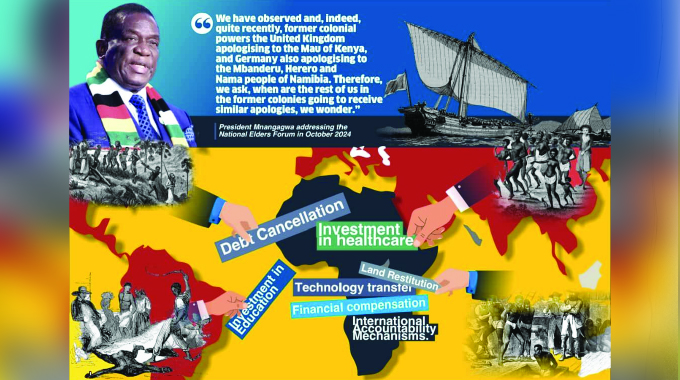
Ranga Mataire, Group Political Editor
THE African Union (AU) has declared 2025 the “Year of Justice for Africans and People of African Descent Through Reparations” — a bold demand for accountability from former colonial powers. For centuries, Africa’s people and resources were plundered to enrich others, leaving a legacy of economic devastation.
Now, the AU is making it clear: The time for empty apologies is over. Reparations are not charity — they are a long-overdue debt.
For decades, calls for reparations have been dismissed as impractical, with opponents arguing that those directly affected by slavery and colonialism are no longer alive. However, Africa’s push for reparatory justice is no longer fragmented. The AU is now leading efforts to develop a continental framework, consolidating existing campaigns and strengthening Africa’s position on the global stage.
The significance of this movement was underscored at the 38th AU Heads of State and Government Summit in Addis Ababa on 18 February 2024, which centred on the theme: “Justice for Africans and People of African Descent Through Reparations.”
The AU’s commitment to reparatory justice extends beyond symbolic recognition; it is an economic imperative aimed at redressing the enduring structural inequalities created by slavery, colonialism, apartheid and systemic discrimination.
Reparations can take multiple forms, including financial compensation, debt cancellation, investment in education and healthcare, technology transfer, land restitution and international accountability mechanisms.
African nations must demand restitution. This is not charity, but a rightful demand for economic justice.
What is the best way to do this? Some have pointed to the complexity of reparations given that generations directly affected by slavery are no longer here. The good thing is that Africa is sharpening its approach to this debate. In the past, Africa’s push for reparations was fragmented.
Today, African countries are seeking to consolidate ongoing campaigns. The AU initiative builds on decades of advocacy and collaboration to foster unity and establish concrete mechanisms for reparatory justice at a global scale.
Genesis of reparations calls
Reparations campaigns or calls can be traced back to the 18th-century civil society activism in the African diaspora. The campaigns have their roots in Pan-Africanists who began in America and the Caribbean. Figures like St Thomas’s Edward Blyden, Trinidad’s Henry Sylvester-Williams, South Africa’s Alice Kinloch and the five Pan-African Congresses organised by America’s W.E.B du Bois and Trinidad’s George Padmore between 1919 and 1945, were critical in pushing for Africa’s imbuing consciousness and liberation.
The 38th African Union Summit in Addis Ababa focused on reparatory justice and racial healing, marking a significant step in the ongoing dialogue about reparations involving Africans from the diaspora, the Caribbean and the continent. This conversation addresses not only historical injustices but also contemporary societal issues.
The AU’s preamble highlights the need for a comprehensive approach to tackle the complexities of past wrongs related to colonialism, enslavement, apartheid and discrimination. By designating reparations as the theme for 2025, the AU aims to build momentum and foster engagement among member states and relevant regional and international partners.
But what does reparatory justice for Africa mean?
Reparatory justice for Africa focuses on healing, equity and recognition of the rights of African peoples, addressing historical injustices from colonisation, slavery and discrimination. This includes initiatives like financial reparations, land restitution, cultural preservation and policy reform.
While the continental movement raises awareness of the impacts of slavery and colonialism, some African states have successfully sought compensation. Inspired by these efforts, President Mnangagwa has initiated a study to examine colonialism’s impact, aiming to demand reparations from Britain.
The study is being conducted by the Zimbabwe National Elders Forum, a civic group led by Dr Felix Mukonowengwe and other members who include academics and clergy.
Dr Mukonowengwe was quoted by the University World News as saying that some of the academics involved in the presidential initiative are vice-chancellors and other renowned academics in Zimbabwe’s universities.
They include Professors; Paul Mapfumo of the University of Zimbabwe, Eddie Mwenje of Bindura University of Science Education, Kuzvinetsa Dzvimbo, CEO of the Zimbabwe Council for High Education and researcher Prof Mark Nyandoro of the University of Zimbabwe.
The commissioning of the study came after a meeting of 55 Commonwealth countries held in Samoa late in October last year that ended with a communique stating; “The time has come for meaningful, truthful and respectful conversation towards forging a common future based on equity.”
Addressing the National Elders Forum in October last year, President Mnangagwa said there was a need for post-colonial restitution for decades of crimes, injustice and trauma inflicted upon indigenous people by successive colonial regimes.
His call for reparations is not without precedence in Africa and beyond.
“We have observed and, indeed, quite recently, former colonial powers the United Kingdom apologising to the Mau of Kenya and Germany also apologising to the Mbanderu, Herero and Nama people of Namibia. Therefore, we ask, when are the rest of us in the former colonies going to receive similar apologies, we wonder,” President Mnangagwa said.
He said the time had come to engage Britain in seeking what he termed the much-delayed, yet important, post-colonial gestures of reparations, restorations, apology and reconciliation.
But how helpful is the study to Zimbabwe or the collective call for reparations? Many experts believe the research is important in building on existing work on Zimbabwe’s historiography.
The relevance of this study in the discourse surrounding reparations is undeniable, serving as a critical backdrop to the future of Zimbabwe-UK relations. While the current UK Government may hesitate to acknowledge its colonial obligations, the revival of Zimbabwe’s reparations claim is essential for illuminating the egregious crimes committed on behalf of the Crown during Britain’s Empire.
Britain cannot simply brush aside the reparations movement; it is a wound that festers on the nation’s conscience, especially at a time when it positions itself as a beacon of democracy and human rights. Ignoring this issue not only contradicts the UK’s purported values but also undermines its standing in the global community. Reparations have become a pivotal element in the UK’s interactions with developing nations, particularly in Africa and the Caribbean.
For a genuine reset in its international relations with former colonies, the UK must engage earnestly with the reparations issue instead of adopting a dismissive stance. It is a glaring historical inconsistency that the UK, while reluctant to confront reparations claims, has previously compensated slave owners upon the abolition of slavery and provided reparations to Afrikaners in South Africa while blatantly excluding black victims.
Compensation for victims of grave injustices is not an unprecedented concept; Germany has made reparations for its role in World War I and for the genocide of Jews during the Nazi regime. This precedent firmly places Zimbabwe and Africa’s reparations calls within the framework of international law.
Reparations can take multiple forms. The Caribbean nations, united under the Caribbean Community (Caricom), have boldly championed reparations within the Commonwealth, presenting a 10-point plan that demands a full formal apology, educational initiatives, healthcare improvements, debt cancellation and direct monetary compensation.
The lack of education left behind in black and indigenous communities at the end of European colonialism in the Caribbean is an indictment that must be addressed. The trans-Atlantic slave trade stands as the largest forced migration in human history, a brutal chapter that must not be forgotten.
The African Union’s reparations strategy aligns with Caricom’s 10-point plan, although it continues to refine its specifics. It is time for both the UK and the international community to confront this historic injustice head-on and take meaningful action towards reparative justice.
Caricoms 10-point
reparations plan
The Caribbean 10-point reparations plan include:
A formal apology to the descendants of the indigenous peoples subjected to genocide, loss of several cultures and languages. A full apology accepts responsibility, commits to non-repetition and pledges to repair the harm caused.
Development programmes for indigenous peoples within individual states subjected to forced migration within countries and across the region to brutal work conditions and genocide.
Repatriation funding to Africa for descendants of African peoples stolen from their homes, lands, people and cultures.
Establishment of cultural institutions and the return of cultural heritage products.
Assistance in remedying the public health crisis by providing high standards of health care for their populations in accordance with their international obligations.
European States, which presided over this system of inequality have a responsibility to build on the laudable efforts of post-colonial governments to build educational capacity and provide scholarships because development requires a highly educated populace.
Enhancement of historical and cultural knowledge exchanges to repair the damage caused by forced acculturation of European culture, which was presented as superior.
Psychological rehabilitation as a result of the transmission of trauma. Responsible European states have an obligation to repair the psychological trauma caused by colonialism and its evils in order to assist in rebuilding full and whole men, women and children.
Right to develop through technology use. For 400 years the trade and production policies of Europe could be summed up in the British slogan: “not a nail is to be made in the colonies”. Technology transfer and science sharing for development by responsible European Stare are important parts of repairing the deliberate harm to the development of post-colonial countries.
Support for the payment of domestic debt, the cancellation of international debt and direct monetary payments where appropriate, are necessary reparatory actions to correct the harm caused by colonialism.
The 10-point plan stands as a forceful indictment of the historical injustices faced by black people, underscoring a commitment to confront the ugly truths of slavery and colonialism head-on. This document is not just a vague outline; it is a bold manifesto aimed at dismantling the remnants of oppression and ensuring that the atrocities of the past are neither forgotten nor whitewashed.
The African Union’s push for a co-ordinated reparations request is not just admirable; it’s essential. This is not a “broken record” but a necessary and ongoing fight for justice. The efforts of the AU and Caricom to carry significant weight, especially considering that some former colonial powers have recently been pressured to compensate African groups for the heinous acts committed by their ancestors.
Take the case of the surviving Mau Mau fighters in Kenya. On June 6, 2013, British Foreign Secretary William Hague begrudgingly announced a compensation package for 5 228 elderly Kenyans tortured during the Mau Mau uprising. While Hague stopped short of delivering a full apology, he offered mere “sincere regrets” alongside a paltry compensation deal of £19,9 million. This is a far cry from genuine accountability.
In Namibia, the Herero-Nama people have waited far too long for justice. In May 2021, Germany finally acknowledged the genocide perpetrated against them and agreed to provide a meagre €1,1 billion for development projects. These examples underscore that reparations are not just a concept; they are a tangible demand that victims are rightfully pursuing against the inhumane treatment they endured at the hands of colonialists and slave drivers.
Throughout history, several nations, including the UK and US, have awkwardly navigated the waters of reparations. Britain’s past payment to slave owners in 1837 — funded by loans that continued well into 2015 — is an insult to the legacy of those who suffered under slavery. Reports by experts like Patrick Robinson have estimated that Britain owes an astronomical £18,8 trillion for its role in slavery across 14 nations, yet the discussion remains painfully stagnant.
The United States has itself paid reparations to Japanese-Americans wrongfully detained during World War II. And yet, nations like Denmark, the Netherlands and Sweden have prioritised compensating former slave owners over the actual victims. This approach is morally bankrupt, as highlighted by historian Professor Eric Foner, who has vehemently criticised the absurdity of paying thieves for returning stolen property.
While it’s true that the AU may not finalise a collective, concrete demand this year, its ongoing efforts to co-ordinate actions, rally resources and raise awareness among African states are critical. According to their concept note on reparations, a Committee of Experts on Reparations will be established to forge a unified African stance. This could lead to the creation of a Global Reparations Fund based in Africa, amplifying the urgency of the reparations campaign and fostering partnerships with the more established Caricom Reparations Commission in the Caribbean.
The time for half-measures and empty gestures has passed. The quest for reparations is not just a dream—it’s a demand rooted in the righting of historical wrongs and it is high time that former colonial powers acknowledge their responsibilities and take meaningful action.