Online Reporter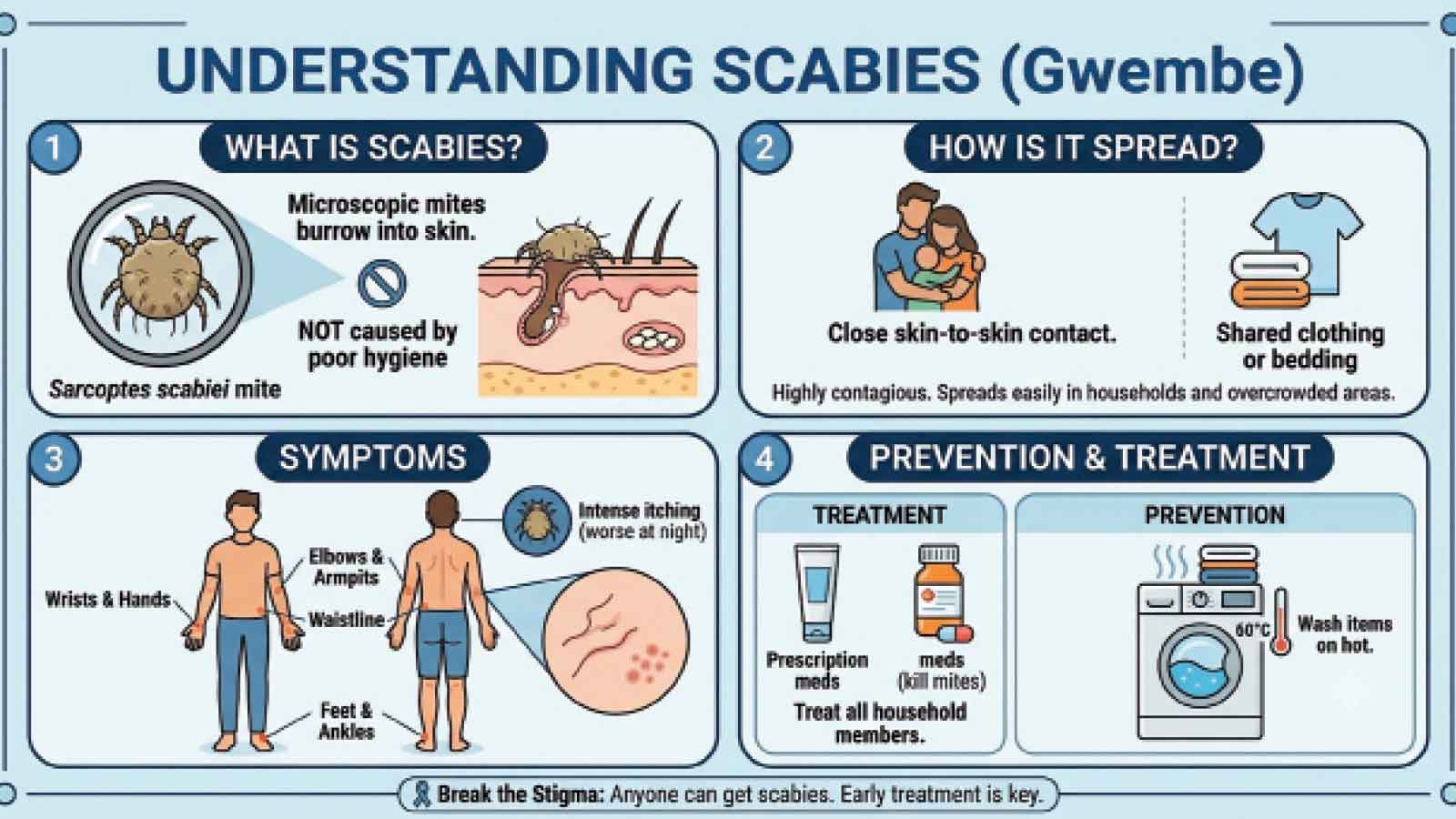
Rumbidzayi Zinyuke-Health Buzz
I remember back in the day, it wasn’t unusual to see a child who kept scratching.
Parents would quickly identify the illness, known as “gwembe”, separate the affected child from other children, boil their clothes and bedding, and make a trip to the clinic.
While many of us thought it was simply an embarrassing childhood skin condition, scabies is actually a highly contagious skin infestation that has been affecting communities for generations.
Today, despite advances in medicine and improved access to healthcare, scabies remains a public health challenge.
The condition has once again made headlines in Zimbabwe, following a recent outbreak in Harare South, where more than 70 cases have been recorded, mainly in Hopley and Stoneridge.
Although often dismissed as nothing more than an itchy rash, health experts warn that untreated scabies can spread rapidly through households and communities, leading to serious skin infections and other complications if not promptly treated.
According to the World Health Organisation (WHO), more than 200 million people are living with scabies at any given time worldwide, making it one of the most common skin diseases.
The WHO classifies scabies as a Neglected Tropical Disease (NTD) because it disproportionately affects people living in overcrowded and resource-limited communities, where access to healthcare and treatment is often limited.
While Zimbabwe does not routinely report national scabies figures, outbreaks continue to occur from time to time, particularly in densely populated settlements, schools, children’s homes and other institutions where people live or spend long periods in close contact.
Harare City Health deputy director Dr Mike Vere said the latest outbreak was first detected at a daycare facility before spreading into the surrounding community.
He said rapid response teams have since been deployed to affected areas, while residents experiencing symptoms have been urged to seek treatment at the nearest health facility.
Scabies is caused by a tiny microscopic mite known as Sarcoptes scabiei. The female mite burrows into the upper layer of the skin, where it lays eggs. It is the body’s allergic reaction to the mites, their eggs and waste products that causes the intense itching and rash associated with the condition.
Contrary to popular belief, scabies is not caused by poor hygiene. Anyone can become infected after prolonged skin-to-skin contact with an infested person. The mites can also spread through shared clothing, towels and bedding, particularly in cases of severe infestation.
Because of this, outbreaks commonly occur in households, boarding schools, daycare centres, prisons, nursing homes and informal settlements where people have frequent close contact.
Several factors increase the risk of infection.
Living in overcrowded conditions remains one of the biggest drivers of transmission. When many people share limited living space, the mites can easily move from one person to another.
Children are among the most vulnerable because they spend long hours playing together and often have close physical contact.
People with weakened immune systems, older adults living in institutional care, and individuals with limited access to healthcare are also at increased risk.
One of the reasons scabies spreads so easily is that many infected people do not realise they have it immediately.
For someone who has never had scabies before, symptoms may take between two and six weeks to develop. During this period, the person can unknowingly infect family members, classmates or colleagues.
The most common symptom is intense itching that becomes worse at night.
A rash made up of tiny red bumps, blisters or pimple-like spots often appears between the fingers, on the wrists, elbows, armpits, waistline, buttocks and around the genital area. Fine, thread-like burrow marks may also be visible on the skin where the mites have tunnelled.
In babies and young children, the infestation can also affect the scalp, face, neck, palms of the hands and soles of the feet.
While the itching itself can be distressing, experts say the biggest danger comes from repeated scratching.
It is believed that broken skin creates an entry point for bacteria, leading to infections such as impetigo. In severe cases, these bacterial infections may progress to bloodstream infections or even contribute to kidney disease, particularly among children living in resource-poor settings.
Diagnosis is usually based on symptoms and physical examination, although health workers may sometimes confirm the infestation by examining skin scrapings under a microscope.
The good news is that scabies is treatable.
Treatment usually involves prescription creams or lotions that kill the mites and their eggs. In some cases, oral medication may be recommended, particularly during outbreaks or for severe forms of the disease.
However, successful treatment requires more than treating the infected person alone.
Health experts recommend that all household members and close contacts receive treatment at the same time, even if they do not yet have symptoms. This helps break the cycle of transmission and prevents reinfection.
Equally important is cleaning the environment.
Clothing, bedding and towels used during the previous few days should be washed in hot water and dried thoroughly. Items that cannot be washed should be sealed in plastic bags for several days to ensure any remaining mites die naturally.
Maintaining good hygiene in homes, reducing overcrowding where possible and avoiding the sharing of clothing or bedding with infected individuals can also help prevent the spread.
Perhaps the biggest misconception surrounding scabies is the stigma attached to it.
Many people wrongly associate the condition with being dirty or neglecting personal hygiene. In reality, scabies can affect anyone regardless of age, income or cleanliness. What matters most is close contact with an infected person.
This stigma often causes people to delay seeking treatment, allowing the infestation to spread further within households and communities.
Recognising the symptoms early, seeking prompt treatment and ensuring that close contacts are treated at the same time can quickly stop transmission.
As Zimbabwe continues to strengthen disease surveillance and community health education, awareness will remain one of the country’s strongest weapons against scabies.
Feedback: [email protected]