admin
admin
Ranga Mataire
Group Political Editor
COMING from a highly successful National People’s Conference in Gweru barely a fortnight ago, the ZANU PF led government has set the ball rolling in implementing its national development projects that were at different stages of completion in the last election term.
Every delegate and observers at the ZANU PF National People’s Conference bore witness to the leadership’s serious intent in ensuring robust engagement and articulation of policies needed to catapult Zimbabwe into an Upper Middle Income economy by 2030 as is the vision of President Mnangagwa.
So the numbers were reduced and the discussions tailor-made on the economy as the ruling party fulfilled its constitutional obligation of holding an annual conference to review the party’s achievements, challenges and outstanding work needing urgent redress.
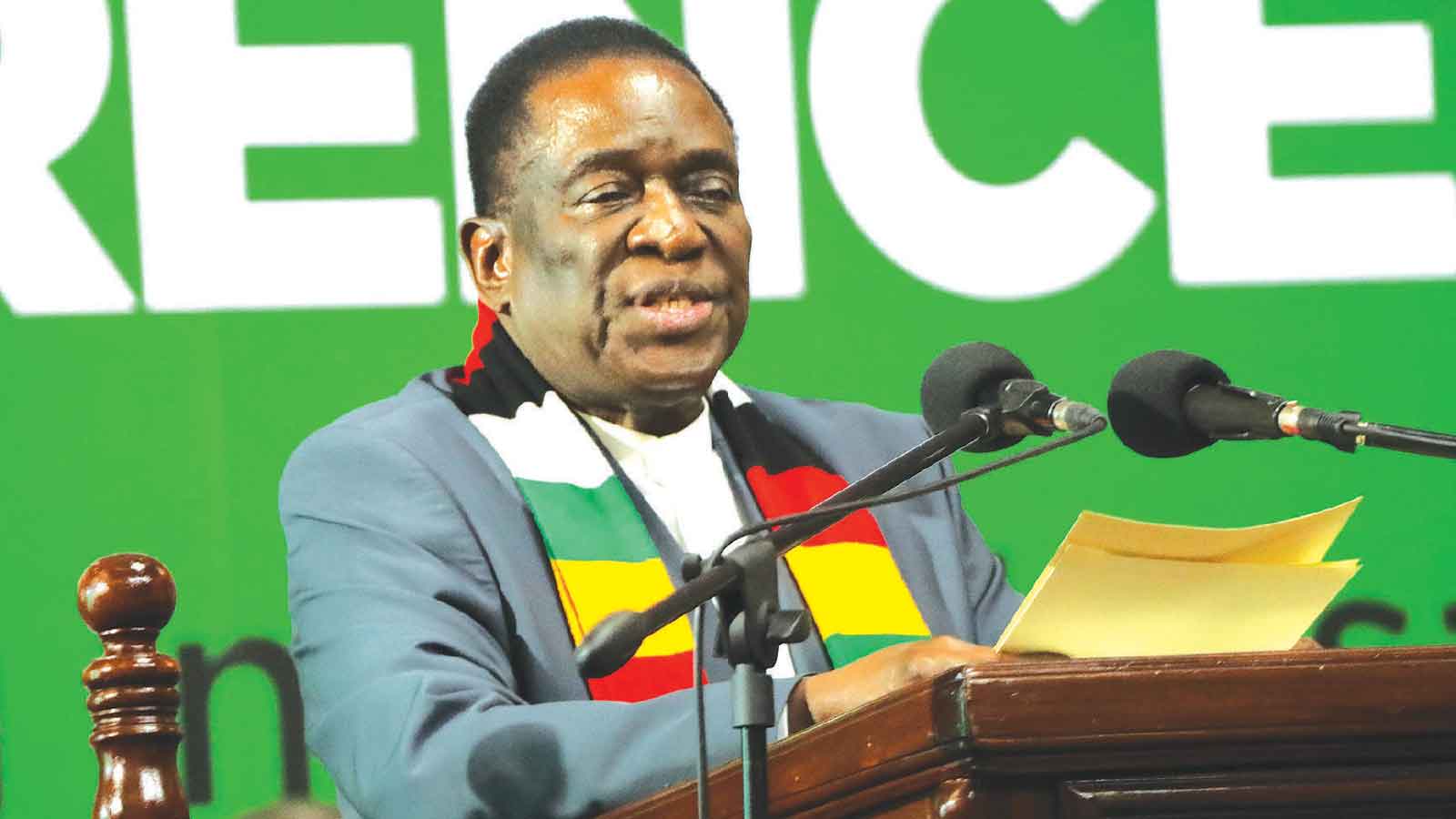
By the close of the conference, no one was left with an illusion of the task ahead. In his concluding remarks, ZANU PF First Secretary and President Mnangagwa emphasised the need to put all pedals on the economic wheel to improve the welfare of all Zimbabweans.
“Let’s continue to modernise our mother land, from Zambezi to Limpopo, brick by brick and stone by stone,” said the President as he officially closed the conference.
There was a different story on every delegate’s face. This was not some kind of merry-making end of year party. No.
It was a candid and robust engagement of the tasks that lie ahead.
Zimbabweans expect expeditious delivery of economic prosperity and the President’s speech was the tonic needed to imbue the delegates with a new sense of purpose.
A few days after the conference, the President led from the front by commissioning a number of projects meant to modernise the country in line with the NDS1 and with the broader vision of attaining an Upper Middle Income.
First, through Cabinet, the nation was briefed about the preparations of the 2023/2024 Summer season in which the Government is targeting to produce 2 800 000 tonnes of maize, 350 000 tonnes of soya beans, 150 000 tonnes of sunflower, 350 000 tonnes of sorghum, 92 658 tonnes of pearl millet and 270 000 metric tonnes of cotton.
The focus on agriculture is not without a reason. Agriculture is the backbone of Zimbabwe’s economy and will continue to be so in the foreseeable future. Although agriculture contributes about 14 percent of the country’s Gross Domestic Product (GDP), the sector provides employment for 70 percent of the population, and about 60 percent of all materials for industry. Also, about 45 percent of exports are of agricultural origin.
Under President Mnangagwa’s leadership, the agricultural sector has experienced exponential growth owing to various funding programmes.
Government has facilitated bank financing, private sector and self-financing.
The construction of dams across the country has made it possible for farmers to increase the hectarage of their produce particularly wheat and maize.
Besides focusing on agriculture, the President is also fixated on modernising local authorities and improving service delivery.
A few days after the ZANU PF national people’s conference, President Mnangagwa launched the Blueprint on “A call to Action- No Compromise to Service Delivery: First Stage of Interventions to Modernise the Operations of Local Authorities towards a 2030 Vision”.
The launch of the blue print comes on the heels of repeated calls by the President for local authorities to improve service delivery.
Most local authorities are in the hands of the opposition, which over the years have seen the deterioration of service delivery especially in the capital Harare.
“We will not stand by and watch our country being returned to medieval times, where solid waste runs along the streets with frequent diseases such as cholera and typhoid. Service delivery must be prioritised and rate payers have a right to demand that heads roll for those who do not deliver,” said the President, adding that the law is to descend heavily on corrupt officials.
The Ministry of Local Government and Public Works, the President said, should not approve any annual budget unless it demonstrates achievable and acceptable service delivery levels and is in line with the law.
While some political parties are bogged down by internal strife, the ZANU PF led Government is leaving no stone unturned in implementing policies that will ensure that “no one and no place is left behind.”
From agriculture and local authorities, the President moved to the mining sector where he officially opened the 26th Edition of the Mining, Engineering and Transport (Mine Entra) expo in Bulawayo on November 2, 2023.
His message has been consistent and crystal clear. The mining sector needs to redouble efforts to ensure that it contributes significantly to the overall GDP and create employment.
Mineral beneficiation and value addition, he said, have become imperatives for the country as it forges ahead to achieve its national development targets, Vision 2030 and the broader benchmarks under the African Union Agenda 2063 and the United Nations Sustainable Development Goals.
President Mnangagwa told delegates at the Mine Entra that the mining sector has a central role in the acceleration of modernisation and industrialisation of the country, the SADC region and the African continent.
In line with the Government’s modernisation thrust, the President was the Guest of Honour at the ground-breaking ceremony of the waste to energy Pomona Waste Management System project in Harare where he commended Geo Pomona Waste Management (Pvt) Ltd for transforming the facility, previously an eyesore, into a promising modern and clean infrastructure.
President Mnangagwa said the project must emerge as a flagship waste-to-energy project to be replicated in other parts of the country.
There is no doubt that if the project becomes fully operational it will go a long way in alleviating the problem of waste in the capital including contributing electricity to the national grid.
Typical of a man on a mission to improve his country’s welfare and attain the vision of an Upper Middle Income society by 2030, President Mnangagwa, without even having a breathing break, was commissioning the US$7,3 million National Oil Company of Zimbabwe (NOIC) ethanol storage facility at Msasa in Harare, that will help save foreign currency, create employment and provide wealth generation opportunities in the biofuel value chain.
Upon completion, the plant will ensure that the country’s national storage and handling capacity which previously was at 5,2 million litres, will be at 11,2 million litres. The facility is a major boost to Zimbabwe’s infrastructure development initiative as it will increase ethanol handling capacity by over 100 percent.
All in all, and in just under a week, President Mnangagwa has been involved in commissioning very impactful projects and initiatives, which points to the seriousness that his Government has in focusing on economic matters that have a bearing on the welfare of the generality of Zimbabweans.


 Online Reporter