admin
admin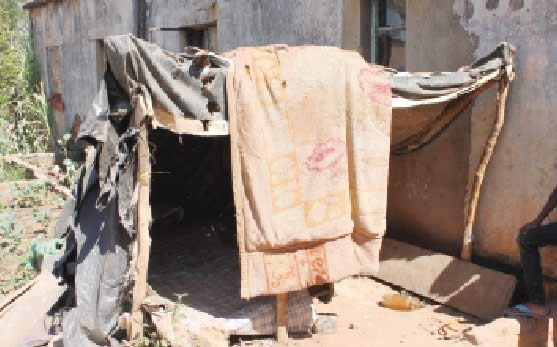
Marvelous Moyo
EVERY human being desires to live in a house that would provide basic needs such as shelter, offer a safe place to rest, sleep, privacy and have some personal space. A house should provide a home for people and a friendly environment to raise children so that they grow up to be productive citizens. For residents living in the single-roomed houses in the Gwanda Town’s oldest location, Jahunda Township, living conditions are very poor and children in this township have been hard hit.
Most of the children from families in the single-roomed houses of Jahunda Township have been forced to live an abnormal life, a life one can never imagine really exists.
The Gwanda municipality under the Jahunda Redevelopment Project is in the process of building semi-detached three-roomed houses for 72 families living in the council-owned one-roomed houses but the stalling of the project which started many years ago, has seen residents, among them children and the aged, suffer as living conditions continue to deteriorate.
There is a need for the municipality and its partners to accelerate the programme to ensure lives, especially of children, are protected.
Young children still doing their primary education have been subjected to harsh living conditions in this crowded township. Due to a shortage of space in their homes, most of them spend the nights sleeping outside.
Some sleep in the shacks made of plastic which are mostly found outside most of the single-roomed houses while others find their way to the cement roofs of the houses.
Virginia Dlamini, a mother of seven children, one of them living with disability, lives in a single room with all the children and her unemployed husband.
She left her poverty stricken rural home in 2011 with hope of finding a better life for her and her family in the mining town but alas, this has not been the case.
Dlamini narrated the pain of bringing up her children in an old single-roomed house that has failed to provide their daily basic needs.
“In this township, life is just terrible. This single room can’t accommodate all my family members because we are a family of nine. Every day when the sun sets, I find no joy in my heart because some of my children have no proper place to sleep.
“My 12-year-old son who is doing Grade Five sleeps on the roof of our house. He will be in the company of other children from some families in the neighbourhood having the same problem. Although we’re aware that it’s dangerous for them, unfortunately there is no other place they can sleep in. There is a possibility that one of them might fall from the roof and if such happens, he won’t survive,” she said.
“On the other hand, my three girls sleep in a shack just outside the house and would be exposed to rapists, drunkards and other criminals who move around at night. Surely, how can a mother sleep peacefully knowing her children are sleeping outside? I find no peace at night and mostly worry about my children,” added Dlamini.
She said the other three young children would be squeezed somewhere in the small room where she usually spends the night with her husband.
“There are times when I let the children sleep in the house while I and my husband sleep in the shack. At night, the environment is not safe for children because we live near a beerhall which is a few metres away,” Dlamini said.
She said because the houses were too old, even those who sleep inside the house live in fear that the walls or roof might collapse on them anytime.
“We’ve continued staying here because we’re poor, both I and my husband are not gainfully employed and we can’t afford to go and rent elsewhere. We pay $10 rentals every month but we struggle to raise that $10 so we can’t move to rent elsewhere.
“The municipality keeps promising to build us better homes but we’ve remained living this miserable life in these dilapidated houses. We also desire to live normal lives like other people,” said Dlamini.
One of the girls, 15, who sleeps in the shack, said life has never been easy for them and sleeping outside has had a bad impact on their lives.
“One night while we were sleeping, someone threw a big stone to our shack but fortunately no one was injured. There are lots of criminals moving around at night and we fear one day something bad might happen to us,” she said.
She said during the rainy season, the problem got much worse.
A 27-year-old woman who identified herself as Berv said her brother would on a daily basis ask to sleep at some three-roomed houses nearby.
“I then remain to sleep in the house with my mother and my eight-year-old daughter because we can’t share a room with my brother,” she said.
However, for Servie Ndlovu, 61, who is a vendor, the single-roomed house has made her go against her cultural beliefs.
She said in her family they were four — her husband, son and his wife and they were forced to share the room at night, which is an invasion of their privacy and sense of dignity. “In our culture (Ndebele), it is taboo for a woman to sleep in the same room with your son and daughter-in-law but we have no choice.
“I spend the night in the same room with my son, 25, and his wife, that is unacceptable. There is nothing we can do because they fear for their lives, they can’t sleep outside except only when my husband is around, they make that sacrifice,” said Ndlovu.
She said her son and daughter-in-law were both jobless hence could not move out of the house.
“We hope the municipality would speed up the process of building new houses so that we can also get some breathing space. This kind of life is not healthy at all. Sicela basizwele lathi siphume ebunzimeni lobu,” Ndlovu said.
Elnet Ngwenya who is asthmatic said she has been in and out of hospital because of poor living conditions.
She said there was no space and order in her one room which she shared with her three grandchildren.
“I’m asthmatic and am always in and out of the hospital. How can I not have attacks when I’m living in a crowded room like this. If we close the door, we feel like suffocating. We’re afraid to keep the windows open because of thieves, they hook things through the window.
“We’re appealing to the municipality to address this housing issue because these houses we live in now have cracks and the walls are peeling off. We’re really at risk,” said Ngwenya.
The municipality’s Jahunda Redevelopment Project is expected to improve living conditions of the residents through upgrading their houses from a one-roomed house which shares water and toilets communally to a three-roomed self-contained family house.
The residents said sharing the toilets had also been their biggest nightmare. More than 100 people share the communal toilets at Jahunda and keeping them clean always was impossible as even the passersby used them.
Gogo Laiza Ndlovu, 85, who has been living in her single room since she was a teenager has challenges in visiting the toilet which is about 30 metres away from her house.
She said she can no longer stand or walk on her own because of age worsened by some illnesses she is suffering from.
“I live in this house alone, my children are also elderly people now and have their homes. The biggest challenge I have is when going to the toilet, most of the time I have a running tummy but because the toilet is far from my house, it becomes a problem.
“We need new accommodation where each house would have its own toilet so that we can live happily. Sometimes I’m forced to handle some dirt in the toilets because they are usually dirty. When there is no water, the toilets can go for a week without being cleaned which is a big disadvantage to me since I’m aged,” Gogo Ndlovu said.
She said she sometimes uses a bucket to relieve herself, which exposed her to disease.
The councillor of the area, Mduduzi Ncube, said he would push for the construction of new houses.
The project has been at a standstill owing to financial constraints.


 Online Reporter