admin
admin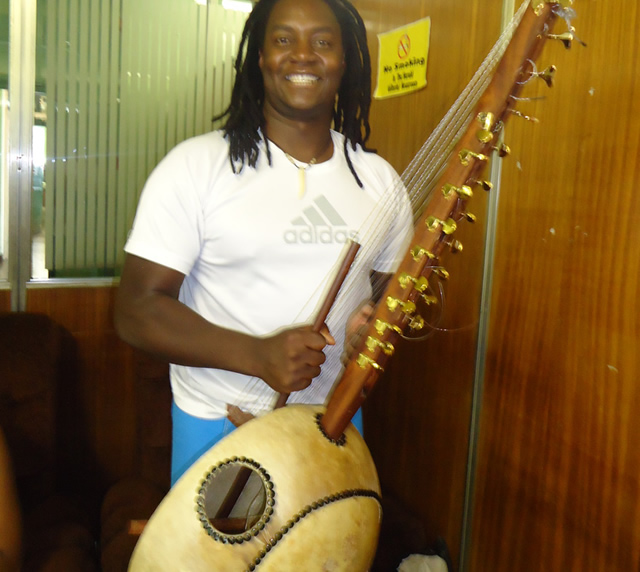
Jonathan Mbiriyamveka Entertainment Reporter
After spending over a decade performing outside Zimbabwean borders, multi-talented artist Jimu Makurumbandi is back home to recreate his artistic skills. The 36-year-old musician, choreographer, actor and dancer is hoping to bridge the cultural barriers that exist in Africa through the kora music instrument.
“It is my hope to take Zimbabwean traditional music to another level.
“I learnt a lot through performing alongside artistes the likes of Habib Koite outside the country and I looked at the kora instrument as a medium through which I would bridge the gap in African cultures.
“You see I have been living outside the country for too long and the problem with that is that as an artiste, your creativity gets to a point where it’s limited.
“For that reason I decided to come home and recreate myself so that I have an identity ,” Jimu said.
Asked what has been the response to his music since he fuses the kora and djembe which are pretty much western African instruments, Jimu said there was already a market for his sound.
“Quite honestly, people have a lost to say and ask before they see me on stage but after that they won’t have anything to say.
“Others only wish they were the ones who were playing the kora.
“Of course a lot of musicians play the guitar which is Spanish and I wanted to do the same but using the African instrument ,” he explained.
Now performing as a solo artist, Jimu says he draws inspiration from the late Zimbabwean mbira gurus in the likes of Dumi Maraire and Ephat Mujuru.
“Basically, I have used me of the folklore songs and put them on the kora but what comes of that is a different feel of music.
“I get inspiration from some of the recordings by Ephat Mujuru and Dumi Maraire,” he said.
Ever since he returned to Zimbabwe in 2013, Jimu has been working with other young artistes among them BaShupi and the late mbira queen Chiwoniso Maraire
He has also staged performances at the Book Cafe’s talent search show called “Open Mic” held every Monday that features different talents.
He has also met with Zimbabwean music icon Oliver Mtukudzi with a view to do a collaboration.
Jimu will next month expected to tour the United States where he will be teaching traditional Shona music at the Spectrum Dance Theatre.
“I am looking forward to going there and take Zimbabwean music beyond our borders because that recognition is important,” he said.
Asked when he will release an album, Jimu said he was in no rush to go into studio.
“I’m still testing my music as well as getting people appreciate it before I got into studio.
“It’s a bad thing to jump into studio when the work is half-baked,” he said.
For those not in the know, Jimu started out with Savanna Arts which was based in Mbare in the 1990s performing Zimbabwean traditional songs and dance.
While there, he was also studying a course with Dance Training Zimbabwe run by the National Ballet as well as being a resource person with the Zimbabwe College of Music.
He worked with Clayton Ndlovu and the late Dumi Ngulube and Pepukai Mudzingwa while the Zimbabwe College of Music.
After graduating at Dance Training Zimbabwe, Jimu then joined the famed group Tumbuka Dance Company.
He was among the first group of dancers to come out of Tumbuka Dance Company with the likes of Sam Felo, Mathias Julius, Baureni Tavaziva, Ricardo Manwere and Alouis Magwenya who was the then principal dancer to name just a few.
“All these guys are working outside the country as musicians. One thing we all shared was that we danced to a lot of music and that obviously inspired us to do music,” he said.
While he worked with Tumbuka he was signed by Theatre Talipot in France and he left for Paris to work on a project before he moved to Norway, where he stayed for the greater part.
In Norway he scored successes when two of his projects of Zimbabwean contemporary dances were performed at the Norway Opera’ second stage. Besides the two projects, he also worked in several schools where taught Zimbabwean music and traditional dances.
Back home, he did choreography on Sebastian Magacha’s video “Ridza Bosvo” and also worked behind-the scenes for the Star Brite talent search show.



 Online Reporter