Chronicle Editor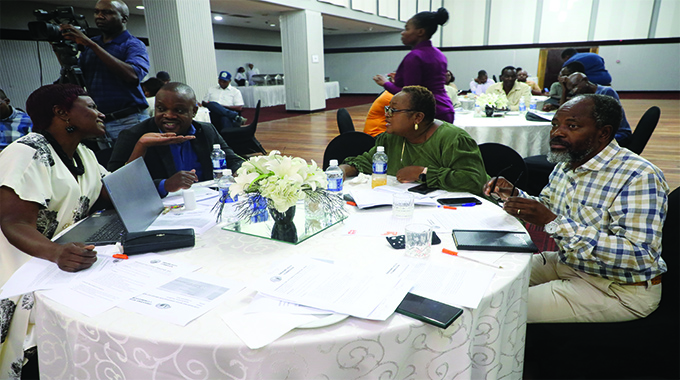
Sikhumbuzo Moyo, [email protected]
JOURNALISTS drawn from various media houses in the country, yesterday met in Bulawayo to fine-tune the standard operating procedures (SOPs) during the Gukurahundi hearings, which are expected to start in the first quarter of the year.
The hearings, which will be led by chiefs in their communities, aim to address the legacy of Gukurahundi, a period of violence and conflict that affected some parts of Matabeleland and Midlands provinces in the 1980s.

President Mnangagwa has shown his commitment to facilitating processes that will bring closure to post-independence conflicts, as part of his vision of nation-building and fostering national unity.
Yesterday’s indaba, which was an open discussion panel, was facilitated by a seven-member technical committee coordinated by the Zimbabwe Media Commission (ZMC).
It was represented by its executive secretary Mr Godwin Phiri and two commissioners, Mr Aleck Ncube and Mr Tanaka Muganyi.
The technical committee comprises journalists Nduduzo Tshuma (The Chronicle), Victoria Ruzvidzo (Sunday Mail), Zenzele Ndebele (Cite), Annahstacia Ndlovu (Voice of America), Albert Chekai (ZBC), Cris Chinaka (ZimFact) and Ms Monica Cheru (ZimNow).

The technical committee was set up two weeks ago, following extensive deliberations between the Chiefs and media houses during a Gukurahundi hearings media reporting sensitisation workshop that was organised by the Office of the President and Cabinet in collaboration with the Ministries of Justice, Legal and Parliamentary Affairs and Information, Publicity and Broadcasting Services.
The debate was sparked by a presentation by the deputy president of the National Council of Chiefs, Senator Chief Fortune Charumbira, when he said members of the security services and journalists would not be allowed to sit at the public hearing to protect the dignity of the victims and witnesses.
Chief Charumbira, said they believed that the hearings must be attended by local people only, as any presence of strangers was likely to raise fear among those making their submissions.

Journalists were ,however, against this position, arguing that such a scenario was against calls by President Mnangagwa for the public to freely speak and discuss the country’s dark and sad history.
In his opening remarks during the meeting yesterday, Mr Phiri said they are carrying out a task they were given by stakeholders to sort out issues of how the media would participate in the outreach programme.

“Hopefully, when we leave this room we would have had concrete engagements and processes that we will take up to chiefs. Let me also state from the onset that as ZMC, this is not our process, ours is to simply facilitate the process,” he said.
The discussions covered several topics, such as the outreach reporting guide, the Gukurahundi Code of Conduct pledge as well as consent, in which reporters agreed that consent must be sought from victims and witnesses before their stories, particularly sensitive ones could be published.
Under the Code of Conduct pledge, the journalists noted that the Gukurahundi outreach programme was crucial to national healing, unity, and development.

This also includes reporting on this critical process with accuracy and reliability. They said the media is critical in terms of providing access to information.
“In line with these principles, we commit to, challenge, and correct statements and claims that have no basis. Avoid highlighting or amplifying falsehoods, hate speech, and incitement to violence, focus on healing, unity, and development, uphold codes of ethics and professional conduct and disclose potential conflicts of interest, and make a clear distinction between news and opinion,” reads part of the Code of Conduct draft pledge.

The resolutions that were made during the breakfast meeting will then be presented to the National Council of Chiefs for approval.
Mr Phiri, said before the commencement of the hearings, there shall be a conflict-sensitive reporting workshop for selected journalists who will cover the hearings. The group will also be accredited for the process for ease of identification.

The chiefs have since crafted and adopted the Gukurahundi manual, which will guide the holding of victim-friendly public hearings, to ensure national healing as the country confronts its unfortunate past.
The manual, which is a product of inclusive engagements between chiefs and various stakeholders, is a culmination of traditional leaders’ meetings with President Mnangagwa.


 Online Reporter