peter
peterAS above, so below. This familiar African adage relates to the relationship between attributes of cosmic bodies and what humans on earth do on the cultural front. They seek to replicate the heavens on earth. For example, humans on many fronts replicate circularity associated with stellar, planetary and lunar bodies. This is particularly so with respect to Africans although they too are beginning to abandon circularity in terms of their many cultural aspects.
Their huts, cattle pens, village layouts and a lot more resemble stellar designs and configurations. They are characterized by circular design or arrangements. This was not an invention on the part of Africans. Instead, they merely copied the heavens. Ideas relating to aesthetics were informed by the heavens. What Africans saw in the night sky underpinned elements of African aesthetics.

In addition to circularity, heavenly bodies are in motion, a motion that is characterised by rhythm, seasonality, regularity, cyclicality and periodicity. These and other traits of cosmic bodies became the hallmark of ideas relating to beauty that Africans sought to capture in their cultural world. Aesthetics is therapeutic and an important ingredient in relaxology. This is what we seek to derive from artistic expressions such as music, sculpture, dance, architecture, graphic design and the literary arts. Stars are enchanting both in their design and in motion. This is what led one poet to compose the now very familiar verse:
Twinkle, twinkle little star,
How I wonder what you are,
Up above the world so high.
Like a diamond in the sky.
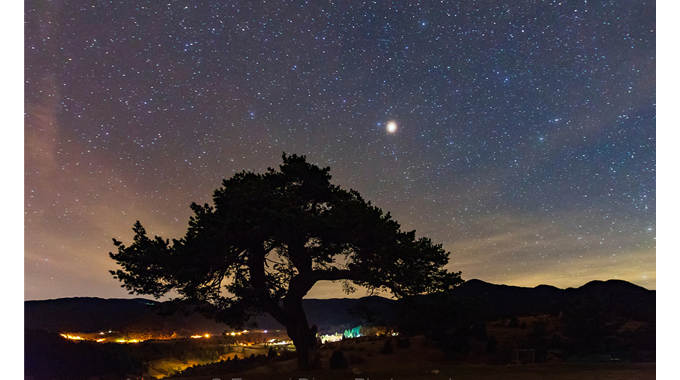
Only last week I had the opportunity to watch the Morning Star, iNdonsakusa, while attending and observing the rain-inducing rituals at the Njelele Fertility Shrine. It was then that I fully appreciated the import of the poem rendered above. So, that is what the poet observed. The moon that had dominated the night sky had set in the western sky. The Morning Star twinkled as if birthing some awe-striking performance. Its light was not constant nor consistent. Its parts took turns to outshine each other. Twinkle, it did but it was not small.
Besides the beauty gleaned from the stars, Africans envied some quality in the stars and other heavenly bodies. The stars expressed eternity, endlessness and perpetuity. Africans sought that trait or quality. It turned out that was not possible. All that they could do was to replicate themselves through sexuality. This is what led me to coin the expression: individuals perish, humanity is forever.
Of course, the said eternity is in relative terms. For example, the sun is thought to have a life cycle of about eight billion years and is presently midway through its life. When the sun’s gases burn out, it will become a red giant that will engulf the planets nearest to it, such as Venus, Mercury and our Earth. Need we worry? Not at all, as a billion years is, to all intents and purposes, eternal. In any case, the death of a star leads to the birth of another. Death begets life.
After scrutinising the names of stars, planets and constellations, I coined a reverse adage, namely: As below, so above. I looked at the names of the heavenly bodies, be they derived from African, Greek, or Maori myths, they indicated projection of the known and experienced world which humans used to make sense out of the distant heavens that they gazed at night.
This observation will constitute a sizeable portion of the journey to the stars. Animals, humans (children, men and women) plants, and the broader environment as perceived and understood by earthly citizens were juxtaposed on cosmic bodies to concretize and make sense out of them.
Observation and correlation were used to come up with conclusions regarding what the stars foretold, portended or signified. Let us go back to the twinkling star, iNdonsakusa. The Nguni people and indeed other African peoples realised that when the Morning Star appeared in the eastern sky, it was as if it literally pulled dawn, ukusa. The Morning Star, actually not a star, but a planet, heralded the soon-to-emerge sun that brought in its wake, welcome light and hope.
As a result, the Morning Star, even in its English term, is associated with morning, a morning characterised by emergence of light, ukusa or dawn. There was thus some perceived link between the appearance of the Morning Star and dawn. It was only appropriate to name the star based on what it is linked with — the sun with its welcome light. The night bade farewell when the light took centre stage.
There was some understanding that when the Morning Star did not appear to pull the sun, the latter was not going to emerge above the eastern horizon. East, iMpumalanga, where the sun emerges, is so named because of the direction the sun appears. Dawn is hope, hope for the day when life processes resume. Humans commence their work. Trees and grasses begin to absorb solar energy that they use in their leaves to synthesize food. This is the process known as photosynthesis. Without light, there cannot be life on planet Earth.
It is being speculated that if nuclear bombs are exploded in the war pitting Russia against Ukraine, the resulting smoke will block solar light from reaching our planet Earth. As a result, plants and grasses will not produce food. There will be serious food shortages that may lead to starvation. Sometimes we take for granted the roles and functions of cosmic bodies as far as life on earth is concerned.
I hope that the adage that I have coined, namely, As below, so above, makes sense. One learning principle that teachers are taught at colleges is that in learning we move from the known to the unknown. What we already know is an important stepping-stone towards future learning through which we extend the horizons of knowledge. We are armed with what we know and get confidence to challenge the unknown.
Naming of heavenly bodies seems to have followed this principle. First to be experienced was the immediate environment-our earth. Humans then looked up at night and saw the numerous white cosmic bodies that he did not know. Humans do not wish to allow ignorance about their environment, whether immediate or distant. The arsenal at the disposal of humans was the knowledge they already possessed from their abode, in particular how the movements and resulting positions of heavenly bodies influenced the environment.
The study of Astronomy became important as it was realised there was some important link between the cosmic bodies and what they portended. Learning took place. Each time a cosmic body appeared, it was followed by the same phenomenon. It was learning and naming through association, through reinforcement
This is another part of the journey to the stars that we shall interrogate. Stars were perceived as markers of and interpretations for forthcoming events. Horoscopes came into use. It stars and other cosmic bodies were that important in terms of their movements and resulting positions in relation to the earth, it made sense therefore for humans to devise mechanisms to monitor the movements of celestial and planetary bodies.



 Online Reporter