Rutendo Nyeve in Kamativi
KAMATIVI Mining Company is investing US$25 million towards the construction of a 36-megawatt solar power farm, which is set to reduce electricity costs and cut carbon emissions in line with the Government’s call for the mining sector to be self-sufficient in energy.
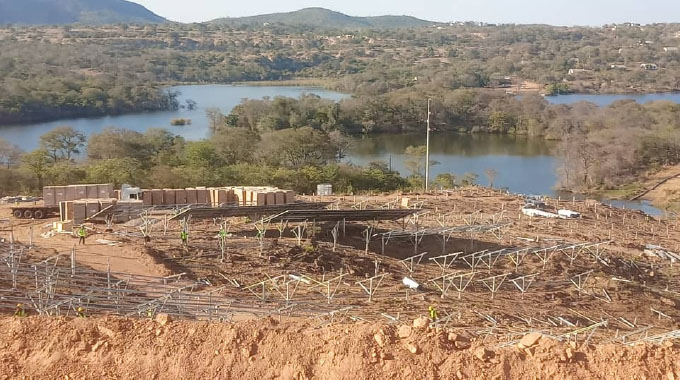
The project, located within the mine’s concession in Kamativi, is expected to be completed by September this year and represents one of the largest private renewable energy initiatives in the region.
The development comes as the Second Republic continues to reap the fruits of its open-for-business policy, which has attracted massive investments into the mining sector, particularly in lithium extraction.
Kamativi, once a vibrant tin mining town that became a ghost settlement following the mine’s closure in 1994, has been resuscitated through new investments in lithium mining that have not only brought life back to Dete and the surrounding areas but also catalysed massive infrastructure developments like the solar farm.
Zimpapers visited the site yesterday and witnessed the contractor, which has since roped in 100 locals into the project, busy with works at various levels.
Truckloads of 710-watt solar panels were being offloaded while excavation works, installation of silver works, and erection of solar panels on other sections were underway.
Special Advisor to the President responsible for monitoring the implementation of Government programme, Dr Jorum Gumbo, visited the mine and witnessed the development firsthand.
Dr Gumbo commended the company’s community engagement model and called for other mining firms to emulate the initiative.
“The involvement of the community on its own is actually commendable, because the community feels the ownership of the project.
“And if this company’s model could be populated by other companies, then definitely the mining sector would be contributing a lot to the communities where they operate,” said Dr Gumbo.
He further suggested that provincial conferences should be established where miners showcase what they are doing for their communities and even provide certificates to recognise those performing well in community development.
“In general, we’ve been very impressed with what we have seen here at Kamativi Mining Company,” he said.
Kamativi Mining Company general manager, Mr Jack Ye expressed optimism about meeting the September deadline.
“We already started, now the material is on the ground. We hope that this solar plant can be finished by the end of September this year. That will produce 36 megawatts of green energy for this project,” said Mr Ye.
He emphasised that the project will benefit not only the mine but also the surrounding community.
“This investment comes as a response to the call of the central Government on the mining sector to produce more energy and become energy self-sufficient.
“Secondly, lithium is a critical mineral for the transition of the energy sector, so we are trying to bring energy for the mining operations,” he said.
Mr Ye expressed gratitude for the support received from central Government, various ministries, local government, and parastatals such as the Environmental Management Agency (EMA) and NSSA, which have been instrumental in the development of this critical project.
Kamativi’s solar project is part of a growing trend among Zimbabwean mines investing in renewable energy to reduce electricity costs and cut carbon emissions.
Zimplats, the country’s largest platinum producer, has commissioned a 35MW solar plant at its Selous Metallurgical Complex, with a further 45MW under construction as part of a long-term 185MW target.
The company plans to invest up to US$201 million in solar power facilities. Caledonia Mining’s Blanket Mine has also invested US$14 million in a 12.2MW solar facility, significantly reducing its reliance on grid and diesel power.
The shift towards captive power generation has been formalised by the Government through the Own-Consumption Licensing Regulations 2026, which provide a legal framework and regulatory clarity for businesses generating electricity for self-use.
The mining sector has become an active co-developer of energy infrastructure, with the sector requiring an additional 2 000MW by 2025 to meet expansion targets.
Kamativi Mining Company’s investment comes after the firm already injected over US$200 million in two phases to set up local processing facilities, including a lithium salt plant.
The former ghost town is now back to life, with employment levels rising from just 67 to over 200 direct employees and more than 1 000 indirect jobs created through contractors.