Siphakeme .Mnindwa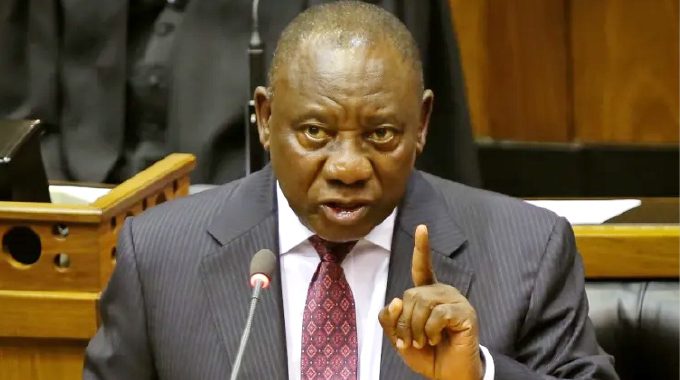
Nqobile Tshili, [email protected]
Despite numerous challenges, chief among them, illegal Western sanctions, Zimbabwe stands out as a notable example of successful land reclamation in Africa, as South Africa’s land reform policies face scrutiny from the United States.
South Africa’s recently signed land expropriation without compensation law has attracted attention and criticism from the United States, which has emphasised the importance of maintaining “a balance between land redistribution and the protection of property rights” to ensure investor confidence and economic growth.
Analysts and political leaders have condemned US President Donald Trump’s attempts to bully the South African government, describing his stance as unwarranted interference in African governance.
Posting on his X account, President Trump, who recently assumed office for his second term, accused South Africa of confiscating land and discriminating against certain groups, labelling the new law a “massive human rights violation”. He further threatened to cut all future funding to South Africa until a full investigation into the matter was conducted.
In response, South African President Cyril Ramaphosa dismissed the allegations, saying his country’s land expropriation policies adhere strictly to legal frameworks and constitutional provisions.
“South Africa is a constitutional democracy that is deeply rooted in the rule of law, justice and equality. The South African government has not confiscated any land. The recently adopted Expropriation Act is not a confiscation instrument, but a constitutionally mandated legal process that ensures public access to land in an equitable and just manner as guided by the constitution,” he said in a statement.
“South Africa, like the United States of America and other countries, has always had expropriation laws that balance the need for public usage of land and the protection of rights of property owners.”
He further clarified that, aside from the President’s Emergency Plan for Aids Relief (Pepfar), which contributes 17 percent of South Africa’s HIV/Aids programme, the country does not receive any funding from the US.
President Ramaphosa said he would engage the Trump administration to find common ground on land reform and broader bilateral relations.
“We are certain that out of those engagements, we will share a better and common understanding over these matters. The US remains a key strategic political and trade partner for South Africa. With the exception of Pepfar Aid, which constitutes 17 percent of South Africa’s HIV/Aids programme, there is no other funding that is received by South Africa from the United States,” he said.
Local analysts have criticised President Trump’s stance, arguing that his approach mirrors the punitive actions taken against Zimbabwe at the turn of the millennium.

Following Zimbabwe’s land reform programme, the US and its Western allies imposed economic sanctions under the pretext of human rights violations, despite the initiative being aimed at addressing colonial land imbalances.
Zanu-PF Secretary General Dr Obert Mpofu said the land issue remains one of Africa’s most critical political and economic challenges. He urged South Africa to remain resolute in implementing land redistribution.
“If you try to be diplomatic about land redistribution, you will achieve nothing. The process is often met with resistance, sanctions and vilification. However, for the benefit of the majority, ultimately, it must be done,” he said.
Dr Mpofu said Zimbabwe’s land reform programme was a success, noting that it has empowered the black majority and considerably improved national food security.
“Negotiating land redistribution with Western powers has never yielded results. Africa must take decisive action on this matter,” he added.
National University of Science and Technology (Nust) lecturer and political analyst Mr Methuseli Moyo said President Trump’s approach reflects a broader effort to undermine African sovereignty.
“The tragedy is that Trump leads a global superpower that sees itself as the world’s prefect. Donald Trump seeks to dehumanise black people to the extent that he thinks they are not fit to have access to anything, especially land, even their God-given land,” he said.
Mr Moyo also criticised the irony of the US positioning itself as a human rights advocate while opposing African-led efforts to rectify historical injustices.
“Are black South Africans not human beings? The hypocrisy is staggering. Thankfully, President Ramaphosa has firmly stood his ground,” he added.
Mr Moyo said more African countries need to take a leaf from Zimbabwe in the manner in which the Government handled the land question.
“Zimbabwe did very well to pioneer a forceful land reclamation process, which stands as a reference point and inspiration to the dispossessed masses in South Africa and elsewhere. They must bite the bullet and take back their land,” he said.
Mr Moyo said African countries must never be apologetic about controlling their resources.
Political governance expert Mr Teddy Ncube echoed similar sentiments, stating that land reform in South Africa, like in Zimbabwe, is about correcting historical injustices rather than pursuing radical agendas.
“Politics is not solely about economic transactions. It is also about people, history and justice. His (President Trump’s) perspective on South Africa’s land reform overlooks the deep historical injustices that necessitated this conversation in the first place,” he said.
Mr Ncube emphasised that the current reform efforts seek to promote fairness and inclusivity while rectifying past wrongs.
“The issue of land reform in South Africa is not about ‘confiscation’ or radical agendas; it is about addressing the long-standing disparities created by colonialism and apartheid,” he said.
Mr Ncube said for generations land was grabbed from Africans leading to poverty and exclusion while also perpetuating inequities.
“The current efforts are aimed at rectifying these imbalances in a way that promotes fairness and inclusivity. Trump’s approach of reducing complex issues to simple economic calculations can be problematic when applied to international relations,” he said.
Mr Ncube said the South African land issue is a domestic matter that should be handled internally, arguing that external interference from the US is unwarranted.
He said President Trump must respect South Africa’s sovereignty and allow its people to shape their own future.
“It is essential that South Africans are given the space to resolve this matter themselves, free from external interference. President Trump should recognise this and allow South Africa to determine its own future based on its own principles and aspirations.”
As the debate over land expropriation intensifies, Zimbabwe’s experience remains a key reference point for African nations seeking to address land ownership disparities. South Africa’s approach, though different in execution, is part of the broader continental effort to ensure equitable land distribution and economic empowerment for historically marginalised communities. — @nqotshili


 Online Reporter