admin
admin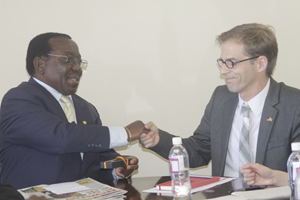
Zimbabwe being lifted anytime soon .
Germany was perceived to be softening when it comes to the stance taken by the EU on Zimbabwe.
Speaking at a meeting with Zanu-PF national chairman Cde Simon Khaya Moyo at the party’s headquarters yesterday, head of the visiting German parliamentary delegation, Mr Stefan Liebich, said his country would act on sanctions only after the completion of the constitution-making process and what he termed the delivery of “credible elections”.
“If the constitutional process is a success and free and fair elections are held, MPs in Germany will campaign for speedy removal of the sanctions,” he said.
Mr Liebich who is leading an eight-member delegation, said Germany was also concerned with the issue of human rights, political violence and Press freedom in Zimbabwe.
However, Cde Khaya Moyo explained to him that Zimbabwe’s liberation struggle was all about human rights.
“We fought for human rights, to do away with racial discrimination. We respect human rights but the rights should fall under laws. Nobody is above the law and I am sure in Germany no one is above the law too,” he said.
Cde Khaya Moyo said Zimbabwe upheld its laws and applied them regardless of one’s political affiliation.
On political violence, Cde Khaya Moyo said a report from the police showed that it was the MDC-T that was topping the violence record and Zanu-PF was just a victim of negative media coverage.
“If MDC-T delegates fight at their congress, it is Zanu-PF to blame. Let’s be fair on analysing things and we should see things correctly.
“We have a lot of newspapers, most of which are sponsored by some Western countries. Everyday they publish stories that Mugabe must go and people say there is no freedom of the press?” asked Cde Khaya Moyo.
He, however, said Zimbabwe had no bone to chew with Germany.
Cde Khaya Moyo said Germany was forced through the EU, to impose illegal sanctions on Zimbabwe over a bilateral dispute between Harare and London.
Earlier, Mr Liebich and his delegation had met Speaker of the House of Assembly, Mr Lovemore Moyo where he slammed historical links between Europe and Africa in which the former exploited Africa through slavery and colonialism.
He applauded the role played by liberation movements in dislodging the racist governments.
“We are aware that the shared history of Europe and Africa has some sad chapters like slavery and colonialism.
“It was the efforts of liberation movements that were able to overcome this legacy,” he said.
Mr Liebich said the partition of Africa at a summit in Berlin in 1884 was a dark chapter in the history of the city.
“While being an MP from Berlin, I would like to mention that it was a dark chapter for Berlin where colonial powers came together to divide Africa without involving people living there.
“It is against this backdrop that it is promising that for the past few decades relations have become closer and better and we are negotiating as partners,” he said.
The German MP said the constitution-making process currently underway was a noble process and said they had visited as a delegation to assess first hand events in Zimbabwe.
Mr Lovemore Moyo said the constitution-making process was going on well despite constraints in getting resources that had caused delays.
The Speaker also said Parliament was operating well and was basing its decision on consensus since there was no opposition party.
“It is a challenge as an institution to operate in an environment where there are no checks and balances in the form of an opposition party or parties. We normally operate on consensus and consultation among parties in the inclusive Government,” he said.
Responding to questions from the German legislators on incidences of violence, Mr Moyo said as an institution Parliament condemned such behaviour.
“As Parliament we condemn all forms of violence be it domestic or political, we condemn all violence that has been reported.
“It is our hope through the negotiations and the structure that was created by the GPA, the Joint Monitoring and Implementation Committee, that they will be able to deal with violence and other human rights issues.
“Cabinet has agreed on the Human Rights Bill. We introduced the Human Rights Commission in 2008 through Amendment (19). What has been outstanding are details on how the commission would operate.
“I am optimistic that the commission would be able to address some of these issues,” he said.


 Online Reporter