

 admin
admin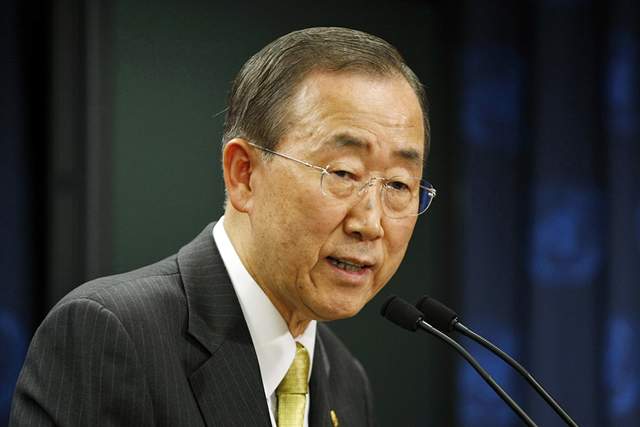
From Tendai H. Manzvanzvike, in JEJU, South Korea
UN Secretary-General Mr Ban Ki-moon yesterday called on all signatories to the Paris Agreement on Climate Change (Cop21), to ratify it as soon possible, amid other pressing global challenges.
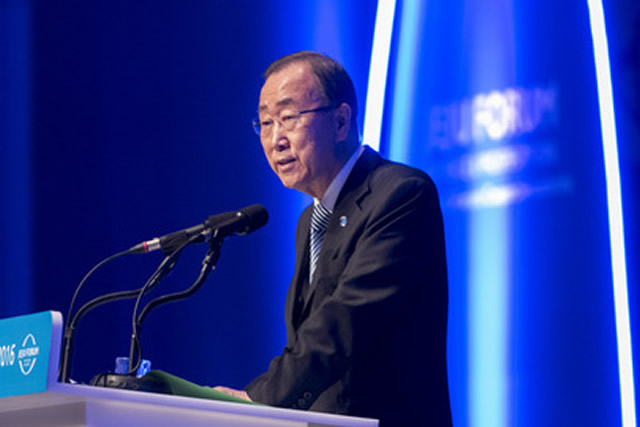
Presenting his keynote address during the official opening ceremony of the 11th edition of the Jeju Forum for Peace and Prosperity, which opened here on May 25, the UN chief, who is strongly tipped as a potential candidate for South Korea’s 2017 presidential elections told delegates that climate change remained a major challenge, saying that Asia was “critical to climate action, accounted for nearly a third of all global greenhouse emissions (and) is also a source of solutions.”
President Mugabe on April 22 joined about 170 world leaders at the UN headquarters in New York to sign the historic Paris Agreement and pledged, “We can reduce our greenhouse emissions by 33 percent below the projected business as usual energy emissions per capita by 2020.”
According to observers, speculation about Mr Ban’s future among Koreans and the international media has been fuelled by his appearance at the Jeju Forum, barely a year before the end of his term of office with the UN.
The three-day Davos-like Jeju Forum, which runs under the theme: “Asia’s New Order and Cooperative Leadership”, is being attended by about 4 000 delegates from 60 countries who include high-level government officials, business executives, academics, youths and activists.
Other keynote speakers included Malaysia’s former Prime Minister Mahathir bin Mohamad, Japanese former PM Tomiichi Murayama, New Zealand ex-PM Jim Bolger, Singapore’s former premier Goh Chok Tong and Italy’s former PM Enrico Letta.
Mr Ban’s address zeroed on four fundamental themes: global action, regional cooperation stability on the Korean Peninsula, and universal human rights.
The world’s top diplomat also urged Asia to learn from Africa, Latin America and Europe in resolving outstanding differences, saying that people should take pride in their countries: “It is time to agree on borders that are disputed (and) rise above conflicting interpretations of history (and) focus on the future,” he said.
Mr Ban added, “I have seen this work on other continents. Latin America, Africa and Europe have successful agreements and organisations. They helped ease tensions and prevent conflicts. There are no winners in violent conflicts, only lost generations, greater poverty and deep bitterness.”
Turning to the millennium generation, the UN Secretary General called on them to be visionaries who in this digital age must look beyond their countries’ borders.
“These national borders do not mean much these days. We must make sure our younger generation become global citizens, with global vision. Look beyond your national borders what other people are doing, how they are doing,” he said.
Former Malaysia PM Mr Mohamad criticised war as a means to resolving conflicts, and called on leaders to seek peaceful means including “negotiation” and “arbitration” to resolve conflicts.
Sixteen journalists from 16 countries that included Zimbabwe, Angola, Mongolia, Peru, Honduras, China, France, the USA among others also attended the forum at the invitation of the Korea Foundation. They took part in a panel discussion of a presentation by Professor Jaechun Kim of Sogang University titled, “Korean unification and international society: The role of international media.”
The Jeju Forum is an international platform established more than 10 years ago when Mr Ban was South Korea’s minister of Foreign Affairs.
It is a forum where world leaders and academics come together to talk about the new order, the significance of cooperative leadership and it’s implementation.
The 11th edition, which runs from May 25 to May 27 takes place as South Korean President Park Geun-hye is visiting three African countries: Ethiopia, Uganda and Kenya.
She was expected to present her country’s Africa policy at the African Union headquarters in Addis Ababa.



 Online Reporter