daniel chigunwe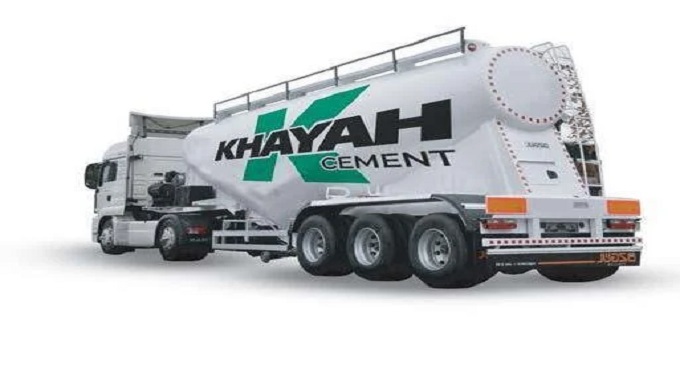
Nelson Gahadza
Zimbabwe’s second-largest cement manufacturer, Khayah Cement, says the shutting down of the kiln plant, which produces clinker, a key raw material for cement production, is straining the company’s capacity as it is relying on imports and excess from other producers.
The company commissioned a new 1 million Vertical Mill Plant (VCM) tonnes-per-year capacity plant last year as part of a US$25 million investment. But the plant is currently not operating at full capacity due to clinker shortages.
“Currently, we are producing at a capacity of 700 000 tonnes per annum against installed capacity. We are importing clinker and getting excess from other producers, but it is a painful process,” group chief executive officer Innocent Chikwata, said during a tour of the company on Wednesday.
He said the Kiln plant had become unreliable due to frequent breakdowns; hence, the company made the decision to halt operating the plant.
“Last year we had some issues in the cement industry and part of what affected us as Khaya was the kiln plant.
“We had to make a decision to come to a point where we stopped it because of unreliability. Therefore, we are about to embark on a project to refurbish the plant and this project is going to cost us between US$15 million and US$20 million,” he said.
Chikwata said the company is working with relevant officials to get support in guarding against cheap imports that are competing with its products.
“These imports are limiting us in terms of what we can supply into the market; hence, we continue to engage with relevant authorities in that regard.
He said the company’s capacity is close to what the market requires; hence, at full capacity it will come in handy.
Due to Government infrastructure projects and home builders, cement consumption has been rising over recent years. Cement consumption increased from below one million tonnes in 2017 to around 1,6 million tonnes in 2023, according to estimates by PPC, the country’s biggest producer.
In total, cement companies have a capacity of 2,6 million tonnes of cement, which should meet current demand. However, production costs and plant breakdowns are keeping them from producing enough cement.
Chikwata said the company is currently in the process of finalising funding arrangements for the project.
“This is monumental for us. It is a project in a normal cement factory that can happen once every 10 years and we are privileged to be part of that monumental event that will happen.
“Once this is done, it will bring a lot of stability not just to us but even the cement industry in terms of raw material supply because when we do have the raw material and it is even in excess, there is also the opportunity to even sell to other producers locally because clinker once in a while in our industry can become an issue.
“So, we have decided as Khaya to spend that money so that we not only stabilise Khayah Cement as an operation, but we also do the same for the cement industry,” said Chikwata.
He noted that in the next couple of months, once funding is finalised, the works will commence thereof.
“In the meantime, there is preparatory work such as demolition of the old plant, and we are doing that to create space because part of the project scope, which will be in phases, will do certain upgrades of the current operation, and we will need a bit of more space so that we bring in new technology that is more efficient.
“In terms of timelines, all things being equal, from start to end, the project will take 8 to 12 months to complete since some of the components will be coming from different countries,” said Chikwata.
He indicated that the project is also part of the group’s support in terms of Vision 2030, which has seen several infrastructure projects being done currently.
“We see the growth that is there in the built industry infrastructure and individual housebuilding and the sooner we do the project, the sooner we can also partake in that whole process that the country is moving in line with,” said Chikwata.
Having been acquired by a consortium of local businesses in 2022, the business rebranded as Khaya Cement in 2023.
Khayah Dry Mortars plant is the biggest locally and was also officially commissioned by President Mnangagwa in 2020, and the plant offers flexibility for innovations in the built environment as it has the capacity to tailor make different varieties of dry mortar mixes.
These include a water shield, a water-proofing cement locally manufactured. Chikwata said product acceptance in the market is good.
“We have witnessed steady growth in sales volumes and revenue, an average 18,4 percent month on month to May 2024. Capacity utilisation is currently at 60 percent,” he said.
He said further growth is expected by the turn of the year on the back of strong market activity.
Chikwata said the company has also made an investment in bulk tankers to take part in the ongoing structural development in the country.
“Of high interest is the supply of cement to contractors doing road stabilisation as well as concrete product manufacturers (CPMS),” said Chikwata.
He noted that there are high expectations of growth in the last half of the year, driven by the Government’s drive towards infrastructure development as well as housing.



 Online Reporter