Online Reporter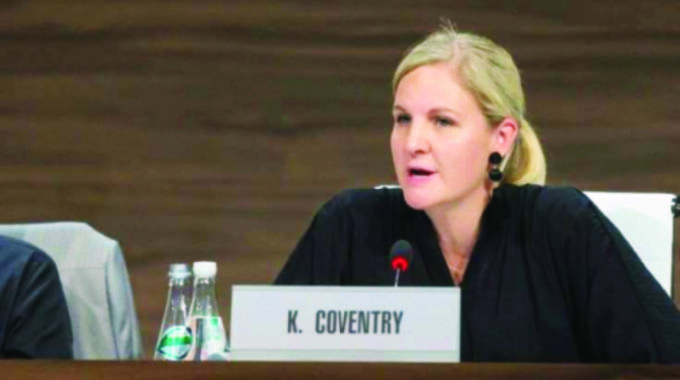
SEVEN-time Olympic medallist and experienced sports administrator, Kirsty Coventry has positioned herself as a transformative leader for the International Olympic Committee with her manifesto, “Unleashing the Transformative Power of Sport.’’
Coventry, currently Zimbabwe’s Minister of Sport, has placed athletes at the centre of her agenda, emphasising mental health, physical recovery, and equitable opportunities, particularly for women.
She has proposed expanding the Olympic Solidarity Scholarship programme and enhancing athlete career initiatives to support their development both during and after their competitive years. Beyond athlete welfare, Coventry is advocating for a more inclusive governance structure within the IOC, aiming to foster open dialogue and empower IOC members, international Federations, and National Olympic Committees. As the Olympic Movement navigates an evolving media and sponsorship landscape, Coventry is calling for deeper engagement with existing partners while exploring new sponsorship models. She has emphasised leveraging digital platforms and AI-powered tools to connect with younger, tech-savvy audiences and expand the Olympic brand’s global reach.
As a swimmer, Coventry represented Zimbabwe at five Olympic Games, winning two gold, four silver, and one bronze medal.
She was elected to the IOC’s Athletics Commission in 2012 and has served as Zimbabwe’s sports minister since 2018.
IOC members will elect a successor to incumbent president Thomas Bach at the IOC Session in Greece on March 18-21.
If elected, Coventry would become the first woman and first African to lead the IOC, marking a historic shift for the organisation.
However, she has expressed her desire to prove herself as the best candidate.
“First and foremost, I want to be the best candidate to win, not just because of my gender or from where I come from,” she said.
Meanwhile, the IOC’s current vice president and one of the seven candidates vying for the organisation’s top position in the March elections, Juan Antonio Samaranch Jr., attended the Asian Winter Games in Harbin this last week, where he highlighted the need to grant members greater decision-making power.
The Spaniard, immersed in a key moment of the campaign, gave an interview to the Chinese news agency Xinhua during his stay at the event.
In his statements, Samaranch made it clear that if he wins the presidential elections, he will fulfil his promise and grant greater prominence to committee members in selecting future Olympic host cities and in shaping the future of Olympism.
“Members must regain the power to decide which cities host the Games. They should be able to participate in designing and discussing the IOC’s main policies, and this is best achieved through more participatory sessions,” said Samaranch, who seeks a more transparent host selection process that ensures the Games’ legacy aligns with the fundamental principles of the Olympic movement. In his conversation with Xinhua, he also addressed another central issue shaping his manifesto: the age limit for IOC members. Currently, they must retire at 70, except for those elected before 1999. Samaranch suggests increasing this figure to 75, which would once again equalise all members and allow the most experienced ones to contribute their expertise for a longer period.
“Being 70 today is like being 60 twenty-five years ago when this policy was introduced,” the Spaniard stated.
“I believe we are losing many people who join the IOC late because they must first rise through the ranks of their international federations, national Olympic committees, or the sports sector.
“By the time they reach 60, they are only just beginning to understand how the IOC works. That is a waste of talent we cannot afford.” Regarding the protection of the Olympic brand against political and economic influences, another of the Spaniard’s concerns, Samaranch stressed the importance of maintaining the integrity of the Games while also promoting innovation in sponsorship and marketing.
From this perspective, he proposed establishing an investment fund for sports and launching an Olympic Donors Programme.
He also suggested reviewing broadcasting rights and updating the TOP Programme, highlighting that “Olympic values are more attractive than ever to business leaders.”
Beyond governance reforms, Samaranch emphasised the importance of maintaining engagement between Olympic cycles.
In this regard, he pointed out that initiatives such as the Youth Olympic Games and the Olympic Qualification Series are valuable tools, although he considered it essential to assess their long-term impact. Regarding inclusion, he underscored the importance of ensuring fair and safe competition while also addressing the challenges posed by the participation of transgender athletes.
“They must be welcomed and helped to participate in sport,” Samaranch stated.
“As for competition, we must ensure that it is fair and safe. If transgender athletes provide an undue advantage in competition, that cannot happen,” he added. — Xinhua/Sports Reporter.