admin
admin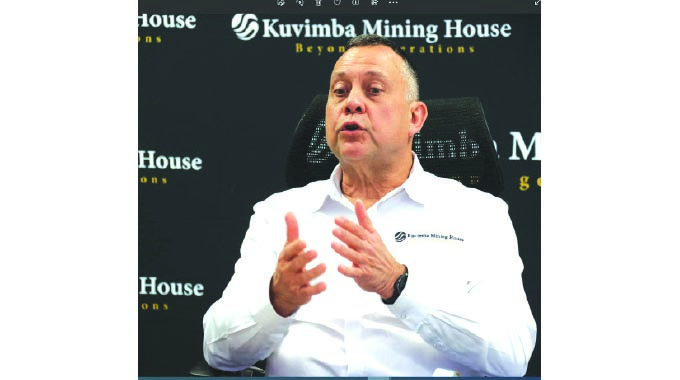
Business Reporter
Kuvimba Mining House (KMH), Zimbabwe’s largest mining group, is confident it will bring the Great Dyke Investments (GDI) project into production soon, even amid the low global platinum prices, which have forced some major producers elsewhere to reschedule capital projects.
The GDI project, which started as a joint venture between Zimbabwe and Russian investors, has always been touted to become one of the largest platinum group metals (PGMs) projects upon reaching production but has taken a long time to materialise due to funding constraints, among other drawbacks.
The Russians pulled out of the deal two years ago due to more pressing commitments arising from the conflict with Ukraine.
KMH, a State-owned enterprise, was created by the Government a few years ago to acquire mothballed mines and industrial operations considered to be of national strategic importance.
The diversified group owns several operations that include Freda Rebecca Gold Mine, Shamva Gold Mine, Jena Mines, Sandawana Mines, GDI and Bindura Nickel Corporation, and ZimAlloys, an industrial operation involved in chrome mining.
In 2022, KMH signed a management contract with the Redcliff-based steel producer Zisco to revive the defunct steelworks that ceased operations in 2008 at the height of hyperinflation.
Speaking to journalists in Harare on Wednesday, KMH acting group chief executive officer Engineer Trevor Barnard said his organisation’s primary focus was operationalising the existing projects and turning them into world class-efficient mining operations.
“Our mission has not changed, it’s still the same as it used to be. The mission is to develop mineral resources to create value for the shareholders, improve the livelihoods of Zimbabweans, and sustain the improvement for future generations.
“But for us, it’s really important to understand that we’re not working for the here and now only. In the mining industry, your horizon is a very long-term horizon, and from that perspective, we believe that we are building a sustainable business that will be able to generate value into the future for future generations of Zimbabweans,” Eng Barnard said.
KMH’s business model, he said, remained anchored on supporting and resuscitating its mining companies.
“So, we look at mining companies and the ones that we’ve got in our portfolio, we support them technically, we support them with capital so that they can improve efficiencies and be sustainable into the future.
“We aim to turn around mining companies and we wish to build them into world-class efficient mining operations,” said Eng Barnard.
So far, through its entities under the gold cluster model, KMH is the biggest producer of yellow metal in the country delivering 300 kilogrammes per month.
On the base metal cluster, Sandawana has the largest lithium deposit in Zimbabwe.
“And once we’ve completed our exploration there, we believe that Sandawana will be amongst the top ten lithium mines in the world.
“It certainly has got huge potential. Our PGMs base group, as I said, consists of GDI; the largest and best well-explored platinum resources on the Great Dyke.”
Regarding sustainability, Eng Barnard said their first issue was on exploration to make sure that the life of a mine is extended across all of KMH’s portfolios.
In terms of GDI, KMH was courting funding partners for the development of open-cast mining operations at the US$2,5 billion project in Darwendale, Mashonaland West Province.
Following the pull-out from the project by Russian partners, Vi Holdings in 2022 citing the impact of the geo-political conflict in Eastern Europe, GDI now owns a 100 percent stake in the project.
Vi Holdings and its local partner, Zimbabwe’s Landela Mining Venture had agreed to develop the project under a 50/50 joint venture arrangement.
Last year, the mining group revealed that over US$50 million was required to kick-start mining operations at the platinum project.
In the long-term, the project requires US$500 million.
“The decrease in the Platinum Group Metals’ prices has certainly had quite an influence on our operations and our plans there (Darwendale platinum project).
“But still, as we speak, we believe that the project has got a bright future and it would still be able to be put into operation under the current pricing conditions that we have.
“So it’s still a very profitable business or project. We’re busy negotiating with several funding partners and other options to try and put the mine into operation.
“We believe we can get the mine into operation on an opencast basis to start off with so that we would be able to shorten the timelines a lot,” said Eng Barnard.
The depressed platinum prices have trended down since April last year with the World Platinum Investment Council (WPIC) indicating that platinum supply in the 2024 full-year is forecast to be near-record low as supply from countries like South Africa and Russia slows.
In March this year, Zimbabwe’s oldest platinum operation, Mimosa Mining, laid off 33 managers and supervisors due to the depressed platinum prices on international markets.
The company said since April last year, platinum prices have fallen by 35 percent, but limited supply in the first quarter may just provide the relief producers of the precious metal were waiting for.
Platinum is Zimbabwe’s second largest mineral export after gold.
Between them, platinum and gold account for more than 50 percent of the country’s export revenue while mining in general brings in over 75 percent of the export earnings.
Mr Barnard said their priority was to find a funding partner and the necessary funds to bring the GDI project into operation.
“At this stage, we can’t divulge the capital outlay that we require for opencast operations.
“When we get to that point, we’ll certainly make sure that the information is available — but just to say that we are looking at a few options which are low-cost so that we can develop that mine in the shortest possible timeframe and be able to start producing platinum concentrate in the shortest possible period,” he said.
In June last year, KMH announced that it had injected close to US$100 million into the platinum project where exploration and feasibility studies have been completed on a concession covering a total of an estimated 6 700 hectares.
Initial development work on the project started in early 2020 and among other infrastructural development, portal one has been developed to start producing ore, accommodation for workers who would be onsite and a guest lodge have also been established.
The operation is expected to yield 1,36 million kilogrammes of platinum over 60 years with a plant processing capacity of 3,5 million tonnes of ore per annum.


 Online Reporter