admin
admin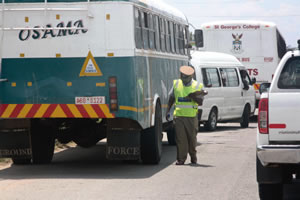
and ensure compliance with traffic laws.
The deal that involves whistle blowing on corrupt activities and ensuring public transport operators comply with the traffic laws is set to put an end to the “war” between the police and the transporters.
The Zimbabwe National Commuter Omnibus Operators Organisation has also written to Harare City Council seeking dialogue on the issue of ranks and rank discs.
They also want to discuss the policing issues, municipal fines and other related matters. While roadblocks are inevitable and a constitutional mandate for the police, transporters have been guaranteed of lesser inconvenience if they comply with the law.
The deal was struck despite the fact that some kombis still carry more than the stipulated number of passengers.
The law requires them to carry 14 people but most crews are tempted to carry up to 22 passengers to realise more profit.
Some commuter omnibus operators in Harare withdrew their services last week leaving most commuters stranded.
They were protesting over numerous roadblocks. The operators complained police at roadblocks were demanding bribes eating into their daily earnings.
At the meeting the parties discussed issues affecting the transport industry in line with the police’s Constitutional mandate to enforce the law before they agreed to bury the hatchet.
They agreed to collectively fight corruption on the roads with the operators blowing the whistle or reporting any forms of corruption by members of the force.
Police said the smashing of windscreens was not a legal action.
The law enforcement agents said only those officers authorised to drive Government vehicles may drive kombis to the police station whenever necessary.
It was also resolved that those kombis with the requisite papers should be allowed to pass through a roadblock without delays.
Zimbabwe National Commuter Omnibus Operators Organisation chairman Mr Aaron Tapfuma confirmed meeting the Officer Commanding Police Traffic Senior Assistant Commissioner Martin Chari over the issues, chief among them, the heavy police presence on the roads.
Mr Tapfuma described the meeting as fruitful and urged his members to ensure their papers were in order to avoid unnecessary inconveniences.
“As a national association, we believe in dialogue. Yes the roads were full of roadblocks but it is not our mandate to determine the number of deployments to be made by the police,” said Mr Tapfuma.
“In the same vein it is logical for us to first look at consequences and effects of our actions while carrying our duties on a fragile economy like ours.
“Delaying workers to work results in loss of production. When the same workers are delayed after work, they will lose time for social activities.
“We are happy that after meeting the officer commanding traffic, things have changed for the better.”
Mr Tapfuma said there have been signs of improvement since the meeting.
He cited a marked improvement on roadblocks along the Bulawayo highway, which connects to suburbs like Warren Park, Kuwadzana and the town of Norton.
Mr Tapfuma urged all operators to ensure their documentation was up to date to avoid unnecessary delays.
“Operators are therefore advised to operate legally so that they do not face hassles on the road,” he said.
The association, Mr Tapfuma said, believed in dialogue and that there was no need for taking such cases to court.
Traffic National Spokesperson Inspector Tigere Chigome confirmed the meeting saying the police clearly indicated its position and legal powers to enforce the law.
Police, he said, has undertaken not to “harass” or delay those operators who comply with the law.
Insp Chigome said the police would not be deterred from arresting the traffic offenders.
“Yes we met the operators and we discussed at length. Those who comply with the law should not be delayed but we cannot be deterred from arresting the offenders.
“Not every police officer should drive the operators’ vehicle.
“Only those authorised to drive Government vehicles may drive the kombis to the station when it is necessary.
“We have agreed to work together to minimise corruption. If the operators do not pay bribes, we will be able to curb corruption. I do not believe the police put their hands into the operators’ pockets, which I understand to be robbery.
“They should refuse to pay bribes and whenever possible they should report such cases to us. As long as the operators operate within the confines of the law, there would be no such problems on the roads,” he said.
A legal expert Mr Wellington Pasipanodya said the police had a Constitutional mandate to enforce the traffic laws and they cannot be stopped from executing their duties.
He suggested that police should install some video surveillance system on traffic vehicles to promote transparency.
“Like in developed countries, police vehicles should have a video surveillance system that records everything that happens on the road to prevent corruption,” he said.
Mr Pasipanodya also urged the motorists to get a receipt whenever they are fined.
“If one pays a bribe or do not insist on a receipt, then he should not be heard crying foul at a later stage,” said Mr Pasipanodya.
“Such culprits are actually fuelling corruption and as long as motorists continue paying bribes, corruption will never end.”
A commuter operator who is not a member of ZNCOOO said the deal was not feasible as the police would always find ways of arresting transporters.
“Even if the papers are in order, you can be charged with overloading because four people would be occupying each seat.
“They can even go on to do the work of the vehicle inspection officials to ensure they find a charge for someone who appears clean,” said the operator.
When most kombis are waved to stop at roadblocks, it is now common to see a conductor running towards the police with at least US$3 without any demand to do so.
The statement came at the time a group of commuter operators plying the waterfalls, Kuwadzana and Crowborough routes had filed a court application at the High Court seeking to bar the police and the Harare City Council from “harassing” their members.
Mr Tapfuma distanced his association from that group saying it was just a minority group that instituted the legal action without ZNCOOO blessings.
“Yes that group has a right to sue but as the national association we have nothing to do with that court case.
“We believe in dialogue and we have not reached an extent of filing a court application,” he said.


 Online Reporter