Theseus Mauruki Shambare in VICTORIA FALLS
KUTSAGA is pursuing a science-led transformation of Zimbabwe’s tobacco industry through a five-pronged research strategy targeting climate-resilient varieties, emerging crop diseases, production costs, energy efficiency and digital extension services.

The strategy seeks to strengthen the industry’s resilience against climate change, rising input costs and evolving pest and disease threats while improving productivity and environmental sustainability.
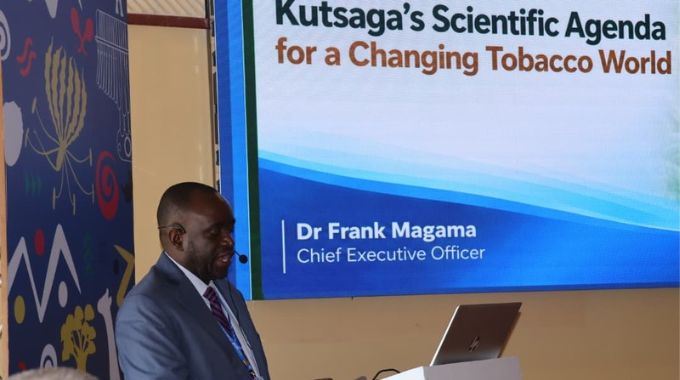
Presenting at the ongoing 70th Cooperation Centre for Scientific Research Relative to Tobacco (CORESTA) Congress in Victoria Falls this morning, Kutsaga chief executive officer Dr Frank Magama said the conditions under which the industry achieved past successes were changing rapidly, requiring new approaches to research and production.

“The climatic and economic conditions under which we achieved yesterday’s successes are changing. And they are changing rapidly,” he said.
“The next 25 years will not reward business as usual. They will reward anticipation, scientific agility, and research translation and adoption.”
Under the first priority, Kutsaga is developing tobacco varieties with improved resistance to emerging diseases such as Phytophthora, Fusarium and Potato Virus Y (PVY).
Dr Magama said the institution had released four new climate-smart varieties over the past three years — T78, T79, T80 and T81 — following multi-location trials under challenging and marginal conditions.
The varieties are currently under limited release, with potential for adoption in other tobacco-producing countries.
Kutsaga is also expanding disease surveillance and pest forecasting, including the development of predictive tools that use weather variables and artificial intelligence to anticipate disease outbreaks and guide crop protection.
“We believe early detection and surveillance is always going to be the number one frontier for us to ensure that before it happens, we are there,” said Dr Magama.
The institution is strengthening biological pest management through research into beneficial microorganisms, including Trichoderma, of which approximately 500 kilogrammes are supplied to growers annually.
On production efficiency, Dr Magama said preliminary biofertiliser research had demonstrated the potential to reduce chemical fertiliser use by 25 percent while maintaining yields and quality and lowering nitrous oxide emissions by 31 percent per tonne of tobacco.
The research is being further validated and scaled up.
Kutsaga is also exploring alternative curing energy sources, including liquefied petroleum gas (LPG), solar and biogas, as it seeks to move beyond conventional fuel-efficiency improvements towards precision-controlled curing systems that reduce energy consumption and production costs.
Dr Magama said LPG trials were in their second season of validation, with solar and biogas technologies also being assessed for energy efficiency, cost and cured-leaf quality.
The fifth priority focuses on translating research into practical solutions for farmers through digital extension services.
Kutsaga is developing SMS-based advisories and decision-support tools, with the programme having a potential reach of 120 000 growers.
Dr Magama said research institutions would not achieve much if their innovations were not packaged and transferred to farmers.
“Research that is concentrated within Kutsaga or any research institution and is not packaged for the farmer, then we will not have achieved much,” he said.
The five priorities form part of Kutsaga’s broader ambition to strengthen scientific innovation, sustainability and collaboration, positioning research as a central pillar of the tobacco industry’s competitiveness.