Chronicle Editor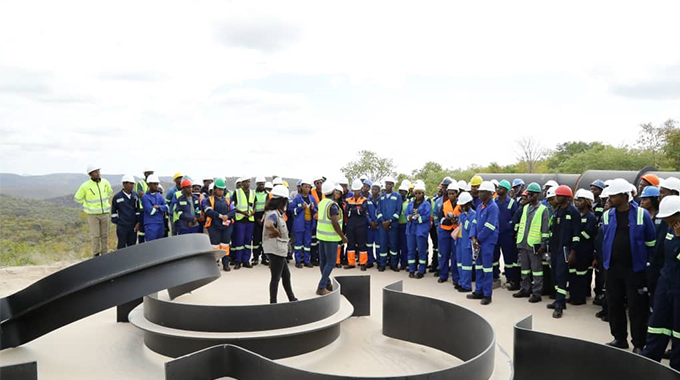
Nqobile Tshili, [email protected]
THE construction of Lake Gwayi Shangani in Hwange, Matabeleland North, has inspired educational tourism as learning institutions tour the project to tap into the advanced engineering practices in the construction of giant water body and mini-hydro power station.
Successive administrations failed to kick-start the mega-project until the Second Republic under President Mnangagwa took over and drove milestone achievement.
The master plan for the dam covers five areas including proving a permanent water supply for Bulawayo and Binga, power generation through the construction of a 10-megawatts hydro power station, establishment of a 10 000 hectare irrigation, which is expected create a greenbelt for Matabeleland North and ensuring national food security.
The project is expected to spur fisheries and tourism economies upon its completion and igniting rural industrialisation. Situated about 6,5km from the confluence of Gwayi and Shangani Rivers, the concrete gravity arch dam was designed and engineered by the Zimbabwe National Water Authority (Zinwa) and has 650 million cubic metres capacity.
As the construction works continue, several higher and tertiary learning institutions have visited the project site to observe progress.
Government through Zinwa has contracted China Water and Electric Corp to lead the construction works and a series of innovations are being introduced with skills transfer being one of the biggest take-aways.
Resident project engineer, Engineer Lucio Chayeruka, described the Lake Gwayi Shangani as the prime engineering project in Zimbabwe.
“The Gwayi Shangani Dam construction is technically the pinnacle of dam engineering in Zimbabwe. Visits from educational institutions are being influenced by the technology inherent with roller compacted concrete construction as the first dam to utilise such technology in Zimbabwe,” said Eng Chayeruka.
“The construction process is in itself an industry as you will find most items are obtained as raw materials and processed on site.
“We manufacture mini-hydro penstocks on site, mine quarry on site, abstract river sand from local rivers and sieve to required fineness. There is a lot to learn since the project also covers almost every branch of engineering, be it civil engineering, mechanical, electrical.”
Eng Chayeruka said some of the key institutions that have visited the construction site include the Zimbabwe Institution of Engineers, University of Zimbabwe, National University of Science and Technology, Bulawayo Polytechnic and the Zimbabwe National Defense University.
He said schools including Marist Brothers Dete, Lubimbi Primary and Lubimbi Secondary have brought learners on an educational tour to Lake Gwayi Shangani construction site. Eng Chayeruka described the construction project as engineering innovation for a more resilient world due to its technological advancement.
He said visiting institutions get to appreciate the latest innovations, some that have never been used before in the country in the construction of massive projects.
“Basically, we are employing up to date technologies in the construction of the dam, which is something that has never happened before. The construction of dams’ functionality has evolved,” said Eng Chayeruka.
“For instance, we are now moved from analogue to digital dam construction monitoring. In past dam constructions we would use physical surveys to assess issues to do with deflation, check the rate of water rise in the foundation. But nowadays we do it digitally and send everything to the register.
“Such technologies have been adopted elsewhere in the world but we had not used it in the country,” he said.
Eng Chayeruka said the fly ash (waste that comes from coal) has contributed to reducing the cost of production as it is a substitute for cement.
“As opposed to using 100 percent cement we are using 50 percent cement and 50 percent fly ash but we are still getting the same desired quality.
“Fly ash is just the waste that comes from coal, so where we were supposed to be spending 100 tonnes of cement we are now using half that reducing the cost of construction,” said Eng Chayeruka.
“Also when you are using cement only, it produces a lot of heat and you can imagine the amount of heat that would have been produced, especially with this massive amount of the project.
“So, we have reduced the amount of heat that is produced during construction through substituting with fly ash.”
He said apart from cement and fly ash, most of the items required in the dam construction are being produced on site, thereby reducing cost related with dam construction.
Eng Chayeruka said geological surveys were conducted that proved that there was a quarry and instead of outsourcing the material a quarry mine was established on site.
“We also are mining river sand within the rivers close to the dam site. So, we can safely say the only external material that we are buying is cement,” he said.
“We incur additional costs in transporting fly ash from Hwange. But the innovations that we have implemented here have resulted in reduced cost in the construction of the dam.”
The dam wall construction is being done simultaneously with the construction of a 10MW hydro-power station where most of the materials are produced on site as well.
He said so far, 39 metres from a total of 72m have been constructed but delays in the allocation of funds has stalled the works.
Eng Chayeruka said at the moment more focus is being channelled in the construction of the hydro-power station.
Higher and Tertiary Education, Innovation, Science and Technology Development Minister, Professor Amon Murwira, said students and lecturers should have on field visits to some of the construction projects that are being undertaken considering the critical need to share knowledge and skill in the development of the country.
He said from the visits that have been undertaken, the expectation is to produce innovative graduates who will produce solutions based on what they see on sites.
“As we move this country forward brick by brick and stone upon stone, we need to expose our students and lecturers to action. Some of the students are likely to take over the projects when they graduate.
“So, it’s important that there is sharing of skills to the next generations in some of these massive construction projects,” said Prof Murwira. —
@nqotshili.



 Online Reporter