Chronicle Editor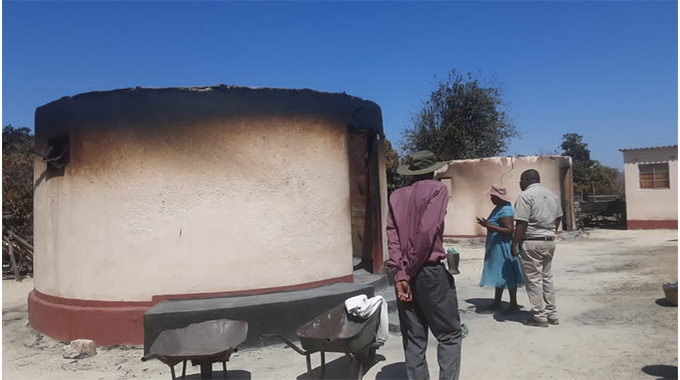
Patrick Chitumba, [email protected]
IT was on August 31 around 4PM when villagers from Hwinya area in Shurugwi under Chief Nhema saw thick smoke billowing from a distance and coming towards their homesteads.
Gripped with panic as the flames continued to spread, the villagers desperately tried using tree branches and sand to extinguish the raging inferno.
Luckily, the fire was contained before it got out of hand and they went to their respective homesteads. Two days later, the fire started again but this time it forced the helpless villagers to abandon the fight.
Village head Mr Handel Chakamanga said the blaze was too powerful and violent that they could not do anything but watch it burn the veld and houses.
“All in all, seven huts from three homesteads were destroyed. The families also lost property and food,” he said.
In the neighbouring Marangarire Village the headman, Mr Auditor Marangarire, said three huts from two families were destroyed last week.
“We battled veld fire incidents from August 31 to September 2 and unfortunately huts were burnt and property lost,” he said.
“We can’t really tell where the fires were emanating from but what we know is that we tried to put them out with no success.”
This scourge of veld fires has become prevalent across the entire province during this fire season amid concern the trend was worsening land degradation and climate change. According to the Environmental Management Agency (EMA), the fire season runs from July 1 to October 31 and during this period dry and windy conditions fuel the spread of veld fires.
Midlands Environmental Education and Publicity Officer, Mr Oswald Ndlovu, said they have noted three major veld fire incidents in the province where community members lost valuable property.
“In Zvishavane District, five huts were burnt during a veld fire that occurred in Ward 7 Mbilashaba under Chief Masunda on September 2. The fire burnt 550 hectares of land and the affected villages include Jonyo, Njese, Pikiri and Ngazimbi,” he said.
“It’s unfortunate that villagers also lost three bags of maize, groceries, three bags of fertiliser, five bags of cement, roofing material and household property during the inferno.
“Investigations are still ongoing but the fire is suspected to have been started by a person who was doing land preparation at his garden.”
In Shurugwi District, Mr Ndlovu said several huts were also destroyed at Chakamanga and Marangarire villages during a veld fire that occurred on the same date.
“In addition, villagers also lost a scotch cart, 17 bags of maize, five bags of cement, kitchen utensils, building materials and household property,” he said.
“The fire also destroyed 420 hectares of grazing land. The cause of the fire is yet to be ascertained.”
EMA has encouraged farmers to desist from using fire during land preparation as most of these fires end up getting out of control especially under windy conditions.
“The province has lost over 25 100 hectares to veld fires since the start of the fire season. Major causes are land preparation, charcoal production, bee smoking and wildlife poachers,” said Mr Ndlovu.
Community members, he said, are reminded that starting a fire outside residential and commercial premises during the fire restriction period is a punishable offence.
“EMA, together with other law enforcement agencies will be on high alert and all those found violating the law will be prosecuted,” he said.
“People should work together in preventing veld fires and report all fire offenders. Let’s join hands and prevent veld fires for the purposes of protecting the environment, agricultural produce, household property as well as preventing loss of lives.”
Statutory Instrument 7 of 2007 Environmental Management (Environmental Impact Assessment and Ecosystems Protection) Regulations stipulates that no one must start a fire deliberately during the fire season.
Available evidence points out that veld fires are mainly caused by human activity, accidental or intentional (arson).
These include unsafe and improper disposal of lit cigarette stubs, land clearing, hunting, smoking out bees, children playing with fire and drivers making fires by the roadside, among other things.
Wildfires that occur naturally are usually caused by lightning, coal-seam or fallen power lines.
Veld fires have adverse effects and negative impacts on both the environment and humanity.
The Paris Agreement under the United Nations Framework Convention on Climate Change highlights that forests play a critical role in mitigating the negative impact of climate change.
Greenhouse gas emissions are significantly reduced through the forests’ ecosystem, thereby making the weather less extreme.
Some of the most common preventive ways of reducing the danger of veld fires are putting up standard fireguards, which are at least nine metres wide around properties and reducing biomas (fuel load) by hay baling and thatch grass combing.
Reduced soil fertility, destruction of vegetation, land degradation — which leads to deforestation and desertification — air and water pollution as well as destruction of wildlife can also be precipitated by veld fires.
With our forests bleeding and choking from veld fires, this militates against the country’s aspirations to attain an empowered and prosperous upper-middle income society as enunciated by Vision 2030.



 Online Reporter