Online Reporter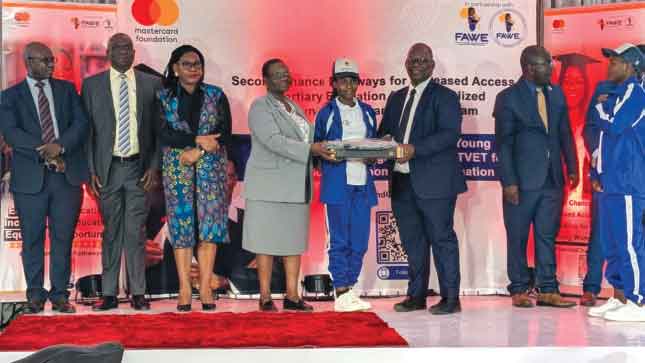
Ivan Zhakata
Features Correspondent
FOR 25-year-old Sharon Ndlovu, a motor vehicle mechanics student at Bulawayo Polytechnic, the journey into technical education was never guaranteed.
Doubts lingered.
The odds seemed stacked.
But on a defining day, those uncertainties gave way to opportunity.
“Although I had some doubts because I was already 25 and the age range was from 15 to 25, I was selected and became part of the 192 beneficiaries,” she said, her voice carrying both relief and pride.
Miss Ndlovu is among 192 students who have received laptops under a programme being implemented by the Forum for African Women Educationalists Zimbabwe (FAWEZI) in partnership with Government and the Mastercard Foundation, targeting Technical and Vocational Education and Training (TVET) learners from marginalised backgrounds.
But beyond the gadgets lies a deeper story — one of transformation, resilience and hope.
For Miss Ndlovu, the programme has opened doors far beyond the classroom.
“Through this programme, I have gained leadership skills. I am now part of the Student Representative Council and serve in the executive as Minister of Education,” she said.
“I am learning a lot and I am now able to give back to my community.”
Her story mirrors that of many young Zimbabweans whose aspirations are being reshaped through access to education and digital tools.
At the official handover ceremony, held in partnership with the Ministry of Higher and Tertiary Education, Innovation, Science and Technology Development, the distribution of laptops was framed not merely as a donation, but as a strategic investment in human capital.
Permanent Secretary in the ministry, Professor Fanuel Tagwira, captured the significance of the moment.
“This is more than a ceremonial event, it is a practical demonstration of our shared commitment to expanding access to quality, inclusive and technology-enabled education, particularly for young people from marginalised backgrounds,” he said.
In today’s fast-evolving digital landscape, he added, access to technology is no longer optional.
“These devices are gateways to knowledge, innovation and opportunity,” said Prof Tagwira.
The ceremony also coincided with the belated commemoration of International Girls in ICT Day 2026, held under the theme “AI for Development: Girls Shaping the Digital Future.”
The symbolism was not lost.
Across Zimbabwe — and indeed the continent — girls and young women remain under-represented in science and technology fields. Yet here, they formed the majority of beneficiaries, a deliberate step towards closing that gap.
FAWEZI Executive Committee chairperson Professor Ruth Gora said the initiative represents a shift from commitment to tangible impact.
“The laptops symbolise more than access to technology. They represent opportunity, connectivity and empowerment,” she said.
“We are not only expanding access to tertiary education, but also equipping young people with tools, skills and confidence to thrive in a rapidly changing world.”
For another beneficiary, Caroline Ncube of Belvedere Technical Teachers College, the programme has ignited a sense of purpose.
“I will work hard in my studies and encourage other students to stay in school. I want to share my story to inspire others and be a role model,” she said.
Her ambition stretches beyond personal success.
“My goal is to finish my studies, build a better future and help others just like me.”
Such testimonies showed the broader vision behind the initiative — one that seeks not only to educate, but to empower a generation to uplift others.
Deputy Minister of Public Service, Labour and Social Welfare Mercy Dinha described the programme as a powerful example of what partnerships can achieve.
“The distribution of these devices is the opening of doors to knowledge, innovation and opportunity,” she said.
Director of Secondary Education in the Ministry of Primary and Secondary Education, Mr Innocent Chishupa, echoed the sentiment and described the programme as a strategic investment in the country’s future.
“By empowering these students with the tools necessary for digital literacy, we are ensuring that they become active contributors to industrialisation and modernisation,” he said.
The laptops are expected to facilitate access to online learning platforms, strengthen research capabilities and support blended learning — all critical in a world increasingly shaped by technology.
Yet, perhaps the most profound impact lies beyond the statistics and policy frameworks.
It is found in the confidence of a young woman stepping into leadership. In the determination of a student who once doubted her place but now dreams bigger.
In the quiet but powerful shift from limitation to possibility.
As Miss Ndlovu reflected on her journey, her words capture the essence of the programme.
“I am changing my life, and I want to give back to my community,” he said
And in that simple declaration lies the true measure of success — not just in the laptops handed over, but in the lives being transformed.