Chronicle Editor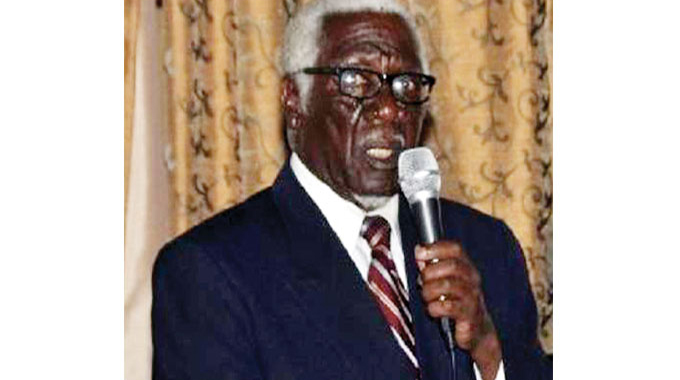
Bongani Ndlovu, Online Reporter
THE Zanu-PF politburo will today deliberate on the hero status for war veteran and historian Cde Saul Gwakuba Ndlovu and two others.
Cde Gwakuba Ndlovu (87) died last Friday, in Bulawayo while the Zanu-PF Matabeleland South chairman, Cde Rabelani Choeni (71) died on the same day at his rural home in the Malusingani area in Beitbridge West constituency.
Last Thursday Secretary in charge of the District Development Fund (DDF) in the Office of the President and Cabinet, Mr James Kenneth Jonga (70) died.
Zanu-PF secretary for administration, Cde Obert Mpofu said the party received the requests for national hero status yesterday.
“We received the request for Saul Gwakuba Ndlovu today and the requests are in the process and maybe we shall know the outcome by tomorrow. The papers came today, all of them, including those of Cde Choeni and Jonga. There are others that we received that are being processed,” said Cde Mpofu.
Cde Gwakuba Ndlovu, died in the early hours of Friday morning due to a heart ailment.
Cde Gwakuba Ndlovu was born on 23 September 1934 at Dombodema Mission in Bulilima District, Matabeleland South province.
During the liberation struggle, Cde Gwakuba Ndlovu was the director of publicity and information of the Zimbabwe African People’s Union (Zapu), between 1964 and 1978.
He once served as the diplomatic representative for Zapu based in Algeria responsible for Tunisia, Morocco, Mauritania, Niger and Mali. He also covered countries such as Spain, Portugal, France, Belgium, Luxemburg, the Netherlands and the Federal Republic of Germany.
On behalf of Zapu he participated in a number of the then Organisation of African Unit summits, Afro-Asian People’s Solidarity Organisation meetings, United Nations, anti-colonialism committee conferences, Heads of State and several international journalism conferences at places such as in Prague, Pyongyang, Moscow, Berlin, Cairo, Kinshasa, Rome and New Delhi.
From mid-June to mid-July 1979, Cde Gwakuba Ndlovu and Dr Barnabas Dzingai Mutumbuka undertook a lecture tour in Canada on behalf of the Patriotic Front (PF) to apprise Canadians on the socio-political situation in the then Zimbabwe-Rhodesia and why the PF was strongly opposed to the treacherous Muzorewa-Smith regime.
In 1972, Cde Gwakuba Ndlovu was sent to the Soviet Union by Zapu and among his group were now Brigadier-General (Retired) Abel Mazinyane, Colonel (Retired) Thomas “Menu” Ngwenya, late Cde Jack Amos Ngwenya, Cde Phebione Makonese, Cde Easter Ndiweni and Cde Josiah Ncube.
Cdes Gwakuba Ndlovu, Ngwenya, Ndiweni and Makonese were to do leadership training in the Soviet Union.
After independence Cde Ndlovu joined the Chronicle as a senior editorial staff member. He was later appointed Features and Supplements Editor for both Chronicle and Sunday News.
The late journalist left Chronicle and The Sunday News in 1984 to join the Munn Publishing Company where he was the contributing editor and regional manager responsible for Matabeleland, the Midlands, Masvingo, Botswana and Zambia.
He left Munn Publishing Company in September 1987 after he was offered a post by Lonrho Zimbabwe as a Public Relations Executive with responsibility over the same region as that he covered with Munn Publishing. Lonrho Zimbabwe later sent him to Swaziland in January 1988, where his responsibility as a consultant at that country’s official newspaper, The Swazi Observer was to revive that publication by training the workers.
Cde Choeni joined the liberation struggle under ZPRA in 1974 when he crossed to Zambia through Botswana.
He then travelled to Morogoro, Tanzania where he received military training.
In 1976, he operated at GCB Gokwe region which was later known as the Northern front.
During the same year, he was promoted to Zone Medical man and later the Zone Commander.
In 1978, he was elevated to the position of Deputy Regional Medical Man, a rank he held until the cease-fire period. – @bonganinkunzi


 Online Reporter