Online Reporter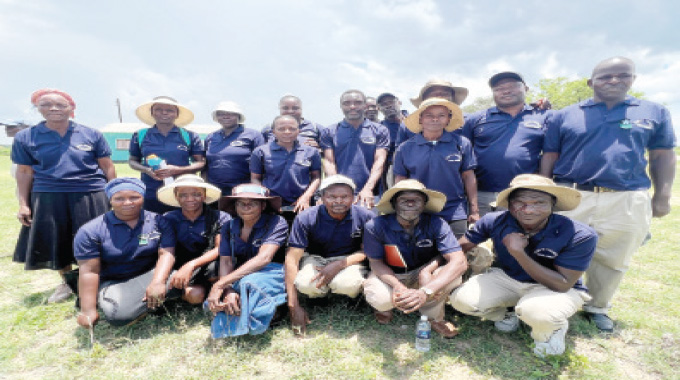
Sukulwenkosi Dube-Matut, Mat South Bureau
THE Government’s drive to transform Zimbabwe’s agricultural sector is gaining momentum in Insiza District, where trained lead farmers are mentoring hundreds of rural households under the farmer field school initiative to promote climate-smart and improved farming practices.
In Ward 19, the Stars of Tomorrow lead farmers’ group, formed in 2023, has emerged as a beacon of knowledge transfer, reaching more than 300 follower farmers since its establishment.
The 30-member group was created under the Climate Resilient Livelihoods (CRL) Project, supported by the Government of Zimbabwe, the Green Climate Fund and the United Nations Development Programme (UNDP). Under the farmer field school concept, trained lead farmers mentor fellow farmers through hands-on learning and practical demonstrations.
Lead farmer Ms Perseverance Ncube said the initiative had fundamentally changed how communities approach agriculture.
“As lead farmers, we were trained under the farmer field school concept and tasked with mentoring others, with each of us assigned about 10 farmers,” she said.
“Climate change is affecting our rainfall patterns, so we have shifted our focus towards small grains, which are more suitable for our area. These climate-smart practices are helping us remain self-sufficient. Farming is central to our livelihoods.”
A farmer field school is a group-based learning approach where farmers conduct simple experiments, make regular field observations and analyse results together, enabling them to make informed, locally relevant farming decisions. Another lead farmer, Mr Johnson Ncube, said the initiative promotes mutual learning and practical problem-solving.
“We receive training from agricultural business advisors and pass that knowledge on to follower farmers, often through practical demonstrations,” he said.
“But it is not a one-way process — we also learn from the farmers we mentor. We have also established Internal Savings and Lending Groups, which allow us to save money and reinvest in our agricultural enterprises.”
Insiza Ward 19 Councillor, Mr Thulani Sibanda, said the farmer field school model has significantly improved agricultural productivity in the area.
“Lead farmers have played a crucial role in spreading knowledge on Pfumvudza/Intwasa and other improved practices,” he said.
“There has been a noticeable improvement in yields, which shows this model is effective. It should be introduced in every village to boost production and fight hunger.”
Follower farmer Ms Sylvia Ndodo said the training had transformed how farmers view agriculture — from subsistence to business.
“We now understand the importance of choosing seed varieties that perform well under our climate conditions,” she said.
“We are farming with a business mindset and planning for the future.”
Matabeleland South provincial Agricultural and Rural Development Advisory Services director, Mrs Shupikai Sibanda, said farmer field schools are key to achieving the Government’s vision of agricultural transformation.
“The vision is to maximise production, regardless of land size or livestock numbers,” she said.
“We want improved productivity, food security and better livelihoods. While agricultural business advisors provide guidance, lead farmers help extend this knowledge deeper into communities.”
The farmer field schools were established under the Building Climate Resilience of Vulnerable Agricultural Livelihoods in Southern Zimbabwe project, funded by the Green Climate Fund and implemented by the Government with technical support from UNDP.
More than 70 000 farmers across 15 districts have been incorporated into the programme, which prioritises women and vulnerable communities.
The project focuses on strengthening climate resilience through access to water, adoption of climate-smart agricultural practices and improved use of climate information, ensuring rural communities are better equipped to withstand the effects of climate change.