Online Reporter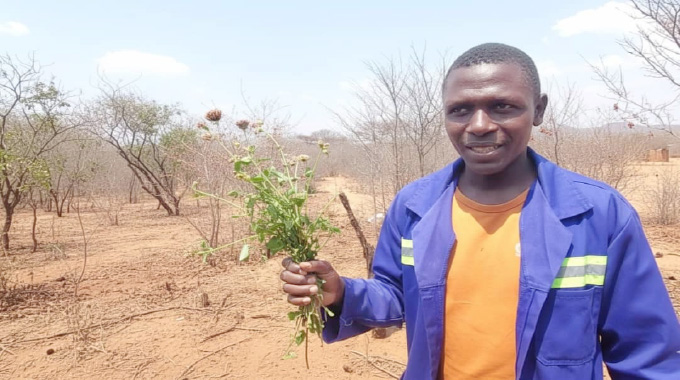
Theseus Shambare, Features Writer
IN the early hours of the morning in Siansundu Village, Binga, Matabeleland North, the forest stirs quietly to life.
Birds announce the arrival of dawn, leaves whisper in the breeze and the earth releases the scent of damp soil and wild roots.
Walking slowly between indigenous trees is Siphosami Tshuma, a 33-year-old herbalist whose very name carries meaning — Siphosami, “My gift”.
For him, the name is not a coincidence.
It is purpose.
“This work is not something I chose,” he said, gently brushing aside leaves to examine a shrub.
“It is something that was given to me.”
That gift, inherited from his late father and shaped by years of close interaction with the forest, has quietly made Siphosami one of Siansundu’s most unlikely forest stewards.
Without uniforms, fences or official titles, his daily movements through the woodland reflect a deeply rooted system of sustainable forest management based on restraint, respect and renewal.
Siphosami learnt herbal healing as a boy, following his father into the forest and memorising plants by smell, texture and season rather than by scientific names.
His father taught him which roots heal, which bark restores strength and which leaves must never be taken.
More importantly, he taught him how not to destroy.
“He used to say, ‘If you kill the plant, you kill tomorrow,’” Siphosami recalled.
That lesson guides every harvest. When roots are needed, he takes only a portion so the plant survives. When bark is required, he removes narrow strips rather than ring-barking.
Leaves are collected sparingly from several plants, never stripping one bare. Some trees, believed to be spiritually significant, are left untouched.
These methods mirror modern principles of sustainable harvesting, yet for Siphosami they are simply inherited rules of survival.
“If you finish the forest,” he said, “you finish yourself.”
As Zimbabwe marked December as tree-planting month, national attention turned to the importance of restoring degraded landscapes using indigenous tree species.
During the World Food Day commemorations at Matopos Research Institute, Professor Obert Jiri, permanent secretary in the Ministry of Lands, Agriculture, Fisheries, Water and Rural Development, planted an indigenous mumvee (umvebe) tree alongside Dr Patrice Talla, the Food and Agriculture Organisation (FAO) subregional co-ordinator.
Prof Jiri said reforestation was no longer optional.
“Trees are central to our food systems, our climate resilience and our rural livelihoods. That is why Zimbabwe has set a target of planting more than 25 million trees annually, with a strong emphasis on indigenous species that are adapted to our environment,” he said.
Dr Talla echoed the same sentiment, stressing that indigenous trees are critical for sustainability.
“Reforestation must go beyond numbers. Indigenous trees restore ecosystems, protect biodiversity and support communities that depend on forests for food, medicine and income,” he said.
“When local people protect trees, they are protecting their future.”
In Siansundu, that future is already being guarded quietly.
Since his father’s death, Siphosami said his relationship with the forest has deepened. At times, dreams guide him — quiet images pointing him toward specific places or plants.
When he wakes, he follows those signs.
While such beliefs are often dismissed as mystical, conservation research increasingly recognises indigenous ecological knowledge as a valuable management tool.
Across Zimbabwe, forests protected by spiritual belief, taboos and customary rules often remain intact long after surrounding areas have been cleared.
Siphosami does not harvest every time he enters the forest. Sometimes he turns back empty-handed.
“You can feel when it is not time,” he said. “The forest also says no.”
That restraint — knowing when not to take — is central to his practice.
A living pharmacy
Siphosami specialises in herbal remedies often sought for intimate health concerns, but he also treats general ailments.
He said he receives at least two patients a day, sometimes more, many travelling from surrounding villages.
In remote communities where clinics are distant and incomes limited; traditional medicine remains essential.
This dependence creates a direct link between forest health and human well-being.
Unlike logging or charcoal burning, herbal practice depends on living, regenerating forests.
Research across southern Africa shows that forests used by traditional healers often retain higher biodiversity because plants are valued as medicine rather than cleared as obstacles.
Siphosami’s livelihood relies on patience. He rotates harvesting areas, avoids young plants and observes seasonal cycles closely.
“I am borrowing. I must leave something behind,” he said.
What Siphosami practises daily is an unwritten forest management system shaped by culture rather than policy. It includes selective harvesting, protection of sacred species, seasonal restraint, regeneration awareness and community accountability.
Globally, studies show that forests managed with strong community involvement and indigenous governance systems tend to be more resilient.
In places like Siansundu, where formal enforcement is limited, belief and tradition act as powerful conservation tools.
Siphosami does not call himself an environmentalist. But his actions tell a different story. Each careful step through the woodland is an act of stewardship.
Despite this quiet guardianship, the forests of Binga are under growing pressure. Agricultural expansion, firewood collection, charcoal production and population growth continue to reduce indigenous woodland cover.
Climate change has also altered rainfall patterns, affecting plant distribution and regeneration.
“There are herbs my father showed me that are now far away. Some are disappearing,” Siphosami said.
This loss mirrors findings from recent ethnobotanical research in Zimbabwe.
A 2025 study titled “Traditional ecological knowledge and practices in Zimbabwe: medicinal ethnobotany and ethnozoology among communities in Chipinge district” by Justice Muvengwi and Alfred Maroyi found that 95 percent of traditional healers reported that some medicinal plant species they once relied on are no longer available in their local areas, forcing them to source herbs from distant or protected forests.
The research also highlighted a worrying decline in indigenous ecological knowledge, as younger generations are less familiar with plant identification, sustainable harvesting techniques and the medicinal uses of these species, placing both the plants and centuries of inherited wisdom at risk.
As elders pass on and younger generations migrate to towns, oral knowledge weakens — and with it, informal conservation systems collapse.
“When the knowledge dies,” Siphosami said, “the forest dies faster.”
Passing on the gift
At 33, Siphosami stands at a critical point — old enough to carry deep knowledge, young enough to pass it on.
As the sun rises over Siansundu, Siphosami leaves the forest carrying only a small bundle of herbs. There are no scars on the trees behind him, no signs of excess.
“The forest knows me. I walk gently because it is my gift,” he said.
As Zimbabwe plants millions of trees beyond the tree planting month, Siphosami’s story is a reminder that planting trees and protecting existing forests are two sides of the same mission — one national, the other deeply personal.