admin
admin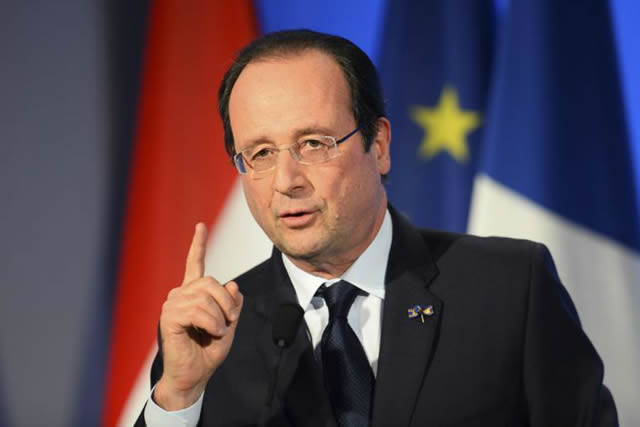
MINSK (Belarus) — The leaders of France, Germany, Russia and Ukraine flew to the Belarusian capital for crucial peace talks yesterday as fighting still raged in eastern Ukraine.The talks, brokered by German Chancellor Angela Merkel and French President Francois Hollande, aim to negotiate a deal to end hostilities between Ukrainian troops and Russian-backed separatists. The conflict has claimed more 5,300 lives since April.
Prior to yesterday’s talks, Merkel and Hollande visited Kyiv and Moscow last week to speak to Ukrainian President Petro Poroshenko and Russian President Vladimir Putin.
“The entire world is waiting to see whether the situation moves toward de-escalation, weapons pullback, cease-fire, or … spins out of control,” Poroshenko said upon arriving in Minsk.
Details of a possible peace deal haven’t been released but key sticking points at the talks include:
● Drawing a new line of division: Ukraine wants the same one that was agreed upon in September, while Russia wants a new line that reflects rebels’ significant territorial gains since then.
● Withdrawing Russian troops and equipment from eastern Ukraine: Russia says it does not have any troops and military hardware in the east, a stance scoffed at by Ukraine and Nato.
● Securing the Ukraine-Russian border: Ukraine wants to get control back over its border with Russia to stem the flow of Russian fighters and weapons, while Russia says that’s up to the rebels.
● Giving the separatists more autonomy: Ukraine says it may offer them broad rights on the basis of the Ukrainian law, but Russia wants guarantees. Russia also wants Ukraine to end its financial blockade of the east.
European leaders have warned there is no guarantee a deal will be reached with Moscow, which the West says is fuelling the insurgency with troops and arms. Germany and France have rushed to mediate after a surge in fighting this year.
In the rebel-held city of Donetsk, rebel officials said five people were killed and nine wounded in a shelling attack yesterday on a bus station, where an Associated Press reporter saw one body. Officials in Kyiv said yesterday that 19 troops had been killed and 78 wounded in a day of fighting in Debaltseve, a hotly contested transport hub in eastern Ukraine.
Poroshenko posted a statement saying he had made an impromptu visit to eastern Ukraine early yesterday, stopping in the city of Kramatorsk, where Kyiv says 16 people were killed and 48 wounded in a rocket strike Tuesday. The city is 30 miles (50 kilometres) from the nearest front line.
“We demand an unconditional peace,” Poroshenko said. “We demand a cease-fire, a withdrawal of all foreign troops, and closing of the border…. We will find a compromise within the country.”
Later, in comments carried by Interfax-Ukraine news agency, Poroshenko said he was “ready to impose martial law across the country if we are not able to reach an agreement today in Minsk.”
At a news conference in Moscow, Russian Foreign Minister Sergey Lavrov said there was “notable progress” in the peace process, but gave no details. He acknowledged that the most important goal of the talks would be to implement a cease-fire, but warned that Ukraine only could fully re-establish its control over the border with Russia after it offers a degree of autonomy to the east and lifts the economic blockade.
“To give away the Russian part of the border also would be to cut them (the rebels) off even from humanitarian help and allow them to be surrounded,” Lavrov said.
French Foreign Minister Laurent Fabius said early Wednesday that “quite a number of problems remain” in negotiations, including the future of eastern Ukraine, guarantees about the Ukraine-Russia border, and the prospects of a possible cease-fire, weapons pullback and prisoner exchange.
Fabius said the aim of the talks is to win an accord that works on the ground, “not just one on paper.” — AP.


 Online Reporter