daniel chigunwe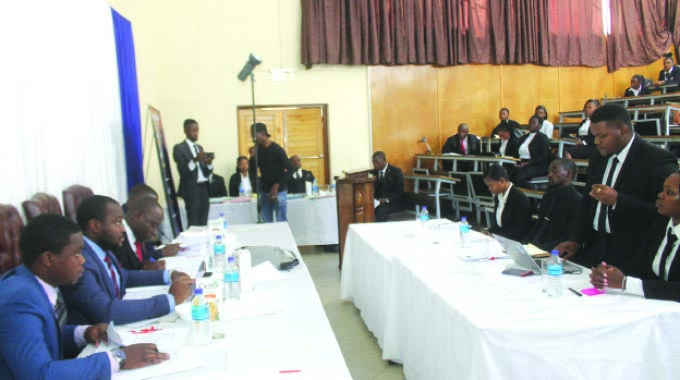
Remember Deketeke
Herald Reporter
The Faculty of Law at the University of Zimbabwe yesterday hosted a prestigious Moot Court competition in an effort to explore the role of specialist courts and the evolving landscape of legal education and create skills that go “beyond a certificate”.
Such competitions are seen as exposing young lawyers to rigorous pressure. The competition sought to challenge law students to apply their expertise in addressing real-world societal issues and argue cases before a panel of judges and also incorporated the Education 5.0 principles into the legal studies.
One of the most essential elements that participating in competitions brings out in a student has to be continuous learning and improvement at each step during a contest.
The moot contest comprised wide-ranging topical issues in corporate law, which is one of the growing fields in legal practice.
Moot courts competitions remain vital for law students as they offer practical legal skills, courtroom experience and opportunities for honing research, oral advocacy, and writing abilities.
A panel of judges assessed the validity of the participants’ arguments, the persuasiveness of their presentation, their poise and advocacy skills, and the thoroughness of their preparation and marks were reserved.
Speaking during the competitions, coordinator of the competitions senior lecturer Advocate Arthur Marara said the idea of the competitions is to produce students who go beyond cramming, passing and forgetting.
“The emergence of artificial intelligence has made students start using the tool to compose assignments, projects, among other things which undermines their thinking capacity,” he said.
“We tried to provide the students something more useful that puts them in touch with real-life situations where they are required to uniquely think on their feet.
“In addition, the skill of the future must go beyond a certificate, critical thinking, leadership and problem-solving skills. Thus, the need for institutions must invest in the future.
“Education 5.0, a policy we want to drive. Let us make things more practical, producing someone relevant to the market place beyond someone who writes an exam,” said Adv Marara.



 Online Reporter