

 admin
admin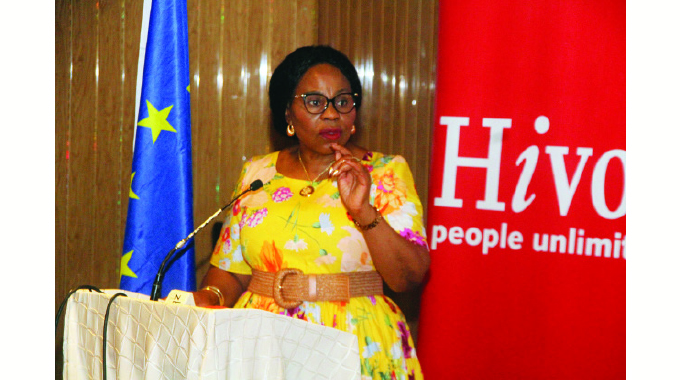
Blessings Chidakwa-Herald Reporter
The Second Republic has made enormous strides in bridging the gender digital divide that has seen more women and girls being included digitally in the economy and society and with more efforts underway to further eliminate any gaps, Information, Publicity and Broadcasting Services Minister, Monica Mutsvangwa has said.
She was officiating at a meeting organised by Hivos to celebrate Women’s Month.
Hivos is an international cooperation organisation with its global office in the Netherlands, that provides support to civil society organisations working in Africa, Latin America, the Middle East and Asia.
Minister Mutsvangwa said Zimbabwe was on the right path as it moved to achieve Vision 2030 of an empowered upper middle-income economy.
“Government, through the Postal and Telecommunications Regulatory Authority (Potraz), has, through the Universal Services Fund, launched a skills development initiative in 2019 which saw over 11 000 citizens in rural areas trained in digital literacy and these included women and girls,” she said.
“The Government has also enhanced access to digital technology in communities through establishment of community information centres in both rural and urban centres.
“This is critical as the success of the National Development Strategy 1 (NDS1) is dependent on digital technology access and use.”
With the Education 5.0 initiative, it is envisaged that as institutions develop more innovations, Zimbabwe will be able to manufacture its own appliances and these would be affordable to ordinary people so they engage with digital technologies.
“My Ministry has great interest in digital technology as its mandate is to ensure accessibility of information by all. Without bridging the digital gender gap, women and girls will be left behind. Information is power and this is even acknowledged in the Bible through Hosea 4:6, which says, ‘My people perish for lack of knowledge’.
“Therefore, access to information is critical for women and girls as it enhances empowerment, which is now readily available through digital platforms,” said Minister Mutsvangwa.
Zimbabwe’s Constitution is progressive in terms of gender equality as noted in the founding values and principles which also sets the foundation for crafting laws addressing digital rights. It requires the State to promote gender parity and full participation of women in all spheres of society.
Minister Mutsvangwa said the Government had a mandate to ensure digital transformation and innovation are balanced and ensure protection of digital rights, which has been addressed through the Cyber and Data Protection Act and Postal and Telecommunications Act. However, she said gaps still existed to ensure complete protection.
“More advocacy work is required to expedite the much-needed amendments, especially to address issues of cyberbullying, which has made women and girls to withdraw from online platforms.
“I wish to emphasise that bridging the gender digital divide requires a multi-stakeholder approach to come up with concrete interventions to close the gap,” she said.
Minister Mutsvangwa said it was time that the private sector, NGOs and civil society organisations complement Government efforts and work together towards the empowerment of women, especially in rural areas because they suffer the brunt of the gender digital divide.
“I also urge Parliamentarians to perform their oversight function well in bridging the digital gender divide through motions and questions during Question Time in order to keep the Government on its toes in addressing the digital gender gap.
“I also wish to reiterate that bridging the digital gender gap is not only right, but smart economics that will raise the country’s GDP as women will engage and participate more in the global economy,” she said.
Information Communication Technology, Postal and Courier Services Permanent Secretary Dr Beaula Chirume said deploying ICT equipment only was not enough. People had to know how to use it.
Potraz Universal Service Fund projects manager Engineer Mavis Maunganidze said Potraz was extending ICT services to the unserved and underserved members of society.
Good strides were being made, including introducing convergence on operators’ licences, and infrastructure sharing for telecommunication companies.
Parliamentary Youth Caucus chairperson Cde Tatenda Mavetera said while it was progressive that the required laws were there, they are rarely implemented.
Cde Mavetera said women have been victims of cyberbullying on social media but law enforcement agents were doing less to bring perpetrators to book.
She also bemoaned the lack of internet services in some remote areas.
Hivos Southern Africa Regional director Ms Nana Zulu said they conducted research on the effectiveness of social media as a tool for opening spaces for women leaders’ participation.
The research showed that digital spaces were making it possible for women to easily interact with others who share similar interests.



 Online Reporter