admin
admin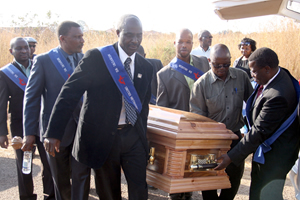
Makunike (83), who died after he was hit by a car, was declared a liberation war hero.
Hundreds of people from all walks of life including Deputy Prime Minister Professor Arthur Mutambara,
Manicaland Governor and Resident Minister Cde Chris Mushohwe, Zanu PF Politburo member Cde Victoria Chitepo, Zanu PF Central Committee Member Cde Nyasha Chikwinya and Vice Chancellor of the Women’s
University in Africa, Prof Hope Sadza, friends and relatives attended the burial.
Speakers described him as a selfless individual who fought for every Zimbabwean’s success during and
after the liberation struggle.
“Makunike taught many people lessons in collective success. That can be proven from his family where he groomed two doctors, an engineer and a writer who are working for the continent. What he wrote was mightier than the sword hence the Government declaring him a liberation war hero. During the liberation struggle he worked hard for this country.
“He was a personified leader who assisted with the burial of Cde Hebert Chitepo after his death while in Zambia,” said Prof Mutambara.
Governor Mushowe said Makunike’s works managed to bring people together in one place before and after his death. “Many positive things he did during his life can be testified by many. He was a selfless individual who committed his life for many people and God.
Also See
“Makunike was a humble, kind and hardworking person until the time of his death. He admired people who wanted to advance themselves and never liked quarrelling or violence,” Cde Mushowe said.
Professor Sadza said Makunike assisted her with ideas when she wanted to establish a University that champions the cause of women in Africa.
“Makunike assisted me in life and he was the first man to support me in opening the Women’s University in Africa. He was the only man in the council of the university who advocated for equality.
“Our first honorary degrees that went to Sarah Chavhunduka (Kachingwe) and Dorothy Masuka of South Africa and the University prayer were all his ideas and we have really lost a pool of ideas as an institution,” Prof Hope Sadza said.
Cde Chikwinya said Makunike ensured that the liberation war continued during his lifetime and was a role model to many women.
“He availed vital information during the liberation struggle to ensure the revolution continued for the best interest of black Africans. He covered the country positively while residing in India and the United States,” Cde Chikwinya said.
Family spokesperson Mr Naboth Makunike thanked Zanu-PF and Government for conferring Makunike a hero’s status.
“As a family we thank the party and the Government for honouring the works of our family member. It is an honour for us to have a hero in the family after recognition of the good things he did,” he said.
Makunike was born on August 7, 1929 in the Nyakatsapa area under Chief Mutasa in Manicaland before going to the then Old Umtali Mission in 1944 and later Old
Mutare American Methodist School.
He attended Goromonzi Government School between 1951 and 1954.
In 1959, the year he married his wife Ella, Makunike won a scholarship to study journalism at Hislop College, Nagpur University in India in 1960 where their first two children, Chido and Batsirai, were born.
It was during that time that he obtained a BA degree in Political Science and a Diploma in Journalism. Upon his return in 1965, he was appointed director of Methodist Publications and Communications before his appointment as the editor of Umbowo.
He went into exile in Zambia after being placed under surveillance for writing an editorial comment that called for Ian Smith to be tried in court.
After independence in 1980, he was invited by the Government to be the founding director of the Zimbabwe Institute of Mass Communication now the Division of Mass Communication at Harare Polytechnic.
He also served as the director of information in the Ministry of Information, Posts and Telecommunications until his retirement in 1989. Having made his exit from active and mainstream journalism, Makunike concentrated on his community life improvement project on a one-hectare plot.
He wrote the book “I won’t call you Sir” among other titles.
He is survived by his wife Ella, four children — Chido, Batsirai, Rudo, Danai and four grandchildren.


 Online Reporter