admin
admin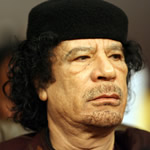
to protest against Libyan leader Colonel Muammar Gaddafi in a district of the capital Tripoli yesterday.
The protest took place in the Tajoura neighbourhood, flashpoint of anti-Gaddafi protests in eastern Tripoli, where residents had previously reported clashes between Gaddafi opponents and forces loyal to him.
About 400 protesters shouted anti-Gaddafi slogans and displayed the green, black and red flag which has been adopted as the symbol of rebellion against his four-decade rule.
As the protest unfolded, two sport utility vehicles pulled into the area where the protest was taking place.
The occupants, wearing green bandanas, the colour of Libya’s national flag, jumped out of their vehicles in a nearby street and fired into the air.
Three police vans and several pick-up trucks full of armed men were parked at the opposite end of a street leading to the roundabout where the protest was taking place.
Graffiti on one wall said “Gaddafi game over,” mimicking slogans used in protests that toppled the leaders of Egypt and Tunisia.
A military helicopter was flying overhead and vehicles of the security forces were seen driving around the area.
Two residents said separately that four protesters had been killed while attending a similar rally late on Sunday. They said Gaddafi militiamen arrived in the area in SUVs and opened fire.
“Gaddafi militia were shooting randomly. They arrived in four cars. Four people were killed. There was a funeral yesterday,” said a computer engineer.
Residents said groups of people appeared in the neighbourhood earlier in the day to paint over anti-Gaddafi graffiti.
Empty buckets of paint were still scattered around the roundabout as protesters doggedly sprayed new anti-government slogans on the freshly painted walls.
The atmosphere was nervous and protesters were stopping cars driving past to check for any weapons.
In one incident, an argument broke out, prompting one man to slash the tyres of a car with a knife.
The car drove off swiftly, its flat tyres screeching against the asphalt.
Residents said armed men stormed into a local clinic several days ago and fired inside it indiscriminately.
“They shot, they shot,” said one man, as he pointed at numerous bullet marks on the walls and windows inside the deserted clinic. He said no one was hurt in the incident.
Omar, a doctor, said: “They shot inside the clinic. One bullet passed just above my head.”
Like other protesters, he asked not to use his full name for fear of being indentified by the government.
The government denies using deliberate force against civilians. A government spokesman said yesterday troops might have fired before but it was because they were not properly trained.
Earlier, Tajoura residents said several people wounded in recent clashes had disappeared from state hospitals, forcing them to treat any new wounded people in smaller, locally-run neighbourhood clinics.
The number of casualties in Tripoli from recent clashes could not be independently verified.
The protest was still going on when a Reuters reporter left the scene. The reporter was in Tripoli as part of a tour for foreign media organised by the government.
Foreign powers accelerated efforts to help oust Gaddafi yesterday as rebels fought government forces trying to take back strategic coastal cities on either side of the capital Tripoli.
Gaddafi’s forces have been trying for days to push back a revolt that has won over large parts of the military, ended his control over eastern Libya and is fending off government assaults in western cities near Tripoli.
It is difficult for reporters to move around western Libya and reports of fighting were hard to verify independently.
But witnesses in both Misrata, a city of a half a million people 200 km to the east of Tripoli, and Zawiyah, a strategic refinery town 50km to the west, said government forces were mounting or preparing attacks.
One witness in Misrata told Reuters by telephone that a plane had been shot down and that “fighting to control the military air base started last night and is still going on.
“Gaddafi’s forces control only a small part of the base. Protesters control a large part of this base where there is ammunition.”
A Libyan government source denied the report.
A resident of Zawiyah told Reuters by telephone: “We are expecting attacks at any moment by brigades belonging to (Gaddafi’s son) Khamis. They are on the outskirts of the town, about 5km to 7km away. They are in large numbers.”
Foreign governments are increasing the pressure on Gaddafi to leave in the hope of ending fighting that has claimed at least 1 000 lives and restoring order to a country that accounts for 2 percent of the world’s oil production.
The UN Security Council on Saturday slapped sanctions on Gaddafi and other Libyan officials, imposed an arms embargo and froze Libyan assets.
European Union governments approved their sanctions against Gaddafi in Brussels yesterday, implementing the UN resolution sooner than expected.
The Pentagon said it was repositioning US naval and air forces around Libya “to provide options and flexibility”.
The US Sixth Fleet operates out of Italy.
In The Hague, the International Criminal Court prosecutor said he would finish a preliminary examination of the violence within days, after which he could open a full inquiry – a step mandated by the Council that could have taken months.
In Washington, a White House spokesman declined to rule out that Gaddafi could be helped to go into exile.
A US official in Geneva said a central aim of sanctions was to “send a message not only to Gaddafi . . . but to the people around Gaddafi, who are the ones we’re really seeking to influence”.
The 68-year-old leader has vowed to fight to death, but a spokesman struck a new, conciliatory tone yesterday.
Mussa Ibrahim told reporters in Tripoli that government forces had fired on civilians, but said this was because they were not trained to deal with civilian unrest.
He said the government was still in control of Zawiyah, even though reporters who were taken there at the weekend saw a town centre under rebel control.
“What you saw was only the centre,” he said.
“We allowed, we let these people with their guns to stand there. Zawiyah has not fallen. The government could have easily killed them and has not done so, because the government has not been bloody”.
In the eastern city of Benghazi, opponents of Gaddafi said they had formed a National Libyan Council to be the “face” of the revolution.
They said they wanted no foreign intervention.
A senior government source said the government was sending an envoy to Benghazi yesterday night to deliver food, medicine and medical equipment.
Opposition forces are largely in control of Libya’s oil facilities, which are mostly located in the east.
Fatih Birol, chief economist of the International Energy Agency, told Reuters Insider TV in Paris that industry reports suggested Libya’s oil output had been halved as expatriate workers pulled out.
Industry sources said actual shipments were at a standstill.
Benchmark Brent oil futures were slightly lower at just under US$112 a barrel. – Reuters.


 Online Reporter