Ray Bande-Mutare Bureau
SCHOOLS and tertiary institutions must align career guidance and training with national industrial needs so that graduates are equipped to drive local manufacturing, value addition and job creation, President Mnangagwa said yesterday.
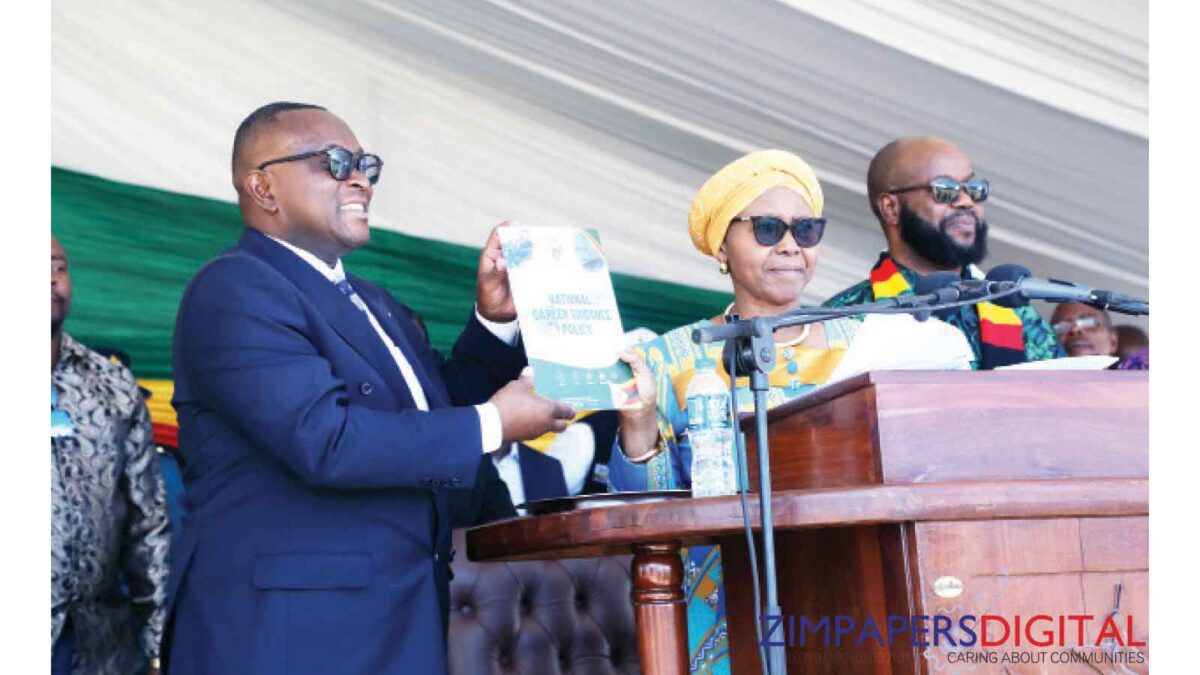
In a speech read on his behalf at the launch of the National Career Guidance Policy at St Theresa Mission in Rusape, by Minister of Defence Oppah Muchinguri-Kashiri, President Mnangagwa said the framework would bridge the mismatch between academic training and industry requirements.
“The situation where industries struggle to find the skills they require, while our graduates struggle to find jobs, must be addressed. The National Career Guidance Policy is designed to close these gaps by ensuring that career guidance, curricula and training provide solutions that meet the needs of communities and, more broadly, the economy,” he said.
Rooted in Science, Technology, Engineering and Mathematics (STEM) and the heritage-based Education 5.0 philosophy, the policy treats career guidance as a lifelong process that runs from early childhood through school, vocational training, college and university, and into working life.
To support this, President Mnangagwa directed the Ministry of Skills Audit and Development to fast-track a national career information system offering real-time data on education pathways and labour market shifts in artificial intelligence, automation, big data, the Internet of Things and smart agriculture.
He noted that the framework builds on the national skills audit commissioned at the start of the Second Republic to map industry needs against academic output.
“Many will recall that at the advent of the Second Republic, I commissioned a skills audit inquiry through the Ministry of Higher and Tertiary Education, Innovation, Science and Technology Development.
The outcomes of that exercise have been instrumental in revealing what industry requires and what academia must produce,” said President Mnangagwa.
Human capital development, he added, is central to achieving industrialisation, value addition and beneficiation under the National Development Strategy 2 (NDS2).
“To achieve these goals, human capital development is one of the fundamental national priorities. Industrialisation and modernisation cannot succeed without developing the requisite skills and capabilities. It is in this context that we are launching the National Career Guidance Policy. This will, in turn, ensure that the national skills base and competencies are strengthened through structured guidance,” he said.
Encouraging youths to become job creators rather than job seekers, President Mnangagwa highlighted emerging opportunities in precision farming, drone technology, agro-processing, renewable energy, mineral beneficiation, urban development, transport, tourism and the creative industries.
“Under this initiative, not every young person must be an employee. We are masters of our own destiny. The entrepreneurial and hardworking people of our beloved motherland, Zimbabwe, are creators of wealth and indeed the employers of tomorrow,” he said.
Implementation will be anchored by a National Coordinating Mechanism, accredited practitioners, the National Career Development Fund, performance-based institutional funding and provincial scorecards tracking youth progression into enterprise, training or employment.
The Ministries of Primary and Secondary Education and Higher and Tertiary Education, Innovation, Science and Technology Development will jointly ensure that schools, colleges and universities maintain functional career guidance services, while the private sector was urged to expand internships, apprenticeships and mentorship programmes.
During the ceremony, 50 laptops, four printers, 20 Starlink kits and four whiteboards were handed over to schools in the rural St Theresa Mission area of Makoni West Constituency.
Also speaking at the event, Minister of Women Affairs, Community, Small and Medium Enterprises Development Senator Monica Mutsvangwa, representing Information Communication Technology, Postal and Courier Services Minister Tatenda Mavetera, stressed that skills development must be backed by digital connectivity and the responsible adoption of artificial intelligence.
She noted that the Presidential Internet Scheme is connecting schools so that learners can conduct research, participate in online lessons and practise coding, while Zimbabwe’s National Artificial Intelligence Strategy seeks to harness AI across agriculture, health, education and public services.
Minister of Skills Audit and Development Dr Jenfan Muswere, Manicaland Minister of State for Provincial Affairs and Devolution Advocate Misheck Mugadza, and other senior Government and ZANU PF officials attended the launch.