

 Chronicle Editor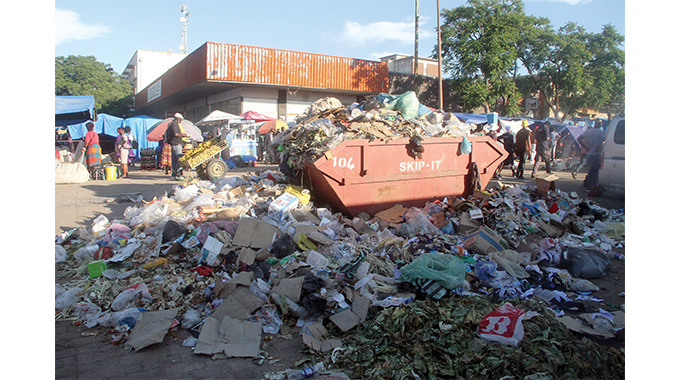
Bongani Ndlovu, Chronicle Reporter
It’s a case of old habits dying hard as litter bugs in Bulawayo continue to dump rubbish in sanitary lanes despite efforts by the local authority to clear them during an exercise that started last month.
The Bulawayo City Council (BCC) embarked on cleaning up sanitary lanes in the city centre which are designed to provide leeway for service vehicles, such as delivery and garbage collection trucks as they had become an eyesore.
The homeless and other members of the public are also taking advantage of sanitary lanes that are not closed off to relieve themselves there, and most have acrid smell of human excrement.
The lanes are also being abused by street kids who burn garbage and use them as toilets and sleeping areas.
It is reported that prior to the lockdown, prostitution and drug peddling were some of the anti-social activities which took place in sanitary lanes. BCC’s operation saw sanitary lanes being cleared of dirt and refuse.
However, nearly a month after the campaign was launched, the litter bugs are back discarding litter in the sanitary lanes. Along 6th Avenue, the sanitary lanes have again been turned into dumpsites, even when there are bins nearby.
The one that is behind Unity Village, has a locked gate but litter bugs are still throwing some rubbish over the gate.
Commendably some of sanitary lanes are still clean but those where there is a high concentration of people, as many sell various goods on the streets ranging from clothes to food such as roasted mealies, are an eyesore.
Mr Michael Ndiweni, the director of the Bulawayo Vendors and Traders Association said vendors must not be solely blamed for the rampant littering around the city.
“People shouldn’t shift blame on the informal traders. Residents who are presentable to society are also the ones who throw litter, such as banana peels and kaylites out of moving car windows and also on the pavements of the city.
It is the responsibility of every citizen to keep the city clean, but to shift blame to vendors is not fair. We are taking advantage of their economic situation as they are the lowest on the ladder,” said Mr Ndiweni.
He said in future, BCC should rope in organisations such as his as a clean city is the responsibility of all.
“We saw a public notice, but to be formally engaged they have not. My view is that we need all stakeholders to come together and stop the blame game, and finger pointing- it is so and so, because every one of us has to play a role,” said Mr Ndiweni.
He said they have been encouraging informal traders to keep their environs clean.
“We have people who move around places, encouraging traders to manage their waste. We are also trying to bring issues of recycling in market places. We are at the advanced stage of trying to bring it to fruition,” said Mr Ndiweni.
Environment Management Agency (Ema) Bulawayo provincial environment officer, Mrs Sithembisiwe Ndlovu said failure to collect refuse by council was problematic.
“Our observation is that the clean-up campaign has been going on well and people have been enthusiastic about it. However, there is an issue of refuse collection and if it isn’t collected on time, people start dumping and rubbish piles up.
We still continue to encourage people even if the local authority fails to collect refuse. Let’s not dump. We’d rather wait for them to come next time than dump in the environment and during this rainy season this might be breeding places for diseases such as cholera that might affect the people,” said Mrs Ndlovu.
By last week, 1 132 litter bugs had been fined and more than 20 local authorities charged for poor waste management by Ema under its blitz on accelerated solid waste management and law enforcement that was launched last month to complement the national clean-up campaign.
Ema says poor waste management affects public health and economic activities such as tourism.
As part of the operation, Ema is also targeting public service vehicles, which according to the law should have litter bags so that passengers do not litter through windows.
Most urban areas are experiencing flash floods due to poor and blocked drainage systems, which eventually become breeding grounds for mosquitoes.
– Follow on Twitter @bonganinkunzi


 Online Reporter
 Blessing Chizhande